

Introduction
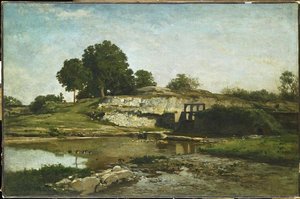
In the heart of the 19th century, a quiet revolution began within the dense, dappled shadows of the Forest of Fontainebleau. A group of dedicated French painters decided to step away from the rigid, polished confines of the traditional studio to seek inspiration directly from the soul of nature. This movement, known as the Barbizon School, marked a profound shift in art history, as these artists traded idealized, mythological scenes for the honest, unvarnished beauty of the French countryside. By capturing the fleeting effects of light through mist, rain, and sunlight, they laid the essential groundwork for the Impressionist movement that would follow.
These artists were united by a shared philosophy: the belief that a landscape was not merely a backdrop, but a living, breathing subject worthy of intense observation. Their works often focus on the quiet drama of woodland paths, the rugged textures of ancient trees, and the atmospheric moods of rural life. This commitment to en plein air painting—working outdoors to capture immediate sensations—changed the way we perceive the natural world on canvas.
Today, the legacy of the Barbizon painters remains deeply resonant. Their ability to evoke a sense of peace, nostalgia, and the sublime power of the earth continues to offer a sanctuary for the modern viewer. As we explore the masters of this movement, we encounter the diverse voices that defined this era, from the sweeping vistas of Théodore Rousseau to the intimate, light-drenched studies of Charles-François Daubigny. The following artists represent the very essence of this naturalistic awakening.
Théodore Rousseau
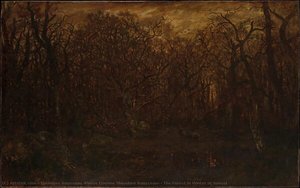 The Forest in Winter at Sunset - Théodore Rousseau
In The Forest in Winter at Sunset, the viewer is enveloped by a profound atmosphere, stepping into a hushed moment suspended outside of time. This monumental work captures the raw, untamed grandeur of nature, where the skeletal architecture of winter trees frames a sky ablaze with the dying light of day. It is a masterful display of the interplay between brooding, dark tones and an ethereal, warm glow.
As a cornerstone of the French Barbizon School, Théodore Rousseau (1812–1867) led the movement away from idealized Romanticism toward an uncompromising devotion to realism. He was a pioneer who sought to capture the spiritual significance and the very soul of the untamed wilderness. His technique is defined by a rich, palpable texture, using oil on canvas to suggest movement within stillness. His ability to translate the atmospheric power of the natural world was shaped by the dramatic influence of Eugène Delacroix and the essence of rural life found in the works of Jean-François Millet. Through his meticulous observation, Rousseau transformed the forest into a space of quiet prestige, making him the definitive voice of this naturalistic revolution.
Charles-François Daubigny
A true pioneer of the Barbizon School, Charles-François Daubigny (1817–1878) played a vital role in shifting the focus of French art from idealized, academic compositions toward a direct, honest observation of the natural world. Born into a family of artists in Paris, he refined his technical skill under the guidance of masters such as Jean-Victor Bertin and Paul Delaroche. However, Daubigny’s true legacy was forged by his departure from the rigid constraints of the studio, choosing instead to find inspiration in the quiet rhythms of the forest and the riverbanks.
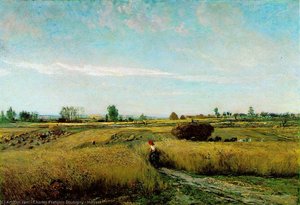
His commitment to capturing the authentic essence of the landscape made him a central figure in the movement, paving the way for the later Impressionist revolution. In his evocative work Harvest (1851), we see this mastery on full display. The painting captures a moment of profound rural tranquility, where the soft, celadon tones of the countryside meet the vibrant detail of a solitary figure in a red hat. Through his ability to translate atmospheric light and the subtle textures of the earth, Daubigny transformed the simple act of looking at nature into a profound artistic experience.
Constant Troyon
 Cows in the Field - Constant Troyon
Constant Troyon (1810–1865) stands as a vital figure within the Barbizon School, a movement defined by its departure from studio constraints to embrace the raw, unvarnished essence of nature. While his early training as a decorator at the Sèvres porcelain manufactory gifted him an extraordinary eye for precision and detail, his true artistic soul was discovered through the landscape. His transition from meticulous ornamentation to naturalism was profoundly influenced by his exposure to the Dutch masters during a pivotal trip to the Netherlands in 1846. Inspired by the works of Paulus Potter and Rembrandt, Troyon moved beyond simple scenery to focus on the authentic, dynamic presence of animals within their natural habitats.
His mastery of the genre is perfectly captured in Cows in the Field (1852), a work that exemplifies the tranquil, pastoral spirit central to the Barbizon movement. In this piece, he utilizes a sophisticated handling of light and color to depict livestock grazing amidst rolling hills and mature trees. By blending the precision of his decorative roots with the atmospheric realism of the Dutch tradition, Troyon helped define the movement's commitment to capturing the profound, quiet beauty of the rural world.
Jules Dupré
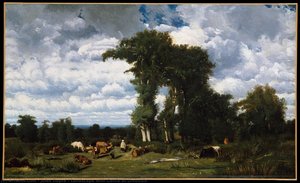 Landscape with Cattle at Limousin - Jules Dupré
Jules Dupré (1811–1889) stands as a cornerstone of the Barbizon School, a movement defined by its departure from studio constraints to embrace the raw, unvarnished reality of nature. While many of his contemporaries sought lyrical stillness, Dupré was drawn to the more tempestuous and emotionally resonant aspects of the landscape. His work is characterized by a profound fascination with the dynamism of the elements, capturing the fury of storms and the melancholic grandeur of shifting light.
His artistic foundation was uniquely shaped by his early training as an apprentice porcelain decorator, a discipline that instilled in him a meticulous attention to texture and organic form. This technical precision, combined with the influence of English landscape traditions like those of John Constable, allowed him to master the interplay of light and shadow. In his representative work, Landscape with Cattle at Limousin (1837), we see this mastery in action. The piece is a sublime study in atmospheric tension, where thick impasto and dramatic cloud formations transform a pastoral scene into a visceral sensory experience. Through his ability to portray the relentless energy of the natural world, Dupré secured his legacy as a vital voice in French landscape painting.
Narcisse Virgilio Díaz
 Road in the Wood - Narcisse Virgilio Díaz
In Road in the Wood, Narcisse Virgilio Díaz de la Peña invites us into a realm of profound, pastoral peace. This work exemplifies his ability to transform a simple dirt path into an immersive experience, where light filters through a dense canopy to create a dappled, ethereal glow across the forest floor. His mastery of chiaroscuro lends a palpable depth to the scene, making the woods feel both enveloping and breathable.
As a pivotal figure of the Barbizon School, Díaz moved away from the rigid conventions of academic history painting to embrace the raw, immediate beauty of the natural world. His commitment to painting directly from nature, particularly within the Fontainebleau forest, helped pave the way for the Impressionist movement. His style is characterized by a rich, evocative palette and a focus on atmospheric light, often blending Romantic sensibilities with a burgeoning naturalism. Whether capturing the quiet rhythms of a woodland path or the vibrant colors of Orientalist scenes, his work remains a testament to the emotional resonance of the landscape. His technical brilliance and dedication to the plein-air spirit solidified his place among the most influential French landscape painters of the 19th century."
Charles Jacque
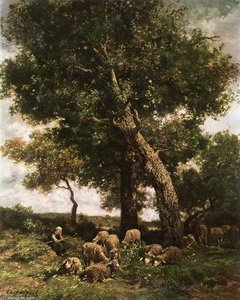 On the Pasture - Charles Jacque
Charles-Émile Jacque (1813–1894) stands as a vital figure of the Barbizon School, a movement defined by its departure from rigid academicism in favor of direct, honest observations of the natural world. While many of his contemporaries focused on sweeping landscapes, Jacque found his soul in the intimate, pastoral details of rural existence. His work is instantly recognizable by its profound sense of tranquility and its focus on the quiet dignity of livestock, particularly sheep, grazing in sun-dappled pastures.
His unique artistic eye was forged through an unconventional beginning; before becoming a master of the brush, he served in the French army, where he developed a meticulous precision through the craft of map engraving. This disciplined attention to detail allowed him to capture the subtle textures of wool, the softness of earth, and the delicate play of light across a field with remarkable accuracy. In his 1860 masterpiece, On the Pasture, this mastery is on full display. The work evokes a serene, idyllic atmosphere, using a warm, earthy palette to depict a moment of peaceful coexistence between man and nature, serving as a timeless testament to the pastoral vision of the Barbizon movement.
Henri Harpignies
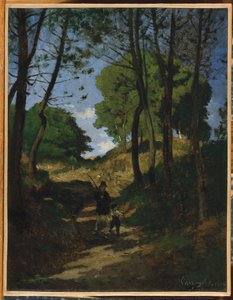 Fir Trees in Les Trembleaux, near Marlotte (Sapins aux Trembleaux à Marlotte) - Henri Harpignies
Henri-Joseph Harpignies stands as a serene pillar of the Barbizon School, a movement defined by its departure from the studio to embrace the raw, unvarnished beauty of the natural world. While his early training under Jean Achard in Paris provided him with a foundation of rigorous draughtsmanship, it was his deep connection to the landscape that truly defined his legacy. Harpignies became closely associated with the leading figures of the Barbizon movement, notably sharing a profound artistic bond with Jean-Baptiste-Camille Corot, with whom he traveled through Italy.
His work is celebrated for its ability to capture the subtle nuances of light and atmosphere, often imbuing the French countryside with a poetic, tranquil sensibility. In his evocative work, Fir Trees in Les Trembleaux, near Marlotte, he demonstrates the quintessential Barbizon approach by focusing on the quiet majesty of the forest. Through a masterful command of light and shadow, Harpignies moves beyond mere topographical recording to create idyllic, meditative scenes that reflect the harmony between nature and the observer. His ability to translate the fleeting moments of the outdoors onto canvas makes him a vital voice in the evolution of landscape painting.
Felix Ziem
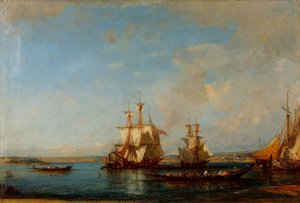 Caiques and Sailboats at the Bosphorus - Felix Ziem
Félix Ziem (1821–1911) represents a luminous evolution within the Barbizon School, bridging the movement's devotion to naturalism with a vibrant, almost Impressionistic approach to light. While his roots were in the disciplined study of architecture, his artistic soul was truly awakened under the mentorship of Adolphe Monticelli in Marseille. This training infused his work with a tactile, textured quality that allowed him to move beyond rigid academic lines, a hallmark of the Barbizon tradition that sought to capture the essence of the atmosphere rather than mere topographical detail.
Ziem’s career was defined by an emotional odyssey through light, most notably during his transformative travels to Venice and the Orient. He became a master of the ephemeral, using a fluid brushstroke to translate the shimmering reflections of water and the hazy glow of dusk into pigment. In his representative work, Caiques and Sailboats at the Bosphorus, this mastery is on full display. The painting captures a rhythmic maritime life through a mesmerizing dance of azure and light, where the sky and sea dissolve into one another. By prioritizing the sensory experience of a landscape over strict documentation, Ziem secured his place as a vital link between the grounded landscapes of the Barbizon masters and the light-drenched explorations of the next generation.
Paul Guigou
 Self-portrait - Paul Guigou
Paul Camille Guigou (1834–1871) brought a unique, sun-drenched intensity to the Barbizon School movement. While many of his contemporaries focused on the dense, shaded forests of northern France, Guigou’s work became synonymous with the rugged, luminous landscapes of Provence. His connection to the land was deeply personal, rooted in his upbringing in Villars-sur-Vaucluse. After studying under Émile Loubon in Marseille, his style underwent a profound transformation. He moved away from academic precision toward a more visceral, expressive approach, embracing the thick, textured brushstrokes characteristic of the Barbizon tradition to capture the heat and atmosphere of the Mediterranean.
His place within the Barbizon School is defined by this commitment to painting en plein air, capturing the immediate reality of nature through a textured, tactile language. This is evident in his evocative depictions of wheat fields, rivers, and local washerwomen. In his 1869 Self-portrait, we see the introspective man behind these landscapes. The work reveals a figure of quiet intensity, characterized by a full, reddish-brown beard and a long-stemmed pipe, rendered with a masterful command of light and shadow that mirrors the atmospheric depth found in his celebrated landscapes.
Jules Coignet
 View of Bozen with a Painter - Jules Coignet
Jules Coignet (1798–1860) serves as a vital bridge between the rigid traditions of Neoclassicism and the atmospheric freedom of the Barbizon School. While his early training under Jean-Victor Bertin emphasized meticulous detail, Coignet found his true voice by abandoning idealized mythological scenes in favor of direct observation. By prioritizing topographical views and the immediate effects of light, he became a pioneer of plein air techniques, a practice that would later define the very essence of the Barbizon movement.
His commitment to capturing the authentic spirit of nature is beautifully realized in View of Bozen with a Painter (1837). In this evocative landscape, Coignet places a solitary artist on a craggy, olive-green outcropping, overlooking a vast valley of sage green meadows and an ice-blue lake. The composition, which transitions from a warm, lemon-yellow horizon to hazy, mauve-tinted mountain peaks, demonstrates his mastery of light and shade. By focusing on these intimate, unadorned moments of landscape study, Coignet helped pave the way for the naturalism and emotional resonance that characterized the great French landscape painters of the mid-19th century.
Conclusion
The Barbizon School represents a profound shift in the history of art, marking the moment when painters stepped away from the rigid confines of the studio to find truth in the dappled light of the forest and the quiet drama of the countryside. From the atmospheric landscapes of Théodore Rousseau to the intimate, textured studies of nature by Charles-François Daubigny, these artists collectively paved the way for the Impressionist revolution by proving that the natural world was a subject worthy of intense, emotional observation. Whether capturing the ruggedness of a woodland path or the soft, shifting light of a rural horizon, these masters taught us to see the soul within the landscape.
At Mus3ums.com, we believe these evocative scenes deserve a place in your own home, bringing a sense of calm and timeless beauty to your living space. You can explore our full collection to find the perfect piece that resonates with your personal style. We invite you to bring these historic moments to life through our museum-quality, hand-painted reproductions, crafted by skilled artists to capture the authentic texture and spirit of the Barbizon masters.