
Introduction
The 1950s in the United States marked a profound cultural pivot, a decade where the visual language of the nation shifted from traditional realism toward the complex, often fractured perspectives of modernity. As the country navigated the tension between post-war prosperity and the underlying anxieties of the Cold War era, its artists began to capture a world in transition. This period saw a fascinating convergence of styles, from the stark, cinematic isolation found in urban landscapes to the high-contrast, emotive power of mid-century photography and the burgeoning movements that would eventually redefine global contemporary art.
This era was defined by a search for identity in a rapidly changing social landscape. While some artists sought to document the quiet, lonely moments of American life through masterful light and shadow, others utilized the camera and the canvas to confront social realities and the complexities of the human condition. The works of this decade do not merely reflect their time; they interrogate it, offering a window into the psychological depth and the evolving aesthetic sensibilities of a superpower finding its voice.
Today, these pieces remain vital, serving as essential touchstones for understanding the roots of modern visual culture. They possess a timeless quality that speaks to the enduring power of composition, light, and the ability of art to freeze a moment of profound cultural significance. The following selection highlights ten significant works from this transformative decade, showcasing the diverse mastery of artists who captured the essence of an American era through painting and lens alike.
Sunlight in a Cafeteria - Edward Hopper
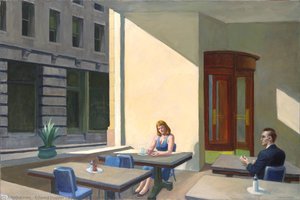 Sunlight in a Cafeteria - Edward Hopper
Edward Hopper’s Sunlight in a Cafeteria (1958) stands as a definitive example of American Realism from the 1950s, a decade where artists frequently explored the psychological complexities of post-war urban life. This oil on canvas, currently held at the Yale University Art Gallery, captures a profound sense of urban alienation through its stark, geometric composition. The scene features a man and a woman seated in a brightly lit cafeteria, yet they remain emotionally sequestered in their own private worlds. Hopper utilizes a sophisticated interplay of light and shadow to emphasize this disconnection; a dramatic, intense beam of sunlight cuts through the space, creating sharp diagonal lines that divide the canvas and heighten the sense of unease.
The color palette is intentionally muted, dominated by beige and gray tones that evoke a melancholic, nostalgic atmosphere. Through precise brushwork and a mastery of chiaroscuro, Hopper transforms a mundane setting into a poignant meditation on solitude. By placing his subjects in close physical proximity yet total emotional distance, he perfectly encapsulates the quiet, unsettling tension characteristic of mid-century American social observation.
Cape Cod Morning - Edward Hopper
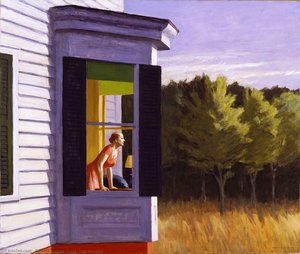 Cape Cod Morning - Edward Hopper
Created in 1950, Cape Cod Morning stands as a quintessential example of American realism from the 1950s, capturing a profound sense of quietude and introspection. The composition centers on a solitary woman in a vibrant red dress, positioned at a window of a white-painted house. She gazes out toward an expansive, lush landscape of greenery under a soft, pastel sky, creating a delicate tension between the private interior and the vast, open world outside.
Hopper’s mastery of light is the soul of this work. Sunlight streams from the side, casting gentle shadows and illuminating the scene with a serene, morning glow. The color palette balances cool tones—plums, greens, and blues—with the warm, striking accent of the woman's attire. Through deliberate, textured brushstrokes and a focus on geometric architectural lines contrasted with organic foliage, Hopper evokes a mood of reflective solitude. This piece exemplifies the era's ability to find deep, evocative meaning in moments of stillness, transforming a simple domestic scene into a powerful meditation on the human connection to the landscape.
In-Home Barbershop, Shady Grove, Alabama - Gordon Parks
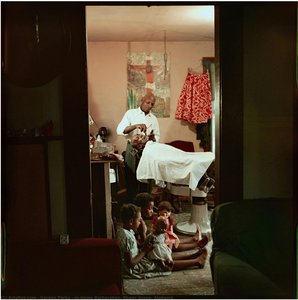 In-Home Barbershop, Shady Grove, Alabama - Gordon Parks
Captured in 1956, In-Home Barbershop, Shady Grove, Alabama is a profound testament to the quiet resilience of the American South during the Jim Crow era. Through his lens, Gordon Parks transforms a modest domestic sanctuary into a stage for communal dignity. The scene depicts a tender, intimate ritual: a man meticulously tending to a young boy’s hair, surrounded by the warmth of family and neighbors. In this small room, the boundaries between commerce and community dissolve, offering a glimpse into a private world that persists despite the heavy weight of societal segregation.
Parks demonstrates a masterful command of black and white photography, utilizing natural light to create a painterly depth. The light streaming into the space illuminates the textures of the room—the coarse fabric of clothing, the subtle sheen on skin, and the cluttered reality of the domestic setting. By stripping away color, Parks heightens the emotional resonance, using a rich interplay of light and shadow to achieve a raw, unvarnished realism. The composition, featuring a dining table, a wall clock, and children resting nearby, captures a reflective moment of calm amidst a transformative decade.
Maude Callen with newborn baby (Nurse Midwife Series) - William Eugene Smith
 Maude Callen with newborn baby (Nurse Midwife Series) - William Eugene Smith
The viewer is immediately drawn into a triangular composition of profound intimacy, where the eye meets the tender connection between a mother, her newborn, and a dedicated caregiver. In this silver gelatin print, the nurse leans over the bed with an expression of focused compassion, while the mother, resting amidst soft linens, cradles her infant. The scene is sculpted by dramatic chiaroscuro; a warm light source casts a glow upon the subjects, contrasting sharply against the deep shadows of the hospital room. This interplay of light and shadow, combined with a shallow depth of field, isolates this sacred moment of caregiving from the blurred background, emphasizing the textures of skin, fabric, and medical glass.
Created in 1951, this work is a quintessential example of American photography from the 1950s, a decade defined by the rise of the editorial photo essay. Through his "Nurse Midwife" series, William Eugene Smith moved away from sensationalism to pioneer a deeply empathetic documentary style. By capturing the quiet heroism of Maude Callen in rural South Carolina, Smith documented the social realities of healthcare and community resilience that characterized the mid-century American experience.
Geodesic dome, Parco Sempione, X Triennale, Milan - Richard Buckminster Fuller
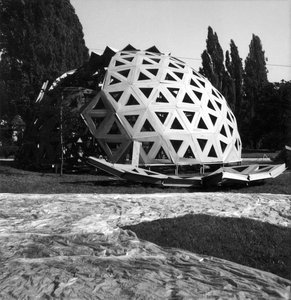 Geodesic dome, Parco Sempione, X Triennale, Milan - Richard Buckminster Fuller
This striking black and white photograph captures a pivotal moment of mid-century innovation: the emergence of Richard Buckminster Fuller's geodesic dome at the 1954 X Triennale in Milan's Parco Sempione. As a quintessential example of American architectural thought from the 1950s, the structure embodies the decade's fascination with technological advancement and futuristic design. The image presents a profound intersection between man-made geometry and the organic verticality of the surrounding trees, creating a tranquil yet awe-inspiring composition.
The dome's intricate network of triangular metal supports and panels creates a visually complex pattern that distributes stress evenly across its spherical form. This ingenious design, inspired by natural structures like honeycombs, allows for immense strength using minimal materials. Through the lens of documentary photography, the diffused lighting emphasizes the monumental scale of the structure, casting a quiet prestige over the scene. The presence of observers in the foreground highlights the public fascination with Fuller's utopian vision, marking this 1954 installation as a landmark of 20th-century structural engineering and a testament to the era's bold, experimental spirit.
Richard Burton as Henry V - Angus Rowland Mcbean
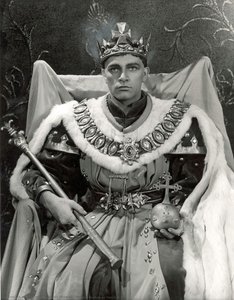 Richard Burton as Henry V - Angus Rowland Mcbean
Captured in 1951, Angus Rowland McBean’s portrait of Richard Burton as Henry V stands as a masterful intersection of theatrical performance and mid-century photographic artistry. This work belongs to the 1950s era of American-influenced dramatic portraiture, a period where the boundaries between stagecraft and fine art photography were frequently blurred through high-contrast, stylized compositions. McBean, a photographer renowned for his surrealist sensibilities, utilizes a dramatic chiaroscuro effect to sculpt Burton’s features, imbuing the actor with a sense of regal gravitas and simmering intensity.
The composition is rich with symbolic weight: Burton is seated in an ornate, velvet-upholstered chair, his posture radiating command. In one hand, he holds an apple—a potent emblem of temptation—while the other grips a sword, representing the dual nature of sovereignty: the burden of leadership and the power of conquest. A crown rests upon his head, anchoring the image in historical legitimacy against a stylized castle backdrop. Through precise studio lighting and a sophisticated play of textures—from the metallic sheen of the crown to the heavy folds of his cape—McBean transforms a promotional theatrical portrait into a profound study of power and intrigue.
The Invisible Man, Harlem, New York - Gordon Parks
 The Invisible Man, Harlem, New York - Gordon Parks
Captured in 1952, Gordon Parks’ The Invisible Man, Harlem, New York stands as a profound visual meditation on visibility and revelation. This black and white photograph is a quintessential example of the dramatic documentary photography that emerged from the United States during the 1950s, utilizing a powerful grayscale palette to heighten emotional stakes. The composition centers on a man emerging from a fissure in the earth, a dynamic movement that suggests a moment caught between concealment and undeniable presence.
Parks employs a masterful use of chiaroscuro, where a strong, unseen light source illuminates the subject's face from above. This creates deep, theatrical shadows beneath the brim of his hat, carving out his features against a blurred, indistinct background. The interplay of textures—the rough weave of his plaid shirt against the granular detail of the soil—grounds this ethereal moment in a tangible reality. Through this striking use of contrast and symbolic emergence, Parks transforms a portrait into a powerful commentary on the human condition and the struggle for recognition.
Suzy Parker, Evening Dress by Dior, Paris Studio - Richard Avedon
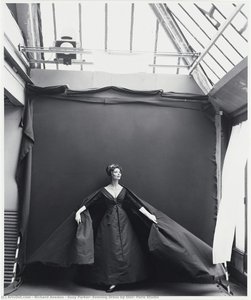 Suzy Parker, Evening Dress by Dior, Paris Studio - Richard Avedon
In this 1956 photograph, Richard Avedon captures the essence of mid-century elegance through a striking black and white composition. The subject, model Suzy Parker, is positioned in a Parisian studio, her arms outstretched to create a sense of dramatic movement. This pose pulls the fabric of her Dior evening gown into sweeping, organic curves, which contrast sharply against the rigid vertical lines of the studio's architectural details and lighting equipment. Such interplay between structured environments and fluid forms is a hallmark of the era's sophisticated aesthetic.
Utilizing a silver gelatin print process, Avedon employs directional, high-contrast lighting to define the textures of the scene. Deep shadows accentuate the contours of the gown and the smoothness of the model's skin, providing a profound sense of depth and volume. The slight upward perspective emphasizes the grandeur of the couture, transforming a functional workspace into a theatrical stage. This work exemplifies the 1950s American photographic movement, where minimalist studio settings were used to elevate fashion into high art through masterful control of light and shadow.
Midwife Maude Callen (with sick child) - William Eugene Smith
 Midwife Maude Callen (with sick child) - William Eugene Smith
Created in 1951, Midwife Maude Callen (with sick child) stands as a profound testament to the humanist photojournalism that defined American visual storytelling in the 1950s. This black-and-white masterpiece by William Eugene Smith captures a sacred ritual of care within a rural setting, focusing on the intimate connection between a dedicated midwife and a vulnerable young patient. The work is a masterclass in the use of chiaroscuro; a strong, directional lantern carves the subjects out of a deep, enveloping darkness, creating a cinematic gravity that emphasizes the solemnity of the encounter.
The technical execution relies on a dramatic interplay of light and shadow to highlight organic textures—the weathered skin of the midwife, the soft features of the child, and the rough, wooden surfaces of the room. This high-contrast approach does more than provide visual depth; it creates a sense of enclosure, shielding this private moment of struggle from the outside world. Through this masterful use of silver gelatin printing techniques, Smith transforms a documentary moment into a timeless symbol of resilience and compassion, embodying the era's preoccupation with the raw, unvarnished realities of human existence.
Vivien Leigh as Lavinia, Titus Andronicus - Angus Rowland Mcbean
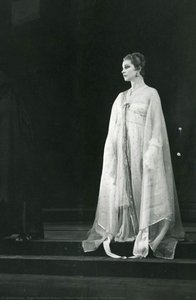 Vivien Leigh as Lavinia, Titus Andronicus - Angus Rowland Mcbean
The viewer is immediately drawn to the haunting, sculptural presence of Vivien Leigh, captured in a moment of profound, quiet intensity. In this 1955 photograph, McBean utilizes a masterful monochromatic palette to distill the emotional weight of Shakespearean tragedy. Leigh, positioned slightly off-center, dominates the frame with a sense of dynamic instability, her form defined by a sophisticated interplay of light and shadow. The soft, blurred textures of the stage curtains and the indistinct figures in the periphery create a dreamlike depth, isolating the protagonist within a space that feels both intimate and vast. The delicate, translucent quality of her costume contrasts with the deep, tonal blacks of the background, emphasizing the raw essence of her character, Lavinia.
This work belongs to the group of American artworks of the 1950s due to its profound connection to the mid-century theatrical landscape and the era's fascination with dramatic, high-contrast portraiture. As a quintessential piece of 1950s stage photography, it reflects the period's mastery of black-and-white film to elevate performance into the realm of iconic, surrealist-influenced art.
Conclusion
The mid-century American aesthetic captured in these works reflects a profound shift in visual storytelling, moving from the quiet, cinematic solitude of Hopper to the high-contrast, emotive power of Avedon and Parks. Whether through the architectural precision of a structural visionary or the evocative textures of mid-century portraiture, this decade defined a unique visual language that balanced post-war optimism with deep, introspective realism. Each piece serves as a window into a transformative era, offering a diverse spectrum of light, shadow, and human experience.
At Mus3ums.com, we invite you to bring this era of American mastery into your own living space. Our artisans specialize in creating museum-quality, hand-painted oil reproductions that preserve the soul and tactile depth of these iconic works. From the subtle brushstrokes of a landscape to the dramatic chiaroscuro of a portrait, you can own a piece of history through our bespoke, fine-art services. Explore our full collection and find the perfect masterpiece to transform your home.


