

Introduction
The 20th century in the Czech lands was a period of profound metamorphosis, where the intersection of a shifting political landscape and a vibrant Central European identity gave rise to a unique visual language. From the ornate, flowing lines of Art Nouveau to the radical abstractions of the avant-garde, these artists navigated a world in flux, blending traditional craftsmanship with the experimental spirit of modernity. This era was defined by a restless search for form and meaning, as painters moved from the decorative elegance of the fin de siècle into the fractured geometries of Cubism and the psychological depths of Surrealism.
What unites this group is a remarkable ability to synthesize diverse international movements—such as Expressionism and Abstraction—with a distinct, often melancholic or highly symbolic, local sensibility. Whether exploring the spiritual essence of color or the dark recesses of the subconscious, these creators responded to the turbulence of their time with immense technical skill and conceptual bravery. Their work remains vital today because it captures the tension between the human spirit and the rapid industrialization and political upheaval of the modern age, offering a visual roadmap of the European soul during its most transformative century.
The following selection explores the diverse legacies of this movement, tracing the evolution of style and thought through ten essential figures who shaped the aesthetic landscape of the Czech Republic.
Alphonse Mucha
 Czech Heart - Alphonse Mucha
In Czech Heart, created in 1917, we witness a profound shift in the artistic trajectory of Alphonse Mucha. This work, rendered in oil on canvas, moves away from the decorative exuberance of his earlier years toward a more emotive, painterly approach. The composition features a woman in a white gown and floral headpiece offering a protective gesture to a young boy, all set against a textured, atmospheric background. The palette is restrained, utilizing desaturated tones of pale blue and grey to evoke a somber, ethereal mood.
As a central figure of the 20th century Czech painters, Mucha’s legacy is defined by his ability to bridge traditional Moravian roots with the avant-garde movements of Paris. While he gained international fame through his Art Nouveau posters for Sarah Bernhardt, his later years were dedicated to monumental themes, such as his massive The Slav Epic. His signature style—characterized by flowing organic lines, idealized female forms, and lush botanical motifs—remains a cornerstone of Czech artistic identity. Whether through his graphic design for the newly independent Czechoslovakia or his deeply symbolic canvases, Mucha’s work captures the transition from the Belle Époque into the modern era.
František Kupka
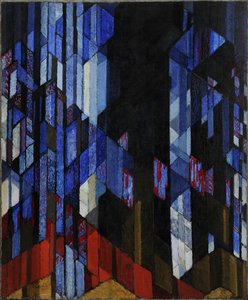 The Cathedral - František Kupka
A central figure among 20th century Czech painters, František Kupka transitioned from the academic traditions of Prague and Vienna to become a pioneer of Orphism in Paris. His evolution from the historical and patriotic themes studied at the Academy of Fine Arts in Prague toward a spiritual, non-representational language marks a pivotal shift in modern art. Influenced by theosophy and Eastern philosophy, Kupka sought to express the unseen through rhythmic color and light, moving beyond the literalism of his early training to explore the underlying structures of reality.
His 1913 masterpiece, “The Cathedral,” serves as a profound example of this transition. In this work, Kupka utilizes fractured planes and geometric abstraction to create a vision of spiritual ascent. Rather than a mere architectural study, the painting uses the luminous properties of tempera to achieve a remarkable depth of color, where saturated hues interact to create an atmospheric, ethereal weight. By blending the structural rigor of Neo-Cubism with a sense of serene verticality, Kupka established a unique visual language that remains a cornerstone of the 20th-century Czech avant-garde.
Bohumil Kubišta
 Pierrot - Bohumil Kubišta
A central figure of the Czech avant-garde, Bohumil Kubišta (1884–1918) bridged the gap between the tangible world and the metaphysical. His journey from the rural landscapes of Bohemia to the prestigious Academy of Fine Arts in Prague and the Reale Istituto di Belle Arti in Florence allowed him to synthesize the emotional intensity of Post-Impressionism with a rigorous, mathematical intellect. As a pioneer of Cubo-Expressionism, his work stands as a testament to the radical shifts defining 20th century Czech painters, moving beyond mere representation to capture the internal human struggle.
In his 1911 masterpiece, Pierrot, Kubišta explores the melancholy of the commedia dell'arte through a lens of structural complexity. The figure is isolated against a void of deep blues and teals, broken into crystalline, faceted planes that suggest a rhythmic, internal movement. Sharp, angular edges define the subject, creating a tension between the recognizable archetype of the clown and a fragmented, modern sensibility. Through muted flesh tones disrupted by saturated orange-red accents, the painting achieves a somber, dramatic intensity that exemplifies the profound psychological depth characteristic of his visionary approach to modernism.
Alfred Kubin
 Dolmen, c. 1900-1902 - Alfred Kubin
Born in 1877 in Leitmeritz, Bohemia, Alfred Kubin stands as a profound figure within the landscape of 20th century Czech painters. His work, deeply rooted in the psychological turbulence of the era, bridged the gap between Symbolism and Expressionism. His formative years were shaped by a transition from an apprenticeship in photography to rigorous studies at the Munich Academy, where the influence of Max Klinger and the visionary works of Edvard Munch helped refine his mastery of atmospheric density.
Kubin’s practice was a deliberate descent into the subconscious, often utilizing Indian ink, wash, and spray paint to navigate the dark corridors of the human psyche. His representative work, Dolmen, c. 1900-1902, exemplifies this preoccupation with the existential. In this haunting drawing, a man’s contorted features are set against a megalithic landscape of weathered stone and scattered birds, all rendered in a somber, monochromatic palette. Through his intricate drawings and literary contributions, Kubin captured the profound sense of dread and dreamlike surrealism that defined the artistic spirit of the early 20th century in the Czech lands.
Jan Saudek (Czech, B. 1935)
 #35 (Life) - Jan Saudek (Czech, B. 1935)
Born in Prague in 1935, Jan Saudek stands as a profound voice within the landscape of 20th century Czech painters and visual artists. His creative journey is deeply rooted in the historical turbulence of the Czech Republic, having survived the trauma of Nazi occupation and the loss of family members during the Holocaust. This early encounter with profound displacement and suffering infused his work with a signature melancholic beauty, transforming the act of creation into an exploration of human vulnerability. His aesthetic is a masterful tension between desire and despair, often blending surrealism with a romanticized, dreamlike quality that echoes the decorative elegance of Alphonse Mucha.
In his representative work, #35 (Life) (1986), Saudek moves beyond mere eroticism to touch upon the essence of human connection. Through a tight, intimate perspective, he depicts a father gently cradling his child, a composition that emphasizes the physical and emotional closeness of the two figures. The work serves as a poignant meditation on the cycle of existence, capturing the profound intimacy of family while reflecting the societal values of late 20th-century Czechoslovakia through a lens of timeless, haunting grace.
Antonín Hudeček
 Psyche - Antonín Hudeček
Antonín Hudeček stands as a vital bridge in the evolution of Czech landscape painting, transitioning from the academic rigor of the 19th century into the atmospheric sensibilities that defined the 20th century Czech painters. Born in Redhost, his early training under masters like Maximilian Pirner at the Academy of Fine Arts in Prague initially focused on the human form. However, his creative soul found its true expression through the mařákovci movement, where he embraced the sensory magic of plein air painting. By abandoning strict studio compositions for the misty forests of Okoř, Hudeček helped shape a new visual language for his nation.
His masterpiece, Psyche (1901), serves as a profound testament to this stylistic shift. In this ethereal oil on canvas, a solitary nude figure wanders through a dense, fog-drenched woodland. The work exemplifies his mastery of Tonalism, using a palette of deep, muted greens and earthy browns to create a sense of profound stillness. Through the soft, diffused light filtering through the canopy, Hudeček captures a fleeting, dreamlike moment, merging the precision of figure painting with the evocative, atmospheric depth that would characterize much of the 20th-century Czech artistic output.
Pavel Baňka
 I Was Too Shy To Speak - Pavel Baňka
Born in Prague in 1941, Pavel Baňka stands as a pivotal figure among 20th century Czech painters and visual artists, representing the era's shift toward experimental and subversive expression. His journey from a technical education at the Czech Technical University to the underground beatnik scene allowed him to develop a visual language that challenged the political and social constraints of his time. As a co-founder of the Action Group of Free Photography and the Prague House of Photography, Baňka was instrumental in reshaping the Czech artistic landscape during the late 20th century, moving away from traditionalism toward a profound exploration of movement and time.
His representative work, I Was Too Shy To Speak (1989), serves as a masterful study of subjectivity and the ephemeral. In this piece, Baňka utilizes light to externalize internal psychological states, capturing a sense of connection that transcends physical presence. The work features a couple enveloped in tangled, kinetic light beams that contrast sharply with their still, detached expressions. Through this interplay of light and shadow, Baňka offers a poignant commentary on intimacy and the complexities of human communication, effectively translating personal memory into a universal visual experience.
Norbert Troller
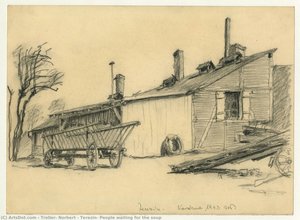 Terezin: People waiting for the soup - Norbert Troller
Born in Brno in 1896, Norbert Troller stands as a profound figure among 20th century Czech painters, representing the intersection of architectural precision and the harrowing realities of mid-century history. After studying at the Brno Technical University and the Academy of Fine Arts in Vienna, Troller’s artistic trajectory was irrevocably altered by the events of World War II. His deportation to the Theresienstadt concentration camp in 1942 transformed his practice from architectural design into a vital, somber documentation of human endurance.
His representative work, "Terezin: People waiting for the soup" (1943), exemplifies this transition. In this piece, Troller utilizes his trained architect's eye to render the structural lines of a house and barn with a clarity that contrasts sharply with the heavy, emotional weight of the scene. The drawing captures a mundane moment of survival—figures gathered near a truck—elevating a simple act of waiting into a powerful symbol of resilience. Through his delicate yet precise lines, Troller provides a silent, visual testimony to the daily life and the indomitable spirit of those living under the shadow of persecution, securing his place in the legacy of Czech modernism."
Ferdinand František Engelmüller
 Cemetery with Cypress Trees - Ferdinand František Engelmüller
In his 1918 work, Cemetery with Cypress Trees, the dramatic interplay of shadow and light is captured through a somber, atmospheric lens. The composition is defined by the vertical silhouettes of cypress trees rising against a turbulent, billowing sky, while the foreground features a dark pond adorned with lily pads and delicate white flowers. This piece exemplifies the painterly technique of Ferdinand František Engelmüller, utilizing thick, impasto-like brushstrokes to give physical weight to the clouds and a palpable density to the vegetation. His palette often relies on deep greens and blacks contrasted against luminous, pale tones, creating a sense of movement within the atmosphere.
As a significant figure among 20th century Czech painters, Engelmüller’s career bridged the transition into the modern era through his commitment to Impressionist and Post-Impressionist traditions. His deep connection to the Czech landscape is evident in his studies of the Elbe riverbanks, the Šumava forests, and the Bohemian-Moravian Highlands. A co-founder of the Mánes Association and a dedicated educator, his influence extended from local art schools to the international stage of the Venice Biennale. His work remains a profound documentation of the specific light and shifting moods of his homeland.
Lubo Kristek
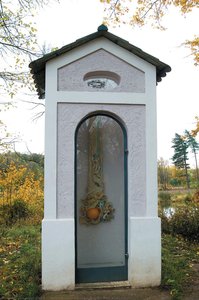 The Birth and Simultaneously Damnation of the Sphere - Lubo Kristek
Born in Brno in 1943, Lubo Kristek stands as a transformative figure among 20th century Czech painters and multidisciplinary artists. His career, which gained significant momentum during the experimental 1960s, is defined by a restless refusal to be confined by traditional mediums. Kristek’s work bridges the gap between painting, sculpture, and performance, often utilizing assemblage to explore profound themes of human vulnerability, medical ethics, and the complexities of the natural world. His relocation to West Germany in 1968 further expanded his conceptual horizons, leading to the development of his unique theory of “holographic perception.”
His 1978 work, The Birth and Simultaneously Damnation of the Sphere, exemplifies this philosophical depth. This ceramic sculpture, situated within the evocative landscape of John’s Castle, utilizes the sphere as a potent emblem of perfection and unity. Through meticulous molding and a stark white finish, Kristek creates an ethereal interplay of light and shadow that invites deep contemplation on the duality of existence. The piece serves as a powerful reflection of the individual expression that flourished even amidst the ideological constraints of the era.
Conclusion
The 20th century was a transformative era for Czech art, a period where the boundaries between the decorative elegance of Mucha and the radical abstraction of Kupka helped redefine the visual language of Europe. From the surrealist depths of Alfred Kubin to the provocative photography of Jan Saudek, these artists collectively navigated the complexities of modernity, shifting between intense emotional expressionism and the structured geometry of Cubism. Each painter contributed a unique layer to this cultural tapestry, ensuring that the Czech artistic identity remained both deeply rooted in tradition and boldly experimental.
For those looking to bring this rich heritage into their own living spaces, Mus3ums.com offers a way to connect with these masters. We specialize in creating museum-quality, hand-painted oil reproductions that capture the authentic texture and soul of these iconic works. Whether you are a seasoned collector or looking for a statement piece for your home, you can explore our full collection and choose a masterpiece that resonates with your personal aesthetic.


