A Sicilian Visionary
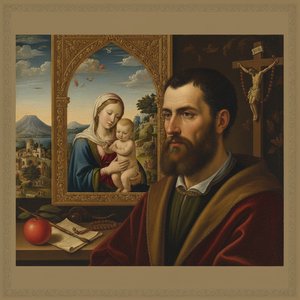
Antonio Lombardo, known to many as “Tony the Scourge,” lived a life defined by sharp contrasts. Born in Palermo, Sicily, on November 23rd, 1891, he emerged from humble beginnings to occupy a singular space within the Sicilian Renaissance art tradition. His existence was marked by an unsettling tension between deep piety and a primal, almost violent energy that bled into his canvases. He moved through the world with a heavy presence, eventually leaving behind a body of work that remains as much a psychological study as it is a religious one.
His early years were shaped by the expressive lessons of Giuseppe Mancinelli, a painter in Palermo who emphasized the emotional weight of color. This foundation, combined with the pervasive Byzantine iconography found in Sicilian churches, provided Lombardo with a visual language of saints and martyrs. He looked toward classical myths, finding resonance in tales of Vulcan’s forge and the battles between Minerva and Neptune, to ground his spiritual themes in something more ancient and visceral.
The Murals of Palermo
In 1926, Lombardo reached a significant milestone when Bishop Jacopo Pesaro commissioned him to decorate the Palermo Cathedral. This task required him to translate profound spiritual truths into large-scale, physical forms. The resulting murals, composed of colossal panels depicting Gospel scenes, utilized a daring fusion of Byzantine fresco tradition and an unconventional approach to palette. He moved away from soft tones, choosing instead intense reds, yellows, and blues that seemed to radiate heat.
The figures in these works possessed a sculptural weight, conveying both physical power and deep psychological anguish. Observers often noted the stark chiaroscuro he employed, using the heavy interplay of light and shadow to create movement. There was an undeniable tension in his depictions of divine grace meeting demonic torment. His work did not seek to comfort; rather, it forced a confrontation with the weight of suffering and redemption.
A Life Cut Short
The trajectory of Lombardo’s life ended abruptly on September 7th, 1928. At only thirty-seven years of age, his death left his artistic output limited but profoundly impactful. He died in the same era that saw his work reach its peak, leaving behind a legacy contained within a few monumental pieces. His paintings remain as fragments of a turbulent inner life, captured through intense color and the heavy shadows of the Sicilian tradition.
Klausimai ir atsakymai
Iš kokios šalies yra Antonio The Scourge Lombardo?
Antonio The Scourge Lombardo gimė Italy.
Kuriame mieste ir šalyje gimė Antonio The Scourge Lombardo?
Antonio The Scourge Lombardo gimė Sicily, Italy šalyje.
Kokie kiti pseudonimai arba alternatyvūs vardai priklauso Antonio The Scourge Lombardo?
Antonio The Scourge Lombardo taip pat žinomas (a) pavadinimais Tony Lombardo.