The Life and Training of Samuel Maurice Jones
Born in the coastal village of Mochdre, in north-east Wales near Colwyn Bay, Samuel Maurice Jones grew up in a household shaped by faith. His father, the Rev. John Jones, served the community as a Calvinistic Methodist minister. This quiet, coastal upbringing provided the backdrop for a life that would eventually be defined by the landscapes of his home country.
His formal education in art began in Caernarfon. At the Caernarfon School of Art, he studied under John Cambrian Rowland, learning the foundational skills required of a professional illustrator and painter. This early training provided the technical grounding necessary for the more rigorous studies that followed in the city of London. Between 1870 and 1873, Samuel Maurice Jones moved to London to continue his education under William Collingwood. During these years, he focused on the essential mechanics of his craft, including the importance of line, composition, and the careful study of shading. His instructors emphasized the necessity of drawing from both nature and memory, teaching him to treat his hand as an instrument capable of executing precise mental commands.
Artistic Style and Influences in His Work
Jones found his true calling in the quietude of the Welsh landscape. Working principally in watercolour, he sought to capture the essence of the countryside through a lens of gentle, pastoral beauty. His studies of the fields near Caernarfon and the Conwy Valley often took on an idealised character, leaning into the English picturesque tradition. He had a particular talent for translating the physical world into scenes of serenity, whether he was painting the stillness of a valley or the sudden, dramatic presence of mountain vistas.
His time in London proved to be a formative period for his developing eye. During these years, he had the opportunity to meet significant figures of the era, including a prominent art critic and a noted painter associated with the Pre-Raphaelite Brotherhood. These encounters provided him with constructive criticism that helped refine his technical approach. His early sketches and notebooks reveal a deep respect for the Romantic landscape traditions, showing a clear connection to the atmospheric works of John Constable and J.M.W. Turner.
This influence is visible in how he handled light and the weight of the natural world. He did not merely record a location; he sought to convey a specific mood through subtle tonal variations. His work often balances the ruggedness of the Welsh terrain with a sense of calm, creating images that feel both grounded in nature and softened by a romantic sensibility.
Notable Works and Artistic Output
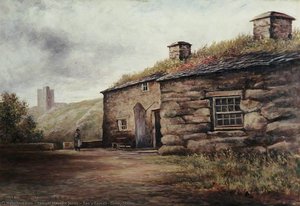
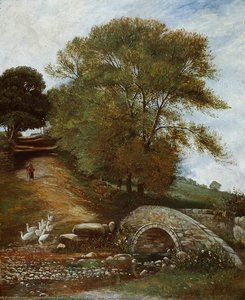
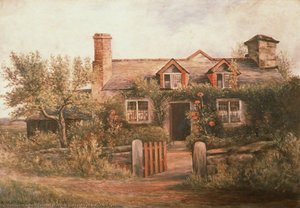
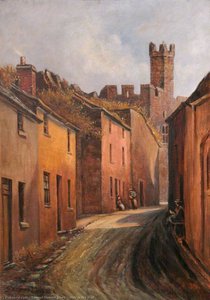
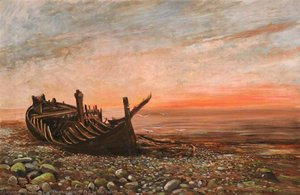
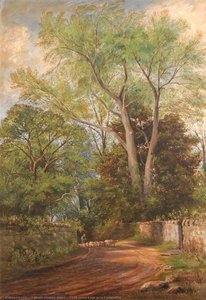
Jones spent much of his life looking closely at the landscape of North Wales. He found deep inspiration in the quiet corners of the Conwy Valley and the fields surrounding Caernarfon. His work often focused on the subtle shifts in light and the textures of the natural world. One of his notable oil paintings, Left by the Tide, captures a shipwreck scene set against a sunset, focusing on the mood of the coast. He also turned his attention to the roads and rivers of his home, such as in Maesincla Road, near Caernarvon.
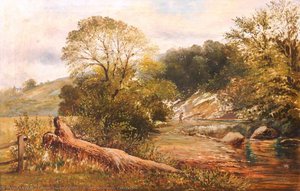
His ability to capture the character of the Welsh countryside is evident in his various studies. He produced Tan y Celyn, Trefriw in 1908 and a landscape work about 1920. Many of his pieces reflect a deep familiarity with the local terrain, from the mountain vistas to the coastal edges. He was particularly skilled at using watercolor to convey the specific atmosphere of the region, often focusing on the interplay between stone, foliage, and the sky.
- Hole in the Wall
- River Seiont near Caernarvon
Professional Recognition and Academic Status
As his career progressed, Jones became a prominent figure within the Welsh art community, particularly through his deep connection to the landscapes of North Wales. His standing in the professional world grew steadily as he moved from a student of the fundamentals to a respected practitioner. In 1882, he achieved a significant milestone when he was elected an Associate of the Royal Cambrian Academy. This recognition reflected his growing skill and his commitment to the visual culture of the region.
His relationship with the Academy remained a constant throughout his life. He was a regular exhibitor at the Academy’s annual exhibition in Conway, frequently presenting his studies of the local terrain to the public. This consistent presence helped cement his reputation as a dedicated observer of the Welsh countryside. By 1921, his professional standing reached a new peak when he was named an Academician (R.C.A.).
Later Years and Death
In his final years, Jones moved to Llandudno, a coastal town that offered a different perspective on the Welsh landscape he had spent a lifetime studying. His personal life was marked by significant change, as he was married three times during his life. He was also a father to one son.
The artist passed away on 30 December 1932. His death marked the end of a long career dedicated to the light and atmosphere of the Welsh countryside.
Klausimai ir atsakymai
Kuriame istoriniame laikotarpyje kūrė Samuel Maurice Jones?
Samuel Maurice Jones kūrė 19th Century laikotarpiu. Šis laikotarpis leidžia įvertinti kūrybinę veiklą istoriniame kontekste.