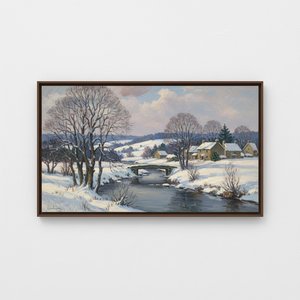
The Impressionist Legacy of Sydney Elmer Schofield
Born in the vibrant landscapes of Pennsylvania around 1901, Sydney Elmer Schofield carried within him a profound artistic heritage that would eventually find its most evocative expression on the rugged shores of Cornwall. As the son of the renowned American Impressionist Walter Schofield, Sydney’s early years were steeped in the traditions of plein air painting and a deep-seated reverence for the natural world. The luminous, shifting light of his American upbringing provided a foundational palette, instilling in him an acute sensitivity to the fleeting moments of atmosphere that define the Impressionist spirit. This lineage was not merely one of blood but of technique, as he inherited a mastery of capturing the dynamic interplay between color and light that would become the hallmark of his mature style.
The trajectory of Schofield’s life took a transformative turn when he relocated to St Ives, Cornwall. This coastal enclave, a legendary sanctuary for British Impressionists, offered a dramatic new stage for his creative evolution. Immersed in a community of luminaries such as Alfred Munnings and Stan Hay, Schofield found himself inspired by the raw, untamed beauty of the Atlantic coastline. The jagged cliffs, the turquoise surges of the sea, and the ever-shifting Cornish skies became his primary muses. In this environment, his work transitioned from the pastoral echoes of his youth into a more robust and atmospheric exploration of maritime life and coastal landscapes, blending the delicate light-work of his father with the rugged textures of the English seaside.
Technique, Subject Matter, and Artistic Vision
Schofield’s oeuvre is a testament to his ability to translate sensory experience into tangible emotion. His approach was characterized by a remarkable sensitivity to tonal variations, utilizing loose, confident brushstrokes that allowed the canvas to breathe with life. Unlike artists who sought to present an idealized or static version of nature, Schofield embraced the transient. He meticulously observed how sunlight cascaded across a landscape or how mist softened the edges of a fishing vessel, translating these subtle shifts into works imbued with a palpable sense of atmosphere.
His subject matter often bridged the gap between the grand scale of the landscape and the intimate reality of human existence. While his seascapes are celebrated for their energy, his portraits of the St Ives fishing community offer a poignant glimpse into the lives of those who lived in harmony with the sea. These portraits were rarely posed or performative; instead, they captured subjects in candid, unvarnished moments, revealing a profound connection between the people and their environment. Through a muted palette and thoughtful composition, he achieved a sense of realism that felt both deeply personal and universally resonant.
Historical Significance and Enduring Influence
The significance of Sydney Elmer Schofield lies in his role as a bridge between two worlds—the American Impressionist tradition and the British coastal school. By synthesizing the light-centric philosophies of his Pennsylvania roots with the atmospheric, rugged demands of the Cornish landscape, he created a body of work that feels uniquely his own. His ability to capture the "soul" of a place through the medium of light remains his greatest achievement.
Today, Schofield is remembered not just as an artist of great technical skill, but as a chronicler of a specific era and landscape. His works serve as historical windows into the vibrant artistic community of St Ives and the enduring spirit of the maritime life it supported. The legacy of his brushwork continues to inspire those who seek to find the extraordinary within the ephemeral, ensuring that his vision of the world remains as luminous as the light he so lovingly captured on canvas.
Klausimai ir atsakymai
Kuriame istoriniame laikotarpyje kūrė Sydney Elmer Schofield?
Sydney Elmer Schofield kūrė Modern laikotarpiu. Šis laikotarpis leidžia įvertinti kūrybinę veiklą istoriniame kontekste.