
Introduction
The 1850s in the United States marked a transformative era where the canvas became a battlefield for national identity and the sublime. As the country expanded westward, artists moved away from European academic traditions to capture the raw, untamed essence of the American landscape and the evolving complexities of urban life. This decade was defined by a profound tension between the burgeoning industrial revolution and a romanticized, almost spiritual reverence for the wilderness, a movement that sought to find the divine within the rugged topography of a growing nation.
During this period, the Hudson River School reached its zenith, utilizing dramatic light and vast scales to evoke awe, while other painters began exploring the nuances of portraiture and the atmospheric qualities of light and shadow. These works serve as more than mere visual records; they are emotional chronicles of a country in flux, capturing a sense of manifest destiny and the quiet dignity of a changing society. The mastery of light and the meticulous attention to natural detail found in these compositions continue to resonate, offering a window into the soul of a developing continent.
The following selection highlights ten significant works from this decade, featuring the profound visions of masters such as Frederic Edwin Church, John Frederick Kensett, and Asher Brown Durand. Each piece exemplifies the stylistic diversity and the intense pursuit of realism and romanticism that characterized American art during this pivotal decade.
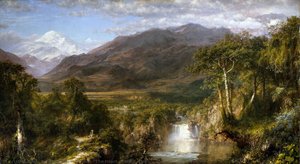
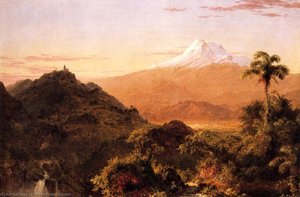
The Heart of the Andes - Frederic Edwin Church
Painted in 1859, The Heart of the Andes stands as a monumental achievement of the 1850s, representing the peak of the Hudson River School's fascination with the sublime. Frederic Edwin Church, a preeminent American landscape painter, moves beyond mere topography to capture an idealized, immersive vision of the South American wilderness. This work is emblematic of the decade's shift toward grand, panoramic compositions that sought to evoke a spiritual connection to the natural world.
The painting utilizes a wide perspective to draw the viewer through a lush foreground of ferns and dense foliage toward a central, cascading waterfall. Towering mountains, partially shrouded in mist and clouds, dominate the upper register, creating a profound sense of scale and atmospheric depth. Church’s masterful use of oil on canvas allows for a sophisticated interplay of light and color, where soft, diffused illumination enhances the tranquil yet powerful presence of the landscape. Through meticulous layering and blending, he achieves a remarkable realism in the textures of rock and water, embodying the Romantic era's reverence for the untamed grandeur of the earth.
Brook Watson and the Shark - John Singleton Copley
 Brook Watson and the Shark - John Singleton Copley
A masterpiece of dramatic tension, Brook Watson and the Shark serves as a profound example of the high-stakes historical painting style that influenced the trajectory of American art. Although the event depicted occurred in 1749, this work remains a cornerstone of the legacy of John Singleton Copley, the preeminent Anglo-American realist. The oil painting captures a harrowing maritime tragedy in the Havana harbor, where a young man clings to life amidst the violent intersection of predator and prey. The composition is anchored by a central knot of tension, as a colossal shark strikes, creating a visceral struggle for survival.
Copley utilizes a sophisticated chiaroscuro effect, where a soft, diffused light strikes the contorted, anguished figures, pulling them out of a murky, atmospheric seascape. The palette is dominated by somber, earthy tones—deep browns, muted ochres, and dark blues—which heighten the tragic mood. Through painterly brushstrokes and organic, fluid shapes, the artist renders the churning white foam and restless swells of the ocean. This work, representing the peak of Copley's ability to blend precise texture with intense emotional narrative, remains a vital reference point for the dramatic realism found in American art history.
George Washington - Rembrandt Peale
 George Washington - Rembrandt Peale
Painted in 1850, this oil on canvas portrait by Rembrandt Peale serves as a profound testament to the legacy of George Washington. As a prominent American Neoclassical portraitist, Peale utilizes this work to capture the first president with a sense of gravity and historical authority. This piece belongs to our collection of American artworks of the 1850s, representing the era's continued reverence for the foundational figures of the republic through refined, academic draftsmanship.
The composition is a bust-length study characterized by a quiet, deliberate balance. Washington is positioned slightly off-center, facing toward the viewer's left while his gaze remains directed forward, establishing an intimate yet respectful eye-level connection. Peale employs a dramatic use of chiaroscuro, where a soft light source from the upper left models the facial structure, defining the jawline and eyes with subtle shadows. The color palette is anchored in warm, earthy tones—deep browns, ochres, and umbers—that create an atmospheric, dark background. This restraint ensures the viewer's focus remains entirely on the subject, specifically the stark contrast between the black coat and the bright white cravat, which lends a tactile depth to the figure's presence.
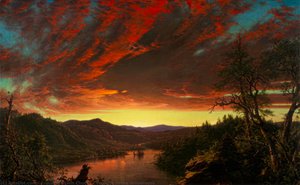
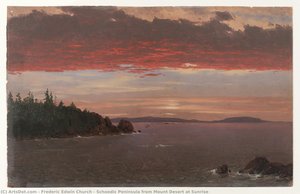
Schoodic Peninsula from Mount Desert at Sunrise - Frederic Edwin Church
 Schoodic Peninsula from Mount Desert at Sunrise - Frederic Edwin Church
The eye is immediately drawn to the dramatic, reddened glow of the sun as it ascends over the Atlantic, casting a luminous light across a heavy bank of clouds. This celestial display dominates the sky, contrasting sharply with the dark, wooded silhouette of the Schoodic Peninsula. In the foreground, rugged boulders and serene trees anchor the composition, while small boats drift upon the rhythmic, steady waters, bridging the gap between the rocky coastline and the vast horizon. The interplay of light and shadow creates a profound sense of stillness and renewal.
As a quintessential work from 1850, this painting exemplifies the American landscape tradition of the 1850s. Through the lens of the Hudson River School, Frederic Edwin Church captures the American wilderness with a blend of scientific precision and spiritual awe. His ability to render the ephemeral qualities of light and atmosphere reflects the decade's fascination with the sublime, transforming a specific coastal moment into a powerful meditation on the majesty of the natural world.
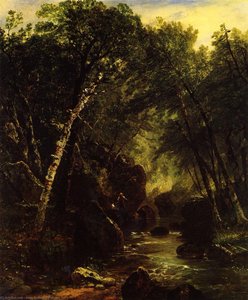
Trout Fisherman - John Frederick Kensett
 Trout Fisherman - John Frederick Kensett
Created in 1852, Trout Fisherman stands as a quintessential example of American Luminism, a movement that defined much of the landscape art produced in the United States during the 1850s. John Frederick Kensett, a master of tranquil New England scenes, utilizes this period's fascination with atmospheric clarity to compose a serene riverbank study. A solitary figure occupies the center of the composition, his fishing pole extended toward the water's surface in a moment of quiet concentration. The scene is framed by a dense arrangement of trees, their verticality anchoring the composition, while scattered rocks provide depth and texture to the foreground and middle ground.
The work is characterized by a steady, diffused glow that permeates the woodland, eschewing dramatic turbulence for a sense of profound stillness. Kensett employs translucent glazes and a muted palette of olive and earthy tones to capture the mossy textures of the rocks and the gentle reflections on the river. This meticulous rendering of light and shadow reflects the Transcendentalist ideals of the era, inviting the viewer into a space of calm, quiet observation and natural harmony.
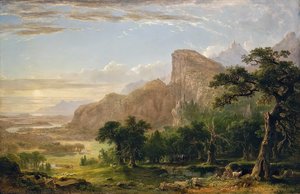
Landscape - Scene from `Thanatopsis` - Asher Brown Durand
Painted in 1850, Asher Brown Durand's Landscape - Scene from ‘Thanatopsis’ serves as a profound testament to the American artistic spirit of the 1850s. As a founder of the Hudson River School, Durand moved away from purely topographical views to capture the sublime, spiritual essence of the wilderness. This work exemplifies the decade's fascination with the intersection of nature and the divine, translating the poetic themes of mortality into a visual experience.
The composition presents a vast, rugged vista where towering mountains recede into a hazy, atmospheric distance under a cloudy sky. A winding river snakes through the valley, grounding the scene in a sense of geological time. Scattered throughout the landscape, small figures—including a solitary farmer and contemplative onlookers—provide a sense of scale, emphasizing the immense, overwhelming grandeur of the natural world. Through a Luminist sensibility, Durand utilizes soft, diffused light and a palette of muted, driftwood tones to evoke a mood of quiet contemplation and melancholic beauty. His expressive brushwork captures both the solid permanence of the earth and the ethereal, shifting qualities of the atmosphere, defining the era's pursuit of the sublime.
Going to Church - Cephas Giovanni Thompson
 Going to Church - Cephas Giovanni Thompson
In this 1852 oil painting, Cephas Giovanni Thompson captures a moment of profound stillness that exemplifies the serene landscape traditions of the 1850s. The work depicts a group of figures in a small boat gliding across a calm expanse of water, a composition that emphasizes the horizontal tranquility of rural life. The scene is set under a soft, overcast sky, where a muted palette of greys, whites, blues, and browns creates a diffused, atmospheric light characteristic of mid-19th-century American realism.
Thompson utilizes subtle brushstrokes to mimic the gentle movement of the water's surface, catching delicate highlights that provide a sense of depth. Through the careful application of atmospheric perspective, the distant shoreline and receding elements appear faint, pulling the viewer into the vastness of the environment. While the overall mood is tranquil and dominated by cool tones, small touches of warmth in the passengers' clothing provide a subtle human presence. This balance between the expansive, quiet landscape and the purposeful movement of the travelers serves as a poignant reflection of community and tradition during this decade.
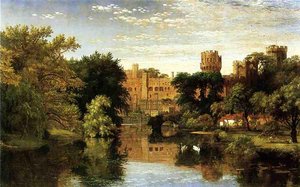
Warwick Castle, England - Jasper Francis Cropsey
 Warwick Castle, England - Jasper Francis Cropsey
Painted in 1857, this work by Jasper Francis Cropsey exemplifies the Romantic sensibilities that defined American landscape painting during the 1850s. Although the subject is an English landmark, Cropsey’s approach is deeply rooted in the traditions of the Hudson River School, utilizing meticulous detail to elevate a historical site into a vision of idealized beauty. The composition is masterfully balanced, employing atmospheric perspective to create a profound sense of depth. Foreground foliage frames the imposing silhouette of Warwick Castle, while the calm, reflective water in the foreground serves to double the visual impact of the architecture, grounding the scene in a state of tranquil permanence.
The palette is a sophisticated study in earthy tones, dominated by lush forest greens and warm autumnal oranges that illuminate the castle's stonework. These warm hues contrast beautifully with the cooler greys of the masonry and the soft, diffused light of a late afternoon sky. Through varied brushwork—from the textured, organic forms of the trees to the smooth, controlled strokes of the architecture—Cropsey captures the intersection of man-made strength and the fluid, ever-changing grace of the natural world.
La Vieille aux Loques - James McNeill Whistler
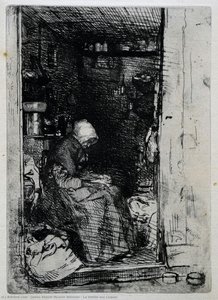 La Vieille aux Loques - James McNeill Whistler
Created in 1858, La Vieille aux Loques serves as a profound testament to the tonalist sensibilities emerging within American art during the 1850s. In this etching and drypoint print, James McNeill Whistler moves away from grand narratives to focus on the quiet, atmospheric essence of a single moment. The work depicts an elderly woman seated in a sparsely furnished room, absorbed in the humble task of sorting rags. Rather than relying on color, Whistler utilizes a sophisticated monochromatic palette, employing dense crosshatching and meticulous layering of ink to build form and texture.
The composition is characterized by a shallow perspective that pulls the viewer into an intimate, cluttered space of solitude. Through the interplay of light and shadow, the artist captures the sheen of glass bottles and the weathered texture of fabric, emphasizing the visual sensation of light over dramatic storytelling. This piece reflects a pivotal shift in the decade's artistic direction, where the focus turned toward the harmony of line and the dignity found in the repetitive, everyday realities of human existence. It is a masterful study in resilience and the quiet beauty of the mundane.
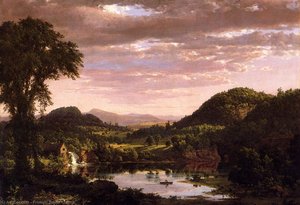
Landscape with Factory - Thomas Doughty
 Landscape with Factory - Thomas Doughty
Painted in 1853, Landscape with Factory serves as a poignant visual document of a nation in transition, a hallmark of American art during the 1850s. Thomas Doughty, a pioneer of the Hudson River School, captures a delicate intersection where the timeless pastoral meets the encroaching industrial era. A majestic tree anchors the composition, acting as a vertical axis that provides a sense of permanence against the shifting, reflective waters in the foreground. Near the water's edge, two figures stand in quiet contemplation, their presence introducing a human element to the vastness of the wilderness.
The work is a masterclass in atmospheric balance, utilizing the soft light hitting the water to create a scene of profound stillness. In the distance, the silhouette of a building emerges—a subtle, geometric reminder of human industry integrated into the natural scenery. Through his skilled brushwork, Doughty explores how the environment absorbs the presence of man-made structures, capturing a world that was beginning to change while still clinging to the tranquil serenity of the river and the woods. It is a serene study of a landscape in flux.
Conclusion
The American landscape and portraiture of the 1850s represent a pivotal era where the raw, untamed spirit of the New World met a sophisticated, evolving artistic language. From the sweeping, dramatic vistas of the Hudson River School to the intimate, atmospheric studies of light and shadow, these works capture a nation in transition. Whether through the grandiosity of a mountain range or the quiet dignity of a formal portrait, the artists of this decade established a visual identity that remains deeply resonant today.
At Mus3ums.com, we invite you to bring this historical grandeur into your own living space. Our master artists specialize in creating museum-quality, hand-painted oil reproductions that preserve the tactile soul and visible brushstrokes of these mid-19th-century masterpieces. You can explore the breadth of this era by browsing our full collection and discover how these timeless works can transform your home through the enduring beauty of fine art.


