



Introduction
The landscape of 21st-century Australian painting is defined by a profound dialogue between the ancient heritage of the continent and the rapid, often fragmented, pulse of modern life. Contemporary artists from this region are united by a unique approach to space and identity, frequently blending traditional indigenous storytelling with avant-garde Western techniques. This era of art is characterized by a deep investigation into the concept of 'place'—whether that be the vast, sun-drenched interior, the urban sprawl of metropolitan hubs, or the complex, layered histories embedded in the soil itself.
Culturally, these painters represent a transformative period in the nation's history, moving beyond colonial perspectives to embrace a diverse, multicultural, and often provocative visual language. Their work navigates the tension between the physical environment and the spiritual or political realities of modern existence. By utilizing everything from expressive impasto to intricate digital-influenced compositions, they have redefined what it means to capture the essence of the Australian experience in a globalized world.
These artists remain vital because they challenge the viewer to see the continent not as a static map, but as a living, breathing entity shaped by continuous movement and evolving social consciousness. Their contributions are essential for understanding how contemporary art responds to the complexities of sovereignty, memory, and environmental change. The following selection highlights ten significant figures whose diverse styles and profound visions exemplify the depth and dynamism of this vibrant artistic movement.
Mervyn Bishop
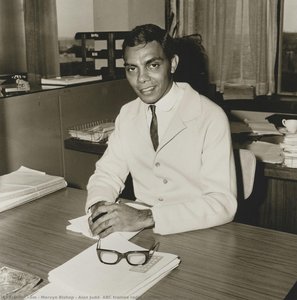 Alan Judd, ABC trainee radio announcer, Sydney - Mervyn Bishop
Mervyn Bishop stands as a pioneering figure whose lens has captured the soul of a changing nation. Born in Brewarrina, New South Wales, in 1945, Bishop’s perspective was shaped by the complexities of post-war Australia and the lived experiences of his Aboriginal family. His journey from a self-taught enthusiast using a Kodak 620 to a professional trailblazer is a testament to visual storytelling. In 1962, he broke significant systemic barriers by becoming the first Aboriginal Australian cadet photographer at the Sydney Morning Herald, a milestone that fundamentally altered the landscape of mainstream media representation.
His work is characterized by a profound ability to document both the quiet dignity of community life and the high-stakes tension of historical moments. A notable example of his documentary precision is the work Alan Judd, ABC trainee radio announcer, Sydney. This gelatin silver photograph, captured in 1968, utilizes a layered composition of desks and bookshelves to create a sense of professional depth, reflecting the subject within his workspace through soft, diffused lighting. As a vital voice in contemporary Australian art history, Bishop’s enduring legacy is cemented by his continued relevance in the 21st century, where his historical archives serve as essential visual records of Indigenous identity and Australian social evolution."
Julie Elizabeth Gough
A defining figure of 21st century Australian painters, Julie Elizabeth Gough utilizes the contemporary era's multidisciplinary tools to perform an archaeological excavation of identity. As a Trawlwoolway artist, her practice is a profound reclamation of silenced histories, bridging the gap between academic inquiry and emotive expression. Her work is deeply rooted in the landscapes of Tasmania, where she navigates the complexities of being a custodian of stories that colonization attempted to erase. Having studied Pre-history and Anthropology at the University of Western Australia and earned a PhD in Fine Arts from the University of Tasmania, Gough’s sophisticated methodology allows her to challenge distorted colonial perspectives through immersive, sculptural interventions.
In her representative work, p/re-occupied (2022), she explores the weight of absence through a haunting installation. The piece features a shower of one hundred 3D-printed stone tools suspended like dark ghosts, mimicking ancestral objects stripped from their rightful lands. This digital rain creates a tension between the permanence of stone and the ephemeral nature of a digital facsimile. Through video projections of Tasmanian riverways, the work facilitates a virtual return to Country, tracing the veins of the land that these tools once belonged to.
Dr Clare Milledge
 Imbás: a well at the bottom of the sea - Dr Clare Milledge
A profound voice in the contemporary Australian art scene, Dr Clare Milledge represents the intellectual and spiritual depth of 21st century Australian painters. Her practice transcends mere visual representation, functioning instead as a ritualistic excavation of shamanic archetypes and historical enigmas. Born in Sydney in 1977, Milledge has bridged the gap between rigorous academic scholarship—culminating in a doctorate from the University of Sydney—and a visceral, transformative approach to storytelling that explores the intersection of occultism and contemporary ecology.
Her mastery of Hinterglasmalerei, the meticulous technique of painting on glass from the reverse side, allows her to navigate the porous boundaries between the subconscious and the physical world. This is vividly realized in her 2022 work, Imbás: a well at the bottom of the sea. This complex installation draws upon the Old Irish myth of Sinann to explore the sacred connections between poetry, truth-telling, and the environment. Through suspended glass paintings and symbolic elements like cauldrons and silk fragments, Milledge transforms ancient folklore into a modern meditation on inspiration and the enduring potency of myth.
Tony Albert
 Once upon a time... (detail) - Tony Albert
A vital voice in the landscape of 21st century Australian painters, Tony Albert uses his practice to confront the profound complexities of colonial history and Indigenous identity. Born in 1981 in Townsville, Albert is a descendant of the Girramay, Yidinji, and Kuku-Yalanji peoples. His formal training at the Queensland College of Art in Brisbane provided the technical foundation for a career defined by sophisticated social commentary. He stands as a defining figure of this era by deconstructing the narratives of assimilation through a jarring, captivating juxtaposition of Pop Art aesthetics and traditional Aboriginal motifs.
In his evocative work Once upon a time... (detail), the artist explores themes of strength and vulnerability. This piece exemplifies his unique ability to repurpose "Aboriginalia"—kitsch, stereotypical memorabilia—to critique the dehumanizing colonial gaze. By transforming these objects into high-concept mixed media and painting, Albert turns symbols of dispossession into powerful tools of resilience. His work does not merely depict history; it actively interrogates the friction between Australia’s past and its contemporary reality, making his presence essential to the modern Australian canon.
Annette Galstaun
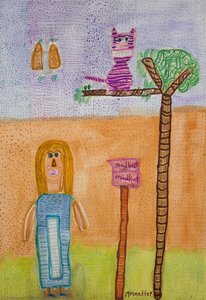 Mad Hat - Annette Galstaun
A prominent figure in the contemporary Australian art scene, Annette Galstaun has established herself as a master of modern surrealism. Born in Sydney, her practice represents the vibrant evolution of 21st-century Australian painting through its seamless fusion of nostalgic memory and whimsical imagination. Her work moves beyond mere representation, instead constructing curated dreamscapes where the terrestrial and the ethereal coexist in a state of serene enchantment.
Galstaun’s technical prowess is particularly evident in her representative work, Mad Hat. In this piece, she employs a meticulous, pointillist-inspired dotting method to build texture and light, eschewing rigid realism for a spontaneous, organic energy. The composition—featuring a serene woman in a blue gown amidst a landscape of undulating orange tones, a purple cat, and delicate birds—serves as a testament to her ability to transform a flat surface into a breathing, pulsating dimension. By blending the familiar elements of nature with the fantastical, Galstaun captures a sense of uninhibited wonder. Her ability to navigate the boundaries between the subconscious and the tangible ensures her place among the most evocative voices in the current century of Australian art.
Robert Roger Ingpen Am, Frsa
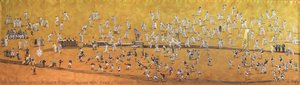 Tapestry, Melbourne Cricket Ground 150th Anniversary - Robert Roger Ingpen Am, Frsa
A viewer can immediately identify the hand of Robert Roger Ingpen AM, FRSA through his extraordinary ability to marry scientific precision with narrative whimsy. His work is characterized by a meticulous graphic clarity and a masterful command of watercolor, often capturing the intricate details of the natural world or the complexities of historical events. Whether documenting biodiversity or illustrating the wonders of childhood, his brushwork possesses a rhythmic, illustrative quality that breathes life into his subjects, using light and color to transform the microscopic or the monumental into something deeply tangible.
As a prominent figure in the 21st century Australian painters group, Ingpen’s continued influence is exemplified by his large-scale commemorative works. A significant example of his contemporary contribution is the Tapestry, Melbourne Cricket Ground 150th Anniversary, created in 2003. This complex, multi-colored work, based on his original design, weaves together a 150-year timeline of the iconic site, featuring approximately 200 individuals. His career, which began in Geelong and was shaped by his studies at RMIT under Harold Freedman, reflects a lifelong dedication to using visual storytelling as a tool for both scientific interpretation and cultural preservation.
Christine Lamson Dean
 Around 1970, Avant-Gardism became the norm in Sydney (Terry Smith) - Christine Lamson Dean
In the evocative piece Around 1970, Avant-Gardism became the norm in Sydney (Terry Smith), created in 2005, the viewer is thrust into a vibrant, pulsating landscape of contemporary abstraction. The work features a bold, saturated orange background that radiates with electric energy, serving as a stage for a rhythmic, typographic choreography. Here, words and phrases dance across the expanse, transforming the canvas into a map of historical consciousness where language and paint engage in a profound visual dialogue.
A prominent figure among 21st century Australian painters, Christine Lamson Dean has spent her career navigating the intellectual friction between late modernism and conceptual storytelling. Born in Sydney, her artistic journey was shaped by studies at the University of Sydney and Sydney Teachers College. Her practice is characterized by a unique ability to blend poetic and political elements through a sophisticated use of text and abstraction. Drawing influence from the legacies of Margo Lewers, Lyndon Dadswell, and the Hinders, Dean’s work explores the layers of memory and the philosophical foundations of modernism. Her compositions are not merely static images but dynamic experiences that bridge the gap between minimalist form and the weight of linguistic meaning.
Linda Brescia
 Skirt #7 - Linda Brescia
A defining figure in the landscape of 21st century Australian painters, Linda Brescia uses her practice to conduct a quiet revolution within the visual culture of Western Sydney. Her work moves away from grand, sweeping narratives to focus on the profound rhythms of domesticity and the often-invisible labor of women. By elevating the mundane to the level of monumental art, she challenges how society perceives the everyday experiences of the communities surrounding her.
Brescia’s technical approach creates a fascinating dialogue with art history, specifically through her use of pointillism to explore contemporary themes. This is masterfully realized in her representative work, Skirt #7. In this large-scale acrylic piece, she navigates the intersection of contemporary realism and expressive abstraction. The work, which emerged from a community engagement program with women from Kingswood, features a striking silhouette that anchors a vibrant, rhythmic background. Through the interplay of light and texture, Brescia captures a sense of presence and strength, turning a simple domestic subject into a powerful testament to identity and communal visibility.
Brook Andrew
A defining figure in 21st century Australian painting and contemporary art, Brook Andrew utilizes a multidisciplinary approach to interrogate the foundations of history and identity. His work is instantly recognizable by its complex, layered compositions that blend sculpture, video, and immersive installations to challenge colonial narratives. Andrew’s aesthetic often functions as an archaeological inquiry, sifting through visual archives to reclaim voices that have been intentionally erased from the official historical canon.
In his representative work, Hope, Hope and Peace Series (2005), the artist creates a vibrant conversation across cultures. The piece features a striking red umbrella set against a joyous, colorful pattern, elevating a mundane object into a potent symbol of resilience and protection. Scattered textual fragments drift through the composition, requiring the viewer to actively participate in reassembling the narrative. This interplay of decorative exuberance and intellectual depth allows Andrew to transform scattered symbols into a powerful declaration of enduring spirit. His practice, shaped by studies at the University of Western Sydney, the University of Denmark, and the University of Melbourne, remains a vital force in the contemporary Australian art landscape, bridging the gap between Western historical structures and Indigenous perspectives."
Nonggirrnga Marawili
 Baratjala - Nonggirrnga Marawili
In the luminous tapestry of Baratjala, created in 2019, the profound spiritual depth of Yolngu cosmology is rendered with breathtaking clarity. This work exemplifies the mastery of Nonggirrnga Marawili, a significant figure among 21st century Australian painters whose practice bridged ancient ancestral wisdom with contemporary expression. Marawili’s art is characterized by a rhythmic, almost ritualistic application of color, where vibrant red circles pulse across the canvas like a visual heartbeat, suggesting sacred sites and the interconnectedness of life.
Born in the coastal region of Darrpirra, Marawili’s aesthetic was forged through a nomadic upbringing and a deep immersion in the traditions of the Djapu clan. Rather than relying on literal representation, she utilized a sophisticated visual language to communicate the essence of her heritage. Her technique, often developed in collaboration with her husband, Djutadjuta Mununggurr, revitalized traditional bark painting sensibilities for a modern era. Her palette and use of elemental motifs—such as the life-giving tree seen in Baratjala—reflect a lifetime of observing the subtle nuances of the natural world. Through her work, the rhythms of Arnhem Land are preserved, ensuring that the complex kinship ties and ancestral journeys of the Yolngu people remain vibrantly present in the contemporary art landscape.
Conclusion
The diverse voices of these 21st century Australian painters represent a profound evolution in contemporary art, bridging the gap between ancient cultural narratives and modern visual languages. From the intricate storytelling of Nonggirrnga Marawili to the bold, identity-driven compositions of Tony Albert, each artist contributes a unique layer to the nation's evolving aesthetic identity. Whether through the light-drenched landscapes or the complex social commentaries found in their works, these creators have redefined what it means to capture the spirit of the Australian continent in the current century.
At Mus3ums.com, we celebrate this vibrant artistic legacy by offering more than just images. We invite you to bring these powerful perspectives into your own space through our museum-quality, hand-painted oil reproductions. Each piece is meticulously crafted by our skilled artists on 100% cotton canvas, ensuring that the texture, brushwork, and emotional depth of these modern masters are preserved for your home or collection. Explore our full collection to find a masterpiece that resonates with your personal style.


