

Introduction
The decade of the 2010s in the United States marked a profound period of artistic interrogation, where the boundaries between traditional medium and digital innovation became increasingly porous. As the nation navigated rapid technological shifts and evolving social dialogues, American artists responded by blending classical techniques with contemporary conceptualism. This era was defined by a restless energy, moving from the visceral, tactile explorations of identity to the high-tech, immersive landscapes of video and digital media.
Culturally, these works emerged from a landscape of intense introspection. Artists began to use their canvases and installations to address the complexities of the human condition, often blending the personal with the political. Whether through the lens of social justice, the exploration of memory, or the deconstruction of urban spaces, the art of this period reflects a society in transition, seeking to find meaning amidst a deluge of digital information and shifting cultural paradigms.
Today, these pieces remain vital because they capture a specific, transformative moment in modern history. They serve as visual records of a decade that redefined how we perceive reality, identity, and the role of the artist in a hyper-connected world. By examining these works, we gain insight into the foundational aesthetics that continue to influence contemporary practice.
The following selection showcases a diverse array of voices from this era, ranging from the profound digital meditations of Bill Viola to the evocative, culturally resonant works of Ayana V. Jackson and Theaster Gates Jr., offering a curated glimpse into the multifaceted spirit of American creativity during the 2010s.
Wild As The Wind - Ayana V. Jackson
 Wild As The Wind - Ayana V. Jackson
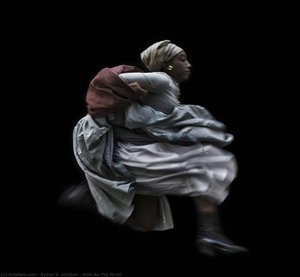
Created in 2015, Wild As The Wind stands as a profound testament to Ayana V. Jackson’s exploration of African identity and the diaspora through the lens of performance and portraiture. This work is a quintessential example of American art from the 2010s, capturing a moment of intense, cinematic movement within a void of absolute black. The subject, a woman caught in a blur of transit, carries the physical weight of a suitcase and handbag, her form tracing lines of speed through a grayscale world.
The composition is defined by a striking tension between the organic curves of the body and the rigid, rectangular shapes of her luggage. A vibrant red scarf, wrapped around her neck and head, serves as the sole splash of color, acting as a defiant focal point against the monochrome shadows. Captured from a slightly low angle, the figure appears imposing and powerful, her flowing dress trailing behind her like a memory in motion. Through this masterful use of motion blur and directional light, Jackson transforms a simple act of travel into a dramatic, metaphorical journey of resilience and strength.
Sergeant John Basilone, USMC – Guadalcanal, Solomon Islands - Colonel Charles H. Waterhouse, Usmcr
 Sergeant John Basilone, USMC – Guadalcanal, Solomon Islands - Colonel Charles H. Waterhouse, Usmcr
Created in 2010, this large-scale work by Colonel Charles H. Waterhouse, Usmcr serves as a poignant chapter in American art of the 2010s, utilizing a romantic realism to bridge the gap between historical record and visceral experience. The painting commemorates the legacy of Sergeant John Basilone, a Medal of Honor recipient, amidst the grueling landscape of the Solomon Islands. As a veteran himself, Waterhouse imbues the canvas with a directness that transcends mere depiction, capturing the heavy, humid atmosphere of the Pacific campaign.
The composition is anchored by a group of at least thirteen soldiers gathered around a mound of earth, their forms defined by the rigid lines of rifles and the weight of military gear. The artist employs a dramatic palette, where shades of Phthalo Green and the grit of the soil ground the viewer in the immediate tension of combat. Through careful placement of figures and the sharp detail of weaponry, the work captures a moment of stillness before the storm, reflecting the profound sacrifices made during World War II. It is a dramatic, sensory exploration of duty and the physical reality of the battlefield.
The Trial\n\nThe Trial - Bill Viola
 The Trial\n\nThe Trial - Bill Viola
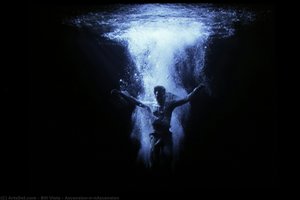
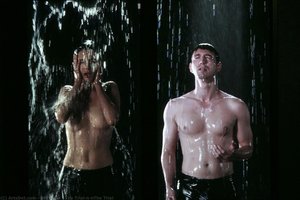
In this 2015 video work, Bill Viola utilizes a split-screen composition to explore the visceral, sensory nature of human interaction. The piece captures a communal social gathering where the primary medium of engagement is the physical sensation of water being sprayed. On either side of the frame, two individuals dressed in black clothing react to the sudden impact of the water, creating a powerful visual symmetry. The dark tones of the subjects' attire provide a stark, dramatic contrast to the clarity and movement of the water droplets, emphasizing the immediate physical experience of the participants.
As a significant contribution to American art of the 2010s, The Trial demonstrates how contemporary video technology can be used to elevate everyday social moments into profound meditations on consciousness and presence. By isolating individual reactions within a shared event, Viola bridges the gap between the personal and the communal. The work’s palette, dominated by deep tones and the translucent quality of water, reflects a sophisticated approach to new media, focusing on the elemental forces that define the human condition.
Great Hornbill - Jane Kim
 Great Hornbill - Jane Kim
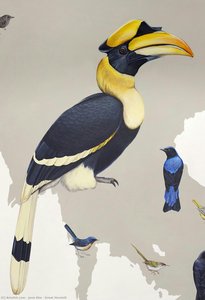
Jane Kim’s 2015 work, Great Hornbill, serves as a striking example of American contemporary realism from the 2010s, a decade where artists increasingly utilized their craft to address global environmental narratives. Executed in acrylic on canvas, this piece transcends simple wildlife depiction by placing the majestic bird atop a stylized map of the globe, creating a powerful visual dialogue regarding biodiversity and conservation.
Kim’s technical approach demonstrates a sophisticated balance between scientific illustration and impressionistic movement. She renders the hornbill’s distinctive yellow beak and intricate feather textures with remarkable precision, yet employs looser, atmospheric brushstrokes to breathe life into the composition. The palette is anchored by earthy browns and yellows, evoking the rich, organic tones of a forest habitat. By surrounding the central figure with smaller birds in flight, Kim adds a sense of dynamic depth to the scene. This meticulous attention to anatomical detail, paired with a serene emotional tone, highlights the era's trend of blending high-fidelity observation with passionate advocacy for the natural world.
Random Act Delphinium Sketch, Andrea LaHue - Andrea Lahue
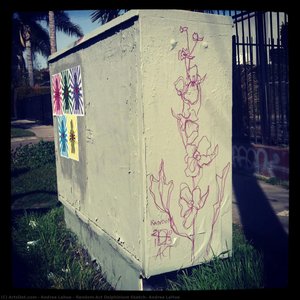 Random Act Delphinium Sketch, Andrea LaHue - Andrea Lahue
Created in 2013, Random Act Delphinium Sketch, Andrea LaHue serves as a poignant example of the urban-botanical dialogue prevalent in American contemporary art of the 2010s. Andrea LaHue, widely recognized by her moniker Random Act, utilizes this piece to explore the intersection of industrial grit and organic vitality. The composition centers on a heavy, textured concrete box, its gray surface transformed by the vibrant, chaotic language of street-style graffiti. This man-made vessel, scarred by colorful markings, acts as a stage for a quiet rebellion against urban monotony.
The work thrives on a profound sense of contrast. Surrounding the weathered container, the delicate, living presence of potted plants introduces soft, biomorphic forms that challenge the rigid, utilitarian edges of the city. Empty benches sit in the periphery, suggesting a space for stillness and social connection amidst the movement of the street. Through a soft, even luminance, LaHue captures a fleeting moment where beauty is found not in a curated gallery, but in the unexpected pockets of a concrete jungle. This 2013 sketch exemplifies the decade's fascination with finding joy and spontaneous life within the structured environments of modern American life."
Gone Are the Days of Shelter and Martyr - Theaster Gates Jr.
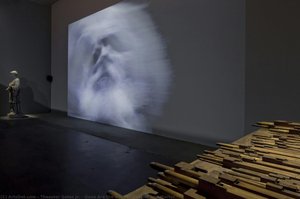 Gone Are the Days of Shelter and Martyr - Theaster Gates Jr.
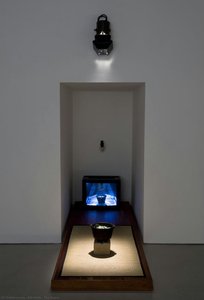
Upon first encounter, Gone Are the Days of Shelter and Martyr presents a raw, geological landscape of fractured materiality. Rather than traditional pigment on canvas, the viewer is met with a substantial construction of concrete fragments, salvaged from the demolished St. Laurence Catholic Church in Chicago’s South Side. This work functions as a concrete requiem, where the artist meticulously stacks and arranges the debris to create a textured, uneven surface that speaks to physical and historical instability. Integrated into this somber, espresso-toned assembly are original artifacts: a weathered bell, fragments of organ pipes, and a portion of a statue of St. Laurence, all serving as tangible anchors to a lost ritual space.
Created in 2014, this piece is a quintessential example of American artworks of the 2010s, reflecting the decade's profound engagement with contemporary spatial practice and urban decay. By transforming the remnants of a community's vital institution into a monumental installation, the artist explores the intersection of Black culture, memory, and the preservation of social archives through a dramatic, nostalgic lens.
The Arcadia Spider - Luke Alexander Taylor
 The Arcadia Spider - Luke Alexander Taylor
Created in 2017, The Arcadia Spider serves as a profound visual document of communal celebration, capturing a fleeting moment of high energy during a music festival. Luke Alexander Taylor utilizes a wide-angle perspective to compress depth, effectively unifying the dense, expectant crowd in the foreground with the monumental, illuminated stage in the midground. This compositional choice emphasizes the sheer scale of the gathering, transforming a singular event into a shared, immersive experience.
The work is defined by a high-contrast interplay between artificial stage lighting and the explosive, radiating trajectories of pyrotechnics. These diagonal lines of light cut through the darkness, creating a dynamic tension against the organic, irregular forms of the spectators' raised hands. The visual impact is further heightened by the contrast in textures, where the smooth, luminous surfaces of the light bursts meet the grainy, tactile quality of the crowd. Through this lens, Taylor captures the essence of the 2010s contemporary photographic movement, focusing on the intensity of live performance and the electric atmosphere of collective joy.
The Struggle Begins Before School (From the - L. Kasimu Harris
 The Struggle Begins Before School (From the - L. Kasimu Harris
Created in 2018, The Struggle Begins Before School (From the) stands as a poignant representative of American contemporary photography from the 2010s. The work is a product of the disciplined, investigative eye of New Orleans-based artist L. Kasimu Harris, whose background in journalism allows him to function as a visual ethnographer of the American South. This piece exemplifies the decade's movement toward documenting underrepresented narratives and the ephemeral textures of community life.
This black and white photograph captures a quiet, communal moment within the interior of a bus, a setting that occupies the majority of the frame. Harris utilizes the composition to highlight a shared experience of transit; passengers are scattered from the front to the shadowed depths of the vehicle, engaged in conversation or quiet reflection. The image serves as a reflective study of social connection, preserving a fleeting instance of human togetherness amidst the movement of the vehicle. Through his lens, Harris reveals the soul of the South, transforming a mundane transit scene into a profound testament to the resilience and interconnectedness of the people inhabiting the Louisiana landscape.
Self Portrait with Friends - David Choe
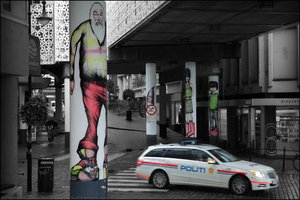 Self Portrait with Friends - David Choe
Created in 2013, Self Portrait with Friends serves as a striking testament to the raw, kinetic energy that defined much of the American urban art movement during the 2010s. David Choe, an artist celebrated for his provocative explorations of urban culture and his signature "dirty style," utilizes the city itself as a living canvas. This work is a collision of worlds, where the grit of the street meets the intentionality of fine art through a spontaneous application of spray paint.
The composition is characterized by a stylized, almost cartoonish figurative approach that rejects polished perfection in favor of unrefined, expressive life. In this specific piece, the artist’s hand moves with a restless urgency, leaving traces of rapid movement across the urban landscape. The visual impact is heightened by a dramatic use of selective color; while the surrounding architecture and street elements exist in a grayscale documentary style, the central figure erupts in vibrant red. This technique creates a powerful tension between the mundane reality of the city and the impulsive, glowing energy of the mural, marking a significant moment in Choe's career as he transforms functional infrastructure into a site of sudden, expressive narrative.
Gunnery Sergeant Robert H. McCard, USMC - Island of Saipan, Marianas Islands - Colonel Charles H. Waterhouse, Usmcr
 Gunnery Sergeant Robert H. McCard, USMC - Island of Saipan, Marianas Islands - Colonel Charles H. Waterhouse, Usmcr
Created in 2010, this significant work by Colonel Charles H. Waterhouse, Usmcr serves as a profound historical tribute within the American contemporary realism movement. The painting commemorates Medal of Honor recipient Gunnery Sergeant Robert H. McCard, USMC, during the pivotal Battle of Saipan in June 1944. As an artist who served with the 5th Marine Division during the Pacific campaign, Waterhouse imbues the canvas with a lived perspective, grounding the dramatic scene in the authentic realities of Marine Corps service.
The composition is characterized by a somber and intense atmosphere, capturing at least thirteen soldiers in uniform amidst a moment of purposeful movement. These figures, some wielding weapons, are arranged to emphasize the collective nature of combat. A heavy tank positioned toward the center-left provides a mechanical counterpoint to the human presence, anchoring the scene within the rugged landscape of the Marianas Islands. Through a palette dominated by gray tones, the artist captures the grit and camaraderie of the era, offering a window into the high-stakes environment of the Second World War. This piece is held in the permanent collection of the National Museum of the Marine Corps.
Conclusion
The diverse expressions found within this collection of American works from the 2010s reveal a decade defined by profound social inquiry and technical evolution. From the conceptual depth of Bill Viola to the vibrant, textured narratives of David Choe and Ayana V. Jackson, these artists collectively pushed the boundaries of medium and message, capturing a unique cultural zeitgeist through both digital innovation and traditional mastery. Each piece serves as a testament to the era's complexity, offering a window into the evolving American identity through varied lenses of abstraction, portraiture, and multimedia storytelling.
For those looking to integrate these powerful aesthetics into their own environments, Mus3ums.com offers a way to bring these historical moments into your home. We specialize in museum-quality, hand-painted oil reproductions that capture the true essence, texture, and soul of these masterpieces. Whether you are a seasoned collector or looking for a statement piece for your interior decor, you can explore our full collection and find the perfect work to live with for generations.