
Introduction
The dawn of the twentieth century in France marked a seismic shift in the visual language of the world, as the traditional boundaries of representation began to dissolve. Between 1900 and 1909, the ateliers of Paris became crucibles of radical thought, where the light-drenched serenity of Impressionism met the structured geometry of a new era. This decade was defined by a restless spirit of experimentation, as artists moved away from mere observation toward the expression of internal emotion and the fundamental essence of form.
During these years, the cultural landscape of France was undergoing a profound transformation, fueled by the rapid pace of modernity and a desire to capture the fleeting nature of contemporary life. The works produced in this period represent the bridge between the classical traditions of the past and the fragmented, vibrant energy of the avant-garde. From the rhythmic, color-driven compositions of Fauvism to the structural inquiries that would eventually lead to Cubism, the art of this decade challenged every established norm of perspective and color theory.
These masterpieces remain vital today because they capture the very moment when art learned to speak a modern language. They offer a window into a period of intense intellectual and sensory awakening, providing a visual roadmap for the evolution of modernism. By studying these canvases, we witness the birth of the concepts that continue to define contemporary aesthetics. The following selection highlights ten significant works from this transformative decade, showcasing the diverse paths taken by the masters who redefined the possibilities of the brush and the canvas.
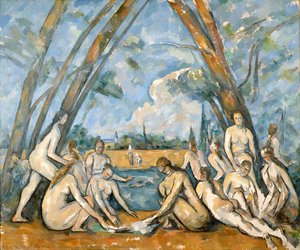
Large Bathers (Philadelphia) - Paul Cézanne
 Large Bathers (Philadelphia) - Paul Cézanne
Completed in 1905, Large Bathers (Philadelphia) stands as a monumental achievement of the first decade of the 1900s, marking a definitive shift in the trajectory of French art. This ambitious work, which Paul Cézanne worked on for several years, serves as a bridge between the fleeting light of Impressionism and the structured, geometric foundations of the coming Cubist revolution. As a quintessential example of Post-Impressionism from this era, it moves beyond mere observation to seek a deeper, more permanent order within nature.
The composition features thirteen nude female figures integrated into a woodland setting, arranged near a body of water. Rather than focusing on individual identity or mythological narrative, Cézanne treats the figures as archetypal elements that exist in total harmony with the landscape. His technique is characterized by:
- Constructive Brushstrokes: Small, deliberate applications of paint that build up planes of color to create structural depth.
- Geometric Simplification: A reduction of organic forms into essential shapes, emphasizing the underlying architecture of the scene.
- Spatial Flattening: A rejection of traditional perspective in favor of a layered, two-dimensional arrangement that challenges the viewer's perception of depth.
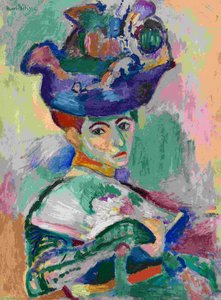
Woman with a Hat - Henri Matisse
 Woman with a Hat - Henri Matisse
Painted in 1905, Woman with a Hat stands as a definitive masterpiece of the 1900s, marking a radical departure from traditional portraiture. This work features Amélie Matisse and serves as a quintessential example of Fauvism, a movement that emerged from the French avant-garde to challenge the very foundations of color theory. Matisse’s approach during this decade focused on emotional intensity rather than realistic likeness, utilizing a vibrant, non-naturalistic palette that shocked the contemporary art world.
The technique is characterized by expressive brushwork and thick impasto, where paint is applied in gestural, energetic strokes to create a tactile, textured surface. Instead of relying on traditional perspective, Matisse flattens the space, defining forms through bold color shifts and simplified shapes. The subject's elaborate, feathered hat becomes a focal point of chromatic energy, while the swirling application of pigment conveys a sense of spontaneity and movement. By prioritizing subjective experience and the raw power of color, this painting encapsulates the transformative spirit of French art at the dawn of the twentieth century.
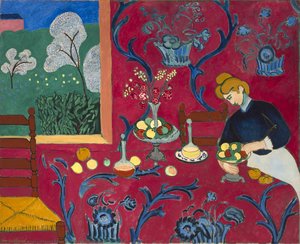
Harmony in Red - Henri Matisse
 Harmony in Red - Henri Matisse
Upon first glance, the eye is immediately arrested by a vibrant, saturated expanse of red that dominates the composition, creating an intense and immersive atmosphere. This 1908 masterpiece by Henri Matisse depicts a woman seated at a table, engaged in the quiet, domestic act of peeling fruit. The scene is characterized by a deliberate flattening of perspective and a rejection of traditional shading, replacing realistic depth with a complex interplay of geometric shapes and organic curves. The composition is divided into distinct zones, where the foreground fruit and the midground table anchor a space that feels both intimate and slightly surreal.
As a seminal work from the 1900s, this painting marks a pivotal transition in French art, moving from the foundations of Post-Impressionism toward the radical expressive power of Fauvism. By prioritizing non-naturalistic color and bold, simplified forms over photographic realism, Matisse redefined the visual language of the decade. The work captures the essence of early modernism, using intense color to evoke an emotional, reflective response rather than a mere imitation of reality.
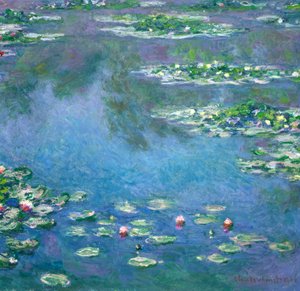
Water Lilies - Claude Monet
 Water Lilies - Claude Monet
Claude Monet’s 1906 Water Lilies stands as a profound testament to the French Impressionist movement during the first decade of the 1900s. This work captures the essence of the artist's beloved Giverny sanctuary, moving beyond mere representation to evoke a dreamlike, tranquil atmosphere. By focusing on the interplay of light and reflection on the water's surface, Monet exemplifies the era's shift toward capturing sensory impressions and the fleeting nature of time.
The technique is defined by a masterful use of impasto, where thick, visible brushstrokes create a tactile, luminous quality on the canvas. His palette is a sophisticated symphony of cool tones, ranging from deep indigo and cerulean to soft emerald and sage, which represent the depths of the pond and the sky's reflection. These cool hues are punctuated by delicate accents of pink and white from the lilies, while subtle hints of yellow suggest the presence of diffused sunlight. Through flattened perspective and organic, blurred shapes, the composition invites the viewer to lose themselves in a serene, aquatic ecosystem where the boundary between water and sky becomes beautifully indistinct.
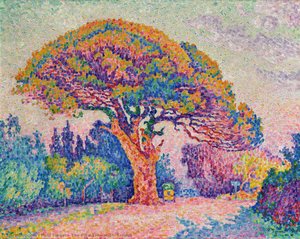
The Pine Tree at St. Tropez - Paul Signac
 The Pine Tree at St. Tropez - Paul Signac
Upon first glance, the eye is immediately captured by the shimmering, rhythmic dance of color that defines this landscape. A majestic pine tree dominates the composition, its expansive canopy rendered through a meticulous application of dense, vibrant dots. This technique creates a textured surface that seems to glow with an internal light, evoking the serene atmosphere of the Mediterranean coast. The palette is intensely layered, utilizing optical mixing to allow the viewer's eye to blend hues, resulting in a luminous effect that transcends traditional brushwork.
As a quintessential work from 1909, this painting serves as a profound example of French art from the 1900s. It represents the peak of Neo-Impressionism, a movement where artists moved beyond the initial experiments of the previous century to achieve a sophisticated mastery of color theory. By prioritizing the scientific arrangement of pure pigment over realistic depth, the work reflects the era's fascination with the intersection of light, optics, and the natural world, cementing its place within the transformative landscape of early 20th-century French modernism.
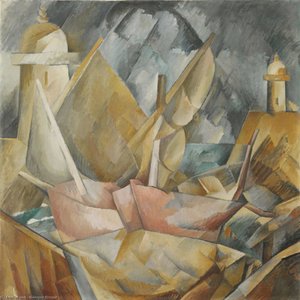
Harbor in Normandy - Georges Braque
 Harbor in Normandy - Georges Braque
Georges Braque's 1909 work, Harbor in Normandy, stands as a pivotal milestone in the evolution of French art during the 1900s. This piece captures a transformative moment in the artist's career as he transitioned from the vibrant, emotive language of Fauvism toward the structural rigor of Cubism. By breaking down the traditional maritime landscape into a complex arrangement of fragmented geometric forms, Braque challenged the long-standing conventions of perspective that had dominated Western art for centuries.
The composition utilizes overlapping planes and sharp, intersecting lines to depict sailboats, a lighthouse, and coastal architecture from multiple viewpoints simultaneously. Rather than relying on realistic depth, Braque creates a sense of space through the rhythmic layering of shapes. The palette is characterized by a sophisticated interplay of driftwood tones and warm hues, evoking the diffused light of a coastal setting. Through a masterful application of oil paint, the artist achieves a textured, tactile surface where visible brushstrokes emphasize the physical presence of the medium. This work exemplifies the radical shift in French modernism, where the essence of a subject is found through abstraction and structural analysis rather than mere imitation.
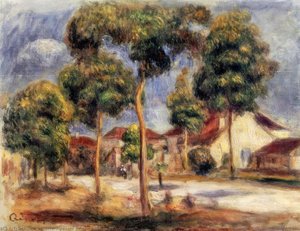
The Sunny Street - Pierre-Auguste Renoir
 The Sunny Street - Pierre-Auguste Renoir
Upon first glance, the eye is immediately drawn to the vibrant interplay of light and foliage in The Sunny Street. The composition is anchored by a central grouping of towering trees, their swirling, organic forms rendered with expressive, broken brushstrokes that suggest constant movement. These trees create a dynamic visual path, guiding the viewer's gaze toward the simplified forms of buildings and barely discernible figures in the background. The scene is bathed in a bright, diffused light that captures a fleeting moment of warmth, utilizing a rich palette of earthy greens, soft blues, and warm oranges to evoke a sense of nostalgic tranquility.
This work is a quintessential representative of French art from the 1900s, marking a period where the principles of Impressionism continued to evolve. Created in 1900, the painting demonstrates the era's mastery of atmospheric perspective and the "broken color" technique. By prioritizing the sensory impression of a rural French street over precise, rigid detail, Renoir captures the essence of the turn of the century, blending the soft edges of Impressionism with the textured, tactile energy of Post-Impressionism.
Irises in Monet's Garden - Claude Monet
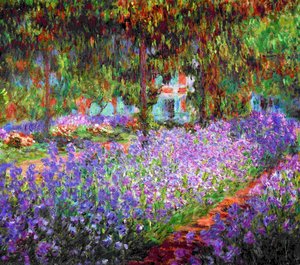 Irises in Monet's Garden - Claude Monet
Painted in 1900, Irises in Monet's Garden serves as a profound testament to the Impressionist movement's evolution at the turn of the century. This work belongs to the 1900s as it captures the artist's mature fascination with the shifting light and botanical abundance of his Giverny estate. Rather than focusing on rigid botanical accuracy, the composition prioritizes the emotional immersion in nature, utilizing a layered and somewhat flattened perspective that emphasizes atmosphere over linear recession.
The foreground is dominated by dense masses of purple and blue irises, rendered with an abundance of texture. Through the use of impasto, the artist applies thick layers of oil paint, creating a tactile surface that suggests movement and luminosity. The brushwork is loose and broken, employing optical mixing to capture the ephemeral quality of light on a hazy, overcast day. In the background, soft foliage and a distant structure emerge from the vibrant chaos, providing a sense of depth through color variation rather than precise outlines. This approach reflects the decade's preoccupation with capturing the fleeting, sensory experience of the natural world.
Chateau Noir - Paul Cézanne
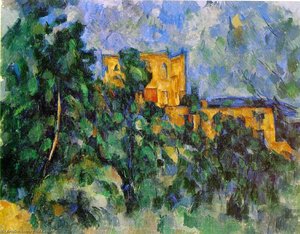 Chateau Noir - Paul Cézanne
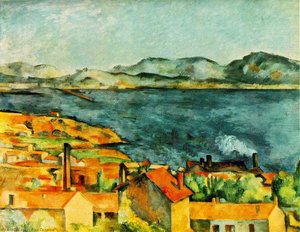
Painted in 1904, Chateau Noir serves as a profound testament to the evolution of French art during the first decade of the 1900s. As a quintessential work of the Post-Impressionist movement, this landscape captures a villa nestled within the lush, vibrant greenery of the Provençal countryside. Rather than adhering to traditional linear perspective, the composition utilizes a flattened perspective, where depth is articulated through the strategic modulation of color and form. This approach was central to the artistic shifts occurring in France at the turn of the century, moving away from mere observation toward a more subjective, structural interpretation of reality.
Cézanne’s technique is characterized by bold, constructive brushstrokes that build layers of pigment, creating a tactile, textured surface. The palette is a dynamic interplay of warm yellows and oranges in the architecture against the deep forest greens of the foliage and the cool blues of the sky. Through these gestural lines and simplified shapes, the work prioritizes the essence of the landscape, capturing a sense of stability and vitality that defines the era's departure from pure Impressionism.
The Football players - Henri Rousseau
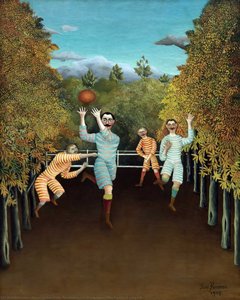 The Football players - Henri Rousseau
Created in 1908, The Football Players serves as a quintessential example of the Naïve art movement that emerged in France during the first decade of the 1900s. Henri Rousseau, a seminal figure of this era, departs from traditional academic realism to embrace a dreamlike, stylized perspective. The work depicts a group of men engaged in a spirited game of football, yet the scene feels untethered from strict reality, leaning instead toward a sense of Symbolism and Post-Impressionism.
Rousseau’s distinctive technique is characterized by flattened perspectives and simplified, rounded forms that evoke a sense of youthful exuberance and innocence. The composition utilizes bold, expressive lines and a palette dominated by blues and yellows to capture a moment of spontaneous camaraderie. By prioritizing emotional sincerity and a folk-art aesthetic over anatomical precision, the painting reflects the broader early 20th-century shift toward capturing the essence of human connection and play. The exaggerated facial expressions and dynamic poses transform a simple sporting match into a vibrant, nostalgic celebration of leisure and vitality.
Conclusion
The dawn of the twentieth century in France marked a profound metamorphosis in the visual language of art, as seen through the diverse lenses of these ten masterpieces. From the structural foundations laid by Cézanne to the vibrant, emotive color palettes of Matisse and the atmospheric light of Monet, this decade served as the crucible for modernism. Each work represents a departure from tradition, whether through the rhythmic brushstrokes of Neo-Impressionism or the radical simplification of form that would eventually pave the way for Cubism. These artists did not merely capture the world; they reimagined it, offering a spectrum of perspectives that continue to influence how we perceive light, color, and emotion today.
For those looking to bring this transformative era into their own living spaces, Mus3ums.com offers a way to experience these historical milestones intimately. Our artisans specialize in creating museum-quality, hand-painted oil reproductions that capture the tactile essence and soul of these iconic works. Whether you are a seasoned collector or looking for a statement piece for your home, you can explore our full collection and invite the timeless elegance of French modernism into your daily life through our bespoke, fine-art craftsmanship.