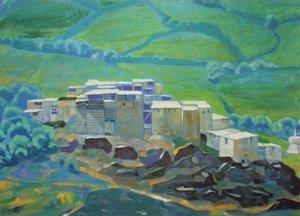
Lahaul. Kardang.
 Olej na płótnie
- Sztuka ścienna
- Symbolism Fauvism Landscape
 1932
1932 42.0 x 58.0 cm
Lahaul. Kardang.: A Hymn to Himalayan Serenity
“Village Kardang. Lahaul.” by Nicholas Roerich (1932) stands as an arresting testament to the Symbolism movement’s fascination with spirituality and landscape—a captivating exploration of nature imbued with profound symbolic resonance. This tempera on canvas masterpiece, currently residing in the State Museum of Oriental Art in Moscow, Russia, transports viewers into a realm where earthly beauty intertwines with cosmic contemplation.- Overall Impression: The artwork presents a tranquil village nestled amidst rolling hills and rugged terrain—a masterful depiction prioritizing color and form over photographic accuracy. Dominating the composition are the buildings of Kardang, rendered in muted whites and grays that create depth through layering and overlapping shapes. Foreground rocks provide textural grounding, while distant hills shimmer with atmospheric perspective achieved through broad brushstrokes conveying movement. A stupa punctuates the right side, serving as a focal point for visual interest.
- Style & Technique: Roerich’s approach aligns squarely with Fauvism's bold chromatic palette and simplified forms—a deliberate departure from realism aimed at capturing emotional essence rather than precise representation. Thick impasto is employed in certain areas, elevating surfaces and enhancing luminosity, contrasting with smoother blended sections. The artist skillfully utilizes oil paints on canvas to achieve a rich textural surface.
- Historical Context: Painted in 1932 during Roerich’s extensive Himalayan expeditions—specifically focused on the Kardang region—the artwork reflects his deep engagement with Eastern mysticism and shamanic traditions. It embodies Roerich's belief that art could serve as a conduit for accessing universal consciousness and fostering spiritual harmony.
- Symbolism: The village itself symbolizes human settlement harmoniously integrated into the grandeur of nature, mirroring Roerich’s overarching philosophical stance. Simultaneously, the stupa represents Buddhist faith—a visual emblem of pilgrimage and enlightenment—underscoring the artwork's symbolic depth.
- Emotional Impact: “Village Kardang.” evokes a palpable sense of stillness and contemplation—drawing viewers into a meditative state reminiscent of Himalayan landscapes. The luminous color palette and expressive brushstrokes convey serenity, inviting reflection on themes of interconnectedness and timeless beauty.
Nikola Roerich (1874 – 1947)
h2>A Life Immersed in Art and Spirit Nicholas Roerich
O tym dziele
- Tytuł: Lahaul. Kardang.
- Artysta: Nikola Roerich
- Rok: 1932
- Wymiary oryginału: 42.0 x 58.0 cm
- Format: Orientacja pozioma
- Status praw autorskich: Domena publiczna
- Ruch: Symbolism Fauvism Landscape
- Technika wykonania: Sztuka ścienna
- Przeznaczenie: Akcent kolorystyczny
- Słowa kluczowe: tibetan art, russian painter, nicholas roerich
Kluczowe informacje
- Artist: Nicholas Roerich
- Title: Lahaul. Kardang.
- Subject or theme: Landscape
- Artistic style: Fauvism
- Location: State Museum of Oriental Art, Moscow
- Influences: Mysticism
- Movement: Symbolism
Kod QR