Introduction
The 18th century marked a transformative era for Swiss art, as the region's painters moved beyond local traditions to become central figures in the broader European Enlightenment. While Switzerland was not a single unified political entity at the time, its artists were deeply connected to the cultural pulses of Paris, London, and Rome. This period saw a fascinating shift from the rigid structures of the Baroque toward the grace of Rococo and the emotional depth of Neoclassicism, often characterized by a mastery of light, delicate portraiture, and a profound connection to the natural landscape.
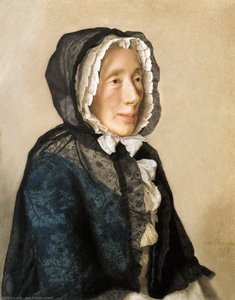
What unites these masters is their remarkable mobility and cosmopolitan spirit. Many of these artists, such as Angelica Kauffmann and Jean-Étienne Liotard, achieved international acclaim by blending Swiss precision with the stylistic elegance of the great European academies. Their work reflects a time of intellectual awakening, where the pursuit of beauty was matched by an interest in human character and the sublime power of the Alps. This era's output ranges from the intimate, textured details of porcelain-like portraiture to the grand, dramatic compositions that anticipated the Romantic movement.
Today, these painters remain vital for understanding the evolution of European visual language. Their ability to navigate diverse national styles while maintaining a distinct sense of craftsmanship provides a window into the sophisticated social hierarchies and aesthetic shifts of the 1700s. By examining their legacies, we gain insight into how a small geographic region could exert such a significant influence on the global art canon.
The following selection explores ten essential figures from this golden age, tracing the diverse paths of artists who defined the 18th-century Swiss aesthetic through their unique contributions to portraiture, landscape, and genre painting.
Henry Fuseli
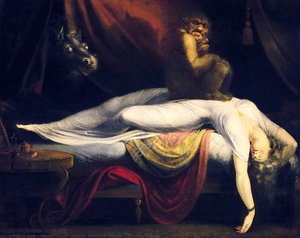 The Nightmare - Henry Fuseli
Born in Zürich in 1741, Henry Fuseli stands as a pivotal figure among 18th century Swiss painters, representing the dramatic shift toward Romanticism. His early life in a large Swiss household was steeped in art, as his father was a noted painter and writer. After a brief period serving as a pastor, Fuseli’s trajectory changed forever upon his arrival in England, where the mentorship of Sir Joshua Reynolds encouraged him to abandon his clerical path for the canvas. His subsequent years in Italy, where he adopted the more Italianized name Fuseli, allowed him to deeply study the works of Michelangelo, a fascination that would define his mature style.
Fuseli is celebrated for his ability to visualize the subconscious, often exploring themes of horror, dreams, and the sublime. His masterpiece, The Nightmare (1781), serves as a profound exploration of the inner psyche. In this work, he utilizes intense chiaroscuro and fluid, organic shapes to depict a scene of supernatural tension, featuring a sleeping woman and a shadowy incubus. Through his expressive brushwork and dramatic compositions, Fuseli bridged the gap between classical structure and the haunting emotional depths of the Romantic movement.
Angelica Kauffmann
 Diana and Her Nymphs Bathing - Angelica Kauffmann
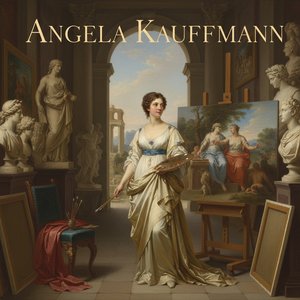
Born in Chur, Switzerland, in 1741, Angelica Kauffmann emerged as a preeminent figure of the Neoclassical movement. Her Swiss origins provided the foundation for a career that would eventually reshape the artistic landscapes of both Rome and London. A child prodigy trained by her father, Joseph Johann Kauffmann, she possessed a rare intellectual fluency that allowed her to navigate the most prestigious European academies with ease. Her work is characterized by a profound engagement with Enlightenment ideals, emphasizing clarity, order, and the grace of classical antiquity.
In her 1778 masterpiece, Diana and Her Nymphs Bathing, Kauffmann exemplifies the serene depth of the Neoclassical style. The painting depicts the goddess Diana and her nymphs in a secluded, wooded grove, gathered around a tranquil pool. Rather than focusing on heavy ornamentation, the composition relies on a balanced, triangular arrangement of figures that emphasizes a sense of communal quietude. Through soft, filtered light and a focus on graceful form, she transforms mythological narratives into moments of timeless, tranquil elegance.
- Movement: Neoclassicism
- Key Themes: Classical mythology, serene landscapes, and female grace
- Style: Clarity of form and balanced composition
Jean-Étienne Liotard
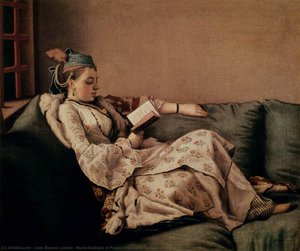
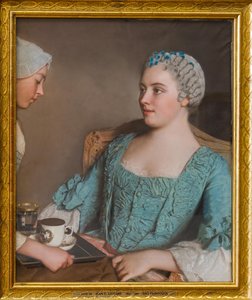
Born in Geneva in 1702, Jean-Étienne Liotard stands as a preeminent figure among 18th century Swiss painters, bridging the gap between disciplined academic training and the exotic allure of the Rococo era. His journey from the Protestant circles of Switzerland to the vibrant courts of the Ottoman Empire allowed him to develop a unique visual language that few of his contemporaries could replicate. After mastering the delicate precision of enamel and miniature painting under the guidance of Daniel Gardelle and Petitot in his homeland, Liotard’s technical dexterity became his greatest asset.
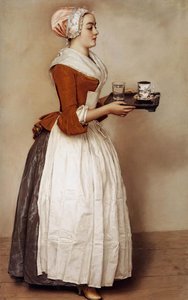
His mastery of texture and light is perhaps most elegantly captured in his 1744 work, The Chocolate Girl. This piece exemplifies the sophisticated portraiture of the period, showcasing an incredible ability to render the luminous quality of skin and the crisp, tactile folds of white fabric. Through his use of nuanced pigments, Liotard achieved a lifelike warmth that defines his legacy. Whether depicting the refined rituals of Parisian society or the intricate details of Eastern aesthetics, his work remains a testament to the technical excellence emerging from 18th century Swiss artistry.
Anton Graff
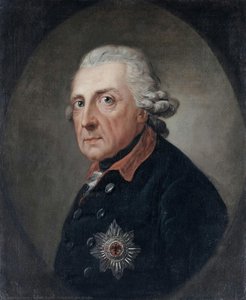 Friedrich der Große - Anton Graff
Born in Winterthur in 1736, Anton Graff stands as a preeminent figure among 18th century Swiss painters, representing the intellectual peak of the Enlightenment through his mastery of portraiture. His journey from the Swiss cantons to the royal courts of Europe was marked by a remarkable resilience; after receiving his initial training under Johann Ulrich Schellenberg, his talent was so pronounced that he had to seek mentorship with Johann Jakob Haid and Leonhard Schneider in Ansbach to escape the professional anxieties of less gifted contemporaries. This drive for excellence eventually led him to the Saxon court in Dresden, where he became the definitive chronicler of the era's greatest minds.
His technical precision and psychological depth are nowhere more evident than in his 1786 masterpiece, Friedrich der Große. In this portrait of Frederick the Great, Graff moves beyond mere likeness to capture the very essence of Prussian authority. Through a sophisticated palette of blacks, whites, and muted tones, he utilizes a three-quarter view and diffused light to highlight the king's forehead and cheekbones, creating an atmosphere of solemn, intellectual power. This ability to blend meticulous detail with a subtle, modern dynamism defines Graff's legacy as a master of the 18th-century portrait.
Georg Gsell
 Portrait of a Man - Georg Gsell
In his 1713 Portrait of a Man, Georg Gsell demonstrates a masterful command of the Baroque aesthetic, utilizing dramatic chiaroscuro to pull the subject from a void of deep shadow. The composition is defined by a striking interplay of light and texture; the luminous, powdered curls of a voluminous wig contrast sharply against the crisp white of a cravat, while a heavy cloak in ochre and deep brown suggests the luxurious sheen of silk or velvet. This ability to render tactile materiality through oil on canvas—capturing the weight of fabric and the subtle contours of the human visage—marks him as a significant figure of the era.
Born in St. Gallen, Gsell’s career exemplifies the international mobility of 18th-century Swiss painters. After studying under Antoon Schoonjans in Vienna, his journey took him through the Dutch art markets to the Russian Imperial Court. As an advisor to Tsar Peter I and a curator for the Kunstkamera, Gsell bridged the gap between fine art and scientific illustration. His legacy is defined by this dual precision, whether he was documenting the treasures of Russia's first museum or teaching the nuances of drawing at the Russian Academy of Sciences.
Jeremiah Theus
 Captain William Richardson (1743-1786) - Jeremiah Theus
Born in Chur, Switzerland, Jeremiah Theus (1716–1774) represents a fascinating bridge between European tradition and the burgeoning colonial art scene of the Americas. As a Swiss-born painter who migrated to South Carolina around 1740, he became a pivotal figure in early American portraiture, bringing the refined sensibilities of the 18th century to the bustling social circles of Charleston. His work is instantly recognizable by its masterful adaptation of English styles infused with a distinct Rococo grace, characterized by a focus on elegance, ornamentation, and a sophisticated use of pastel hues.
In his representative work, Captain William Richardson (1757), Theus demonstrates his ability to capture the dignity of the colonial elite. The portrait is a study in precision, utilizing a restrained color palette where the creamy whites of a waistcoat contrast sharply against deep blue trims. His technical skill is evident in the meticulous rendering of metallic embroidery and the soft, blended textures of the skin tones. Through directional lighting and subtle tonal variations, Theus creates an atmospheric depth that elevates a formal bust-length portrait into a profound statement of social status and character.
Jean Huber
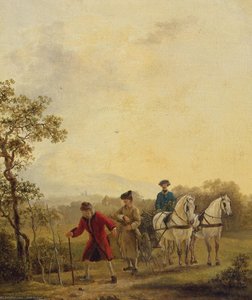 Voltaire Planting Trees - Jean Huber
Born in Geneva, Jean Huber (1721–1786) stands as a quintessential figure among 18th century Swiss painters, embodying the era's fascination with both scientific precision and Enlightenment wit. His multifaceted career saw him evolve from a disciplined observer of nature into a celebrated innovator of the silhouette portrait. Huber’s artistic identity was deeply shaped by his proximity to the intellectual elite, most notably through his friendship with the philosopher Voltaire. This connection allowed his work to transcend mere decoration, infusing his compositions with the social commentary and rationalism characteristic of the age.
His mastery is perhaps most evident in his ability to navigate between the minute details of animal studies and the grander narratives of human character. In his representative work, Voltaire Planting Trees, Huber captures a profound dialogue between man and the natural world. Through a sophisticated use of light and shadow, he depicts the philosopher engaged in the act of cultivation, transforming a pastoral scene into a visual metaphor for progress and civic virtue. Whether through his satirical caricatures or his delicate, light-drenched landscapes, Huber’s legacy remains a testament to the creative versatility of the Swiss Enlightenment.
Benjamin Samuel Bolomey
 Frederika Sophia Wilhelmina of Prussia (1751-1820), Wife of Prince Willem V - Benjamin Samuel Bolomey
Born in Lausanne in 1739, Benjamin Samuel Bolomey stands as a distinguished figure among 18th century Swiss painters, having transitioned from his Swiss roots to become a central pillar of the Dutch art scene. His career was defined by a sophisticated mastery of pastel and oil, a skill set refined under the tutelage of Joseph-Marie Vien in Paris. Bolomey’s work is instantly recognizable by its ability to balance the soft, luminous textures of Rococo aesthetics with a burgeoning Neoclassical precision, capturing both the physical likeness and the social dignity of his subjects.
A quintessential example of his talent is the 1770 portrait, Frederika Sophia Wilhelmina of Prussia (1751-1820), Wife of Prince Willem V. In this piece, Bolomey demonstrates his command over light and texture, utilizing a delicate palette to render the sheen of silk and the intricate details of lace. His ability to portray the high-society figures of The Hague—where he served as court painter to William V—makes his oeuvre a vital record of 18th-century aristocratic poise. Through subtle shading and a refined approach to skin tones, Bolomey’s portraits remain powerful studies in elegance and status.
Robert Mussard
 William V (1748-1806), Prince of Orange-Nassau, as a child - Robert Mussard
Born in Geneva in 1713, Robert Mussard stands as a distinguished representative of 18th century Swiss painters, having elevated the delicate art of portrait miniature to the highest levels of European aristocracy. His career was defined by a remarkable technical command over watercolor and gouache on vellum, a medium that allowed him to achieve a level of precision and luminous detail impossible in larger oil formats. This mastery facilitated his ascent to the prestigious position of Court Artist, serving both the Dutch elite and the French Court of Louis XV before his death in Paris in 1777.
His skill is epitomized in the 1751 work, William V (1748-1806), Prince of Orange-Nassau, as a child. In this exquisite miniature, Mussard captures the young prince with a sense of poised stillness and ethereal light. The portrait showcases the artist's ability to render intricate textures—from the gold embroidery of a reddish-orange coat to delicate lace cuffs—using the transparency of watercolor to create soft, lifelike skin tones. Through this meticulous approach, Mussard bridged the gap between his Swiss origins and the central hubs of Enlightenment-era portraiture.
Heinrich Wüest
 The Rhone Glacier - Heinrich Wüest
A master of the sublime, Heinrich Wüest (1741–1821) stands as a pivotal figure among 18th century Swiss painters, specifically for his ability to translate the rugged topography of his homeland into the language of Romanticism. Born in Zurich, his artistic evolution was shaped by formal training under Johann Balthasar Bullinger and a transformative period in the Netherlands, where the influence of the Dutch Golden Age and his mentorship under Jacob Maurer refined his technical precision. This continental exposure, including time spent in Paris, allowed him to return to Zurich with a sophisticated, elemental approach to landscape.
Wüest is instantly recognizable by his dramatic use of scale, often employing tiny figures—known as staffage—to emphasize the overwhelming magnitude of the natural world. His brushwork captures the geological weight of the Alps, moving away from structured compositions toward a more raw, atmospheric realism. His representative masterpiece, The Rhone Glacier (1775), exemplifies this vision. In this work, a mighty stream of ice spills into a valley beneath a dramatic, clouded sky, inviting the viewer to contemplate the immense power of the Alpine landscape. Through his mastery of light and shadow, Wüest captured the very essence of the Swiss wilderness during a century of profound scientific and artistic reinterpretation.
Conclusion
The 18th century was a transformative era for Swiss artistic expression, a period where the boundaries between portraiture, landscape, and the burgeoning Neoclassical movement began to blur. From the ethereal, dreamlike compositions of Henry Fuseli to the refined elegance of Angelica Kauffmann, these artists demonstrated a remarkable ability to navigate the shifting tastes of European courts while maintaining a distinct sense of identity. Whether capturing the delicate textures of silk in a Liotard portrait or the pastoral serenity of a Jean Huber landscape, these masters collectively elevated the visual language of the Enlightenment, leaving behind a legacy of technical precision and emotional depth that continues to resonate across centuries.
At Mus3ums.com, we invite you to bring this rich history into your own living space. Our artisans specialize in creating museum-quality, hand-painted oil reproductions that capture the authentic brushstrokes and tonal richness of these historical masterpieces. You can explore our full collection to find the perfect piece and experience the timeless beauty of Swiss art through a bespoke, handcrafted lens.