The Luminous World of Paolo Antonio Barbieri
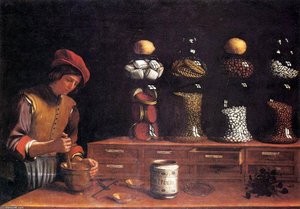
In the heart of the Italian Baroque, a period often defined by grand theatricality and sweeping mythological dramas, there existed a quieter, more intimate form of brilliance. Paolo Antonio Barbieri (1603–1649) was a master of this subtle intensity, finding profound beauty not in the heavens or ancient legends, but in the delicate textures of the natural world. Born in Cento, near Bologna, Barbieri’s artistic soul was deeply intertwined with the legacy of his elder brother, the legendary Il Guercino. Under his brother's watchful eye and mentorship, Barbieri transitioned from a student of the workshop to a singular voice in European still life painting, developing a style that married scientific precision with an almost poetic sensitivity to light.
The influence of Guercino provided Barbieri with a formidable technical foundation, particularly in the mastery of chiaroscuro. From this school, he learned to manipulate the dramatic interplay of shadow and illumination to breathe life into his subjects. However, while his brother often sought the monumental, Barbieri turned his gaze toward the "minor" genres—the meticulous study of flora, fauna, and the quiet objects of everyday existence. He possessed an extraordinary ability to capture the vivacity of color and the tactile reality of his subjects, whether it was the translucent scales of a freshly caught fish or the velvety surface of a ripening fruit. His work does not merely represent nature; it celebrates its intricate, often overlooked, complexities.
A Master of Anatomical Fidelity
Perhaps the most enduring hallmark of Barbieri’s oeuvre is his unparalleled dedication to the depiction of aquatic life. He achieved an astonishing level of anatomical fidelity that elevated fish paintings from mere decorative still lifes to profound studies of biological truth. To gaze upon a Barbieri composition is to witness the subtle shimmer of wet skin, the rhythmic patterns of fins, and the very essence of movement frozen in time. This fascination with the naturalistic was not limited to the water; his canvases frequently featured:
- Botanical Compositions: Meticulously rendered flowers and fruits that showcase a masterful command of light and organic form.
- Animal Studies: Detailed portrayals of game and insects, captured with an unwavering attention to detail.
- Atmospheric Landscapes: Occasional glimpses into the natural environment that provide context to his more intimate studies.
In many of these works, a beautiful collaboration occurred between the brothers; Guercino would occasionally contribute human figures—such as a fisherman or a gardener—to Barbieri’s compositions, adding a narrative layer to the otherwise silent, naturalistic scenes. This fusion of Guercino's dramatic figure painting with Barbieri's precise still life technique created a unique tension between the human presence and the overwhelming beauty of the wild.
Legacy and Historical Significance
Though his life was tragically cut short in Bologna at the age of forty-six, Barbieri’s impact on the evolution of the still life genre remains significant. He helped transition the genre from simple ornamentation to a respected medium capable of expressing deep observation and technical virtuosity. His ability to find monumentality in the minute allowed him to achieve considerable fame during his lifetime, with his works finding homes in prestigious collections across Italy, including Ferrara, Modena, Bologna, and even Rome.
Today, Barbieri is remembered as a painter who eschewed the theatrical for the truthful. His legacy lives on in the way we perceive the natural world—reminding us that within the scales of a fish or the petal of a flower lies a universe of light, color, and life waiting to be discovered. He remains a cornerstone of the Bolognese school, a master who proved that the smallest subjects can command the greatest artistic devotion.
Perguntas e Respostas
Por quais outros nomes Paolo Antonio Barbieri é conhecido(a)?
Paolo Antonio Barbieri também é conhecido como Paulo. Ant. Barbieri de Cento, fratello del Guercin da cento, frello del Guercin da cento.
A qual período histórico pertence a obra de Paolo Antonio Barbieri?
Paolo Antonio Barbieri atuou no período Early Modern. Este período situa a atividade do artista na história.
Em que cidade e país Paolo Antonio Barbieri nasceu?
Paolo Antonio Barbieri nasceu em Cento, em Italy.