Introduction
The Italian peninsula served as the cradle for a profound cultural rebirth, a period where the shadows of the Middle Ages gave way to a luminous era of humanism. During the Renaissance, a transformative shift occurred in how humanity perceived its place in the universe, moving from purely symbolic representations toward a deep, scientific investigation of the natural world. This movement was defined by a pursuit of proporzione, the mastery of linear perspective, and an unprecedented understanding of human anatomy, allowing artists to breathe life into the two-dimensional plane.
As the wealth of city-states like Florence and Venice fueled a new era of patronage, painters began to harmonize classical ideals with religious devotion. They sought to capture not just the physical form, but the emotional depth and psychological complexity of their subjects. This era established the foundational principles of Western art, blending the mathematical precision of geometry with the soft, atmospheric grace of light and shadow.
The legacy of these masters remains vital in the modern age, as their innovations in composition and color continue to influence how we perceive beauty and realism. To understand the evolution of visual storytelling, one must look to the pioneers who first mastered the canvas. The following selection explores the diverse brilliance of this movement, from the structural precision of Leonardo da Vinci and the harmonious grace of Raphael to the intricate, narrative-driven compositions of Domenico Ghirlandaio and the atmospheric mastery of Giovanni Bellini."
Leonardo da Vinci
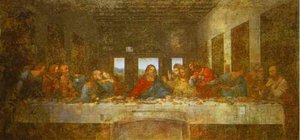
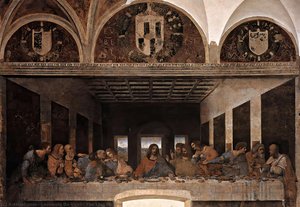
The monumental The Last Supper stands as a profound testament to the psychological depth and dramatic tension that define the High Renaissance. In this masterpiece, Leonardo da Vinci captures the electric moment of betrayal, utilizing a sophisticated understanding of human emotion to render the reactions of the apostles. His ability to weave complex narratives through gesture and expression makes him a central figure among Italian Renaissance painters, as he moved beyond mere representation to explore the very soul of his subjects.
Born in 1452 near Vinci, Leonardo’s journey from the Tuscan countryside to the vibrant workshops of Florence shaped his legendary technical precision. Under the guidance of Andrea del Verrocchio, he mastered the rigorous discipline of disegno, learning to harmonize the mechanics of anatomy with the delicate play of light across a surface. His career, marked by significant periods in both Florence and Milan under Ludovico Sforza, allowed him to pioneer experimental techniques that pushed the boundaries of artistic possibility. Through his mastery of perspective and light, he transformed the canvas into a window of profound, living reality.
Andrea Mantegna
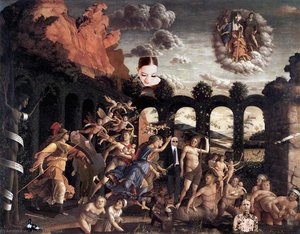 Pallas Expelling the Vices from the Garden of Virtue - Andrea Mantegna
A visitor can immediately recognize the hand of Andrea Mantegna through his sculptural precision and a profound command of linear perspective. His works are characterized by a stony, almost architectural clarity, where figures possess the weight and permanence of classical marble. This mastery of spatial illusion and anatomical rigor firmly establishes him as a central figure among Italian Renaissance painters, bridging the gap between the study of ancient antiquities and the burgeoning humanist ideals of the 15th century.
Born near Padua around 1431, Mantegna’s artistic identity was forged under the influence of Francesco Squarcione, a collector of Roman antiquities whose vast collection inspired the artist's obsession with classical forms. After establishing his own workshop in Padua by age seventeen, his career flourished through strategic ties to the Venetian Bellini lineage. His ability to manipulate depth and drama is epitomized in his 1499 fresco, Pallas Expelling the Vices from the Garden of Virtue. In this complex allegory, Mantegna utilizes a lush, detailed landscape to contrast the divine wisdom of Pallas Athena against the chaotic distress of the expelled vices, demonstrating the sophisticated narrative power that defined the era.
Giovanni Bellini
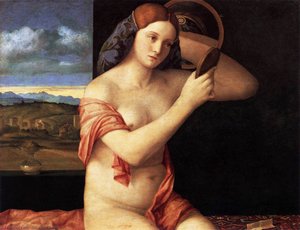 Naked Young Woman in Front of the Mirror - Giovanni Bellini
In his 1515 work, Naked Young Woman in Front of the Mirror, Giovanni Bellini explores the profound intersection of beauty and introspection. This exquisite piece serves as a testament to his ability to capture an elusive mood—a sense of quiet contemplation that transcends mere likeness. As a central figure of the Venetian Renaissance, Bellini was instrumental in transitioning the region's artistic language from the rigid traditions of the Byzantine era toward the burgeoning humanism of the 16th century. His mastery of the oil medium allowed him to move beyond the flat surfaces of his predecessors, instead building depth through meticulous glazing and layering.
Bellini’s significance within the Italian Renaissance is defined by his revolutionary use of light and color. Growing up in the creative environment of Venice, he absorbed the traditions of his family and worked closely with Gentile Bellini, eventually developing a style characterized by a luminous, atmospheric quality. His palette often utilized warm, golden tones that seem to emanate from within the canvas itself. Through his technical precision, he transformed the canvas into a window of light, making him a foundational master whose influence shaped the trajectory of Venetian art for generations.
Paolo Veronese
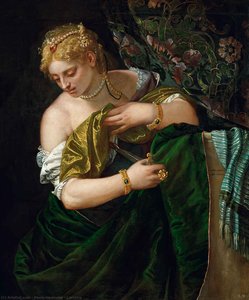 Lucretia - Paolo Veronese
Born in 1528 to a stonecutter in Verona, Paolo Veronese’s early life was shaped by the permanence and structural precision of his father's trade. This foundation in form, combined with his training under Antonio Badile and Giovanni Francesco Caroto, allowed him to evolve into a master of the Venetian school. Veronese belongs to the Italian Renaissance movement through his ability to synthesize the graceful, rhythmic lines of Raphael with the rich, atmospheric colorism of the Venetian tradition. Unlike the more austere spiritualists of his era, he transformed sacred narratives into grand, theatrical spectacles of earthly splendor.
His masterpiece, Lucretia, serves as a profound testament to this stylistic elegance. In this work, he moves beyond simple portraiture to capture a sense of regal dignity and melancholic poise. The painting exemplifies the Renaissance mastery of light and shadow, utilizing a sophisticated palette to render the textures of opulent attire and intricate jewelry. Through his meticulous brushwork, Veronese elevates the subject into a vision of nobility, proving that the Renaissance was as much about the celebration of human grandeur and material beauty as it was about classical ideals.
Luca Signorelli
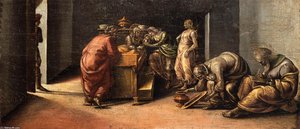 The Birth of St John the Baptist - Luca Signorelli
A central figure among Italian Renaissance painters, Luca Signorelli bridged the gap between the rigorous geometry of the early period and the dramatic dynamism of the High Renaissance. Born Luca d'Egidio di Ventura in Cortona, his artistic trajectory was profoundly shaped by a prestigious apprenticeship under Piero della Francesca, a connection facilitated by his uncle, Lazzaro Vasari. This mentorship instilled in him a mastery of perspective and anatomical precision that would become the hallmark of his career.
Signorelli’s journey saw him move through the vital artistic hubs of Arezzo, Siena, and Florence, eventually reaching Rome, where he contributed to the decoration of the Sistine Chapel. His work is defined by a sophisticated balance of classical influence and a palpable, earthy realism. In his representative masterpiece, The Birth of St John the Baptist (c. 1485-90), Signorelli demonstrates this unique ability to ground divine narratives within human experience. Through masterful foreshortening and a vibrant, celebratory composition, he transforms a sacred event into a bustling, lived-in tableau. His capacity to render the human form with both dignity and expressive vitality ensures his enduring legacy within the Italian Renaissance movement.
Pietro Perugino
 Baptism of Christ - Pietro Perugino
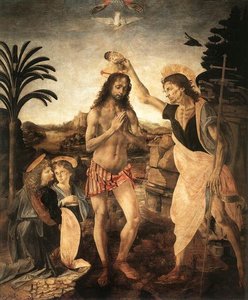
In the quiet, luminous realm of the High Renaissance, few moments capture the intersection of the earthly and the divine as gracefully as Pietro Perugino’s Baptism of Christ. This exquisite piece, dating back to approximately 1500, serves as a profound window into the spiritual serenity that defined the Umbrian school of painting. The scene unfolds along the banks of the Jordan River, where the air seems thick with sanctity and the stillness of a sacred ritual. At the heart of this composition, we witness the pivotal moment of Christ’s baptism, orchestrated by John the Baptist. Perugino, a master of clarity and balance, directs our gaze toward the central figures, whose interaction is marked by a profound, meditative peace.
As a pivotal figure of the Italian Renaissance, Pietro Vannucci—known as Le Perugino—was instrumental in bridging the gap between the early and High Renaissance styles. Having trained under the master Piero della Francesca, he absorbed a profound mastery of perspective and idealized realism. His work is characterized by luminous colors, graceful compositions, and a sensitivity to humanist ideals that influenced generations of artists. Through his meticulous study of natural forms and his ability to manipulate light, Perugino achieved a rhythmic harmony that resonates with both theological depth and aesthetic perfection.
Domenico Ghirlandaio
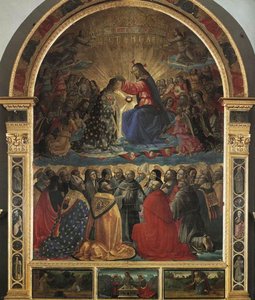 Coronation of the Virgin - Domenico Ghirlandaio
Domenico Ghirlandaio stands as a quintessential figure among Italian Renaissance painters, embodying the era's shift toward humanism and meticulous observation. Born in Florence in 1449, his nickname, which translates to "garland-maker," stems from his father's profession as a goldsmith. This early exposure to the precision of metalwork deeply influenced his painterly style, instilling a devotion to detail that would define his career. After apprenticing under Alesso Baldovinetti, Ghirlandaio became a master of the Florentine school, eventually training a young Michelangelo Buonarroti in his bustling workshop.
His contribution to the Renaissance movement is most evident in his ability to bridge the gap between the divine and the everyday. Rather than relying solely on abstract symbolism, he populated sacred narratives with recognizable contemporary Florentines, grounding spiritual events in a tangible, earthly reality. This approach is masterfully displayed in his 1483 work, Coronation of the Virgin. In this monumental composition, the celestial event is framed by a meticulously rendered Florentine streetscape, where architectural precision and vibrant color transform a theological mystery into a lived, human experience. Through such works, Ghirlandaio captured the very essence of the Florentine spirit during this transformative period.
Filippo Lippi
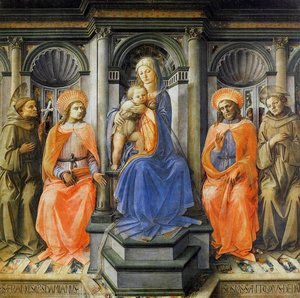 Madonna Enthroned with Saints - Filippo Lippi
Filippo Lippi stands as a pivotal figure among Italian Renaissance painters, bridging the gap between the rigid traditions of the Middle Ages and the burgeoning humanism of the Quattrocento. Born in Florence in 1406, his journey was shaped by a life of profound contradictions; orphaned early, he entered the Carmelites' convent at age eight, where his spiritual environment deeply informed his later artistic sensibility. A transformative encounter with the frescoes of Masaccio in the Brancacci Chapel redirected his trajectory, inspiring him to move beyond mere devotion toward a sophisticated naturalism.
Lippi’s contribution to the Renaissance movement is defined by his ability to infuse sacred subjects with a lyrical grace and an unprecedented emotional depth. His work moved away from the flat, stylized icons of the past, favoring instead a delicate coloring and a sense of maternal tenderness that would deeply influence later masters like Botticelli. In his 1445 masterpiece, Madonna Enthroned with Saints, this evolution is strikingly evident. The painting captures a luminous, serene majesty, presenting the Virgin Mary not as a distant deity, but as a figure of humanized, graceful presence amidst a celestial assembly. Through his innovative compositions and mastery of light, Lippi helped redefine the visual language of Florentine art.
Ludovico Mazzolino
 The Lamentation - Ludovico Mazzolino
A distinctive voice within the Ferrarese school, Ludovico Mazzolino represents a fascinating intersection of styles during the Italian Renaissance. While many of his contemporaries moved toward the serene idealism of classicism, Mazzolino carved out a unique niche by blending devotional fervor with a more expressive, almost primitive intensity. Trained in Ferrara under the guidance of Lorenzo Costa, his aesthetic was deeply shaped by the works of Ercole Roberti and the intricate detail found in German prints, allowing him to bring a unique emotional urgency to the sacred narratives of his era.
His mastery of the devotional cabinet picture is profoundly evident in his 1514 work, The Lamentation. In this piece, Mazzolino moves away from grand, distant spectacles to focus on the visceral, intimate reality of human grief. The composition centers on a tender, emotionally charged grouping of figures cradling the body of Christ, capturing a moment of profound empathy. Through expressive gestures and a rich, layered narrative, Mazzolino transforms a monumental religious event into a deeply personal experience, marking him as a vital figure for those studying the diverse emotional landscapes of the Renaissance.
Antonio Badile
 Portrait of an unknown woman - Antonio Badile
Antonio Badile represents a fascinating bridge within the Italian Renaissance, embodying the transition where the structured elegance of the Gothic tradition met the burgeoning humanism of the 16th century. Born in Verona around 1517, Badile was deeply rooted in a prestigious lineage, being the grandson of the renowned Giovanni Badile. His artistic identity was forged through rigorous training under his uncle Francesco Badile and Giovanni Francesco Caroto, eventually evolving into a style that harmonized the Veronese tradition with the sophisticated influences of masters like Paolo Veronese and Giovanni Battista Zelotti.
His ability to navigate these stylistic currents is masterfully captured in his Portrait of an unknown woman (1550). This work exemplifies the Renaissance preoccupation with dignity and material reality. Through a sophisticated use of chiaroscuro, Badile isolates the subject against a dark void, drawing the eye to the precise textures of her attire. The interplay of light on her skin and the meticulous rendering of pearls and gold jewelry demonstrate a technical precision characteristic of the era. By blending somber, dramatic tones with a formal, geometric composition, Badile showcases the profound capacity of Renaissance portraiture to capture both the physical presence and the quiet, composed essence of the individual.
Conclusion
The legacy of these masters lies in their shared pursuit of a new visual language, one that transitioned from the symbolic flatness of the Middle Ages into a profound exploration of human anatomy, mathematical perspective, and atmospheric depth. From the delicate grace of Perugino to the monumental complexity of Leonardo and the vibrant colorism of Veronese, each artist contributed a vital layer to the foundation of Western art. Whether through the precise linear perspective of Mantegna or the soft, luminous transitions of the Venetian school, these painters redefined how humanity perceives space and light.
At Mus3ums.com, we believe that such transformative beauty should not be confined to distant museums. We invite you to bring the spirit of the Italian Renaissance into your own home through our museum-quality, hand-painted oil reproductions. By choosing a piece from our full collection, you are not merely decorating a space, but welcoming a timeless dialogue between history and your contemporary living environment.