Introduction
The 1840s in France represent a profound era of transition, a decade where the rigid structures of Neoclassicism began to dissolve under the weight of Romanticism and the emerging grit of Realism. It was a period of intense cultural ferment, where the canvas became a battlefield for competing ideologies—from the dramatic, emotional surges of Eugène Delacroix to the grounded, unvarnished observations of Gustave Courbet. As the nation navigated the political upheavals of the July Monarchy, artists sought to capture not just the idealized beauty of myth, but the raw pulse of contemporary life, the majesty of the natural world, and the psychological depth of the human condition.
This decade serves as a vital bridge in art history. The works produced between 1840 and 1849 laid the essential groundwork for the Impressionist revolution that would follow later in the century. By shifting the focus toward light, texture, and the authentic experience of the viewer, these painters broke the shackles of academic tradition. Today, these masterpieces remain significant because they embody the tension between the old world and the new, offering a visual dialogue on how art can reflect both the sublime and the mundane.
In the following selection, we journey through this transformative decade, examining ten significant works that define the French spirit of the 1840s. From the sweeping landscapes of Jean-Baptiste-Camille Corot to the powerful animalier studies of Antoine-Louis Barye, these pieces illustrate the diverse paths taken by the masters who shaped the trajectory of Western art.
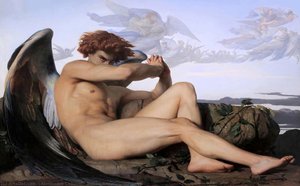
Fallen Angel - Alexandre Cabanel
The viewer is immediately arrested by the raw, visceral anguish of a solitary figure. At the center of the composition, a young angel reclines in a state of profound despair, his head buried in his hands as he grapples with an overwhelming sense of loss. This dramatic scene, characterized by a melancholic atmosphere, presents a departure from traditional depictions of evil, opting instead to focus on the intense pathos of divine suffering. The figure's musculature and the delicate texture of his wings are rendered with a sculptural precision that highlights the artist's mastery of form and light.
Completed in 1847, this work is a quintessential example of French art from the 1840s, a decade where the tension between Romanticism and Academic Realism was palpable. Alexandre Cabanel, a prominent figure in the French academic tradition, utilizes a pyramidal composition and a palette of warm ochres and deep reds to heighten the emotional intensity. By capturing such a private, vulnerable moment of mythological grief, the painting exemplifies the era's fascination with idealized beauty and the profound emotional depths of the human—and divine—condition.
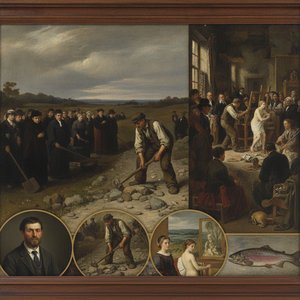
The Stone Breakers - Gustave Courbet
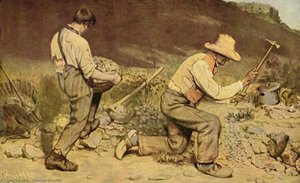 The Stone Breakers - Gustave Courbet
Upon first glance, the eye is drawn to the somber, rhythmic toil of two figures—a young boy and an older man—stripped of any romanticized veneer. They are positioned within a rugged, rocky landscape, their bodies bent under the weight of arduous manual labor. The composition utilizes strong diagonal lines and a slightly elevated perspective to create a sense of depth, while the texture of the rough stones and the worn clothing of the laborers are rendered with a tactile, heavy presence. The palette is dominated by earthy tones of ochre, brown, and muted yellow, which anchor the scene in a stark, unvarnished reality.
As a seminal work from 1849, this painting stands as a cornerstone of the French art movement of the 1840s by signaling the rise of Realism. By eschewing the traditional mythological and historical grandeur favored by the academies, the artist turned his gaze toward the working class and the dignity of everyday toil. This shift toward depicting the raw, unidealized essence of rural life marks a pivotal moment in the evolution of 19th-century French painting, challenging the viewer to confront the social realities of the era.
The Desperate Man (Self-Portrait) - Gustave Courbet
 The Desperate Man (Self-Portrait) - Gustave Courbet
Painted in 1845, The Desperate Man is a seminal self-portrait by Gustave Courbet that exemplifies the shift toward Realism within the French art scene of the 1840s. This work marks a departure from the idealized, polished aesthetics of the preceding era, opting instead to confront the viewer with the raw, unvarnished intensity of the human psyche. By capturing himself in a moment of profound psychological disquiet, Courbet moves beyond mere likeness to explore the visceral nature of emotion.
- Subject Matter: The portrait serves as an intimate psychological study, depicting Courbet with his hands pressed against his head and his gaze directed upward in a state of shock or intense anxiety.
- Style & Technique: Demonstrating the hallmarks of his Realist approach, Courbet utilizes thick impasto strokes that provide a tactile, physical presence to the canvas. This heavy application of oil paint emphasizes texture over smooth finish, rejecting theatrical grandeur in favor of a direct, honest observation of the self.
As a product of the 1840s, this piece represents the burgeoning movement of Contemporary Realism, prioritizing the truthful representation of the individual over the romanticized conventions of the time.
Plowing in the Nivernais - Rosa Bonheur
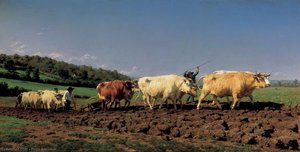 Plowing in the Nivernais - Rosa Bonheur
Painted in 1849, Plowing in the Nivernais stands as a definitive masterpiece of the 1840s, marking a pivotal moment in the career of Rosa Bonheur. This work exemplifies the Realist movement through its unflinching, honest depiction of agricultural labor, moving away from idealized pastoral scenes toward a profound meditation on the connection between humanity and the land. As a prominent figure in the 1840s French art scene, Bonheur utilized her deep understanding of animal anatomy to capture the raw power of the Charolais cattle essential to the Nivernais region.
The composition illustrates a rhythmic, almost tranquil unity between the farmer and his livestock. A line of at least twelve oxen stretches across the fertile landscape, their muscular forms rendered with remarkable tactile precision. The artist avoids mere romanticism, instead focusing on the physical exertion and the earthy textures of the soil. Through her masterful brushwork, the sheen of the animals' coats and the heavy movement of the plowing process are brought to life, cementing this work as a cornerstone of the 1840s French Realist tradition.
Bonaparte Crossing the Alps - Paul Delaroche
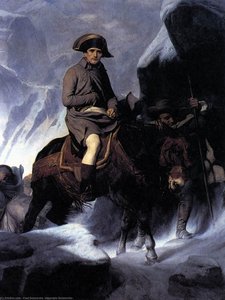 Bonaparte Crossing the Alps - Paul Delaroche
Paul Delaroche’s Bonaparte Crossing the Alps, executed in 1848, stands as a quintessential example of French art from the 1840s, a decade where the theatricality of the Romantic tradition began to merge with a burgeoning interest in meticulous realism. This work captures a pivotal moment of Napoleon Bonaparte’s military expedition through the treacherous Alpine passes, yet it eschews the hyper-idealized heroics of the Neoclassical era. Instead of a conqueror on a rearing stallion, Delaroche presents a more grounded, human figure, emphasizing the grueling reality of the journey through a pragmatic choice of subject matter.
The composition is defined by a dramatic tension that bridges the gap between Romantic emotion and Academic precision. The palette is dominated by deep, somber tones—particularly black and dark military hues—which contrast sharply against the stark, biting whites of the snow-covered mountains. This high-contrast lighting heightens the cinematic quality of the scene, drawing the eye to the central figure amidst a retinue of soldiers. Through this masterful use of light and shadow, Delaroche transforms a historical event into a profound study of human will against the overwhelming power of nature.
The Abduction of Rebecca - Eugène Delacroix
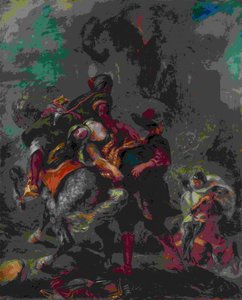 The Abduction of Rebecca - Eugène Delacroix
Completed in 1846, The Abduction of Rebecca stands as a cornerstone of French Romanticism, a movement defined by fervent emotion and dramatic storytelling. This work exemplifies the artistic output of the 1840s, a decade where Eugène Delacroix solidified his reputation as a leader of the Romantic school through his mastery of color and intense psychological depth. Inspired by the narrative of chivalry and heroism in Sir Walter Scott’s novel Ivanhoe, the painting captures the audacious abduction of Rebecca by Muslim warriors amidst the chaos of a burning castle.
Delacroix’s composition is a symphony of movement and tension. The dynamic arrangement of galloping horses and scrambling figures creates a palpable sense of urgency. His color palette is both strategic and visceral; the striking scarlet of Rebecca’s gown serves as a focal point of courage, contrasting sharply against the deep blues, greens, and smoky grays of the besieged setting. Through expressive, swirling brushstrokes and dramatic chiaroscuro, Delacroix transforms a literary scene into a high-stakes spectacle of light and shadow, embodying the very essence of the Romantic era's passion.
Christ on the Sea of Galilee - Eugène Delacroix
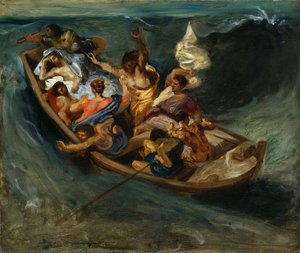 Christ on the Sea of Galilee - Eugène Delacroix
A cornerstone of French Romanticism, Eugène Delacroix’s 1841 masterpiece, Christ on the Sea of Galilee, exemplifies the decade's shift toward intense emotionality and dramatic movement. This work belongs to the 1840s through its profound departure from Neoclassical restraint, favoring instead the visceral energy of a tempestuous sea. Delacroix, a leader of the Romantic movement, utilizes a sophisticated arrangement of diagonal lines—the cresting waves and the tilting mast—to create a sense of perpetual motion that keeps the viewer’s eye in a state of restless engagement.
The composition centers on the profound contrast between human vulnerability and divine authority. Amidst the churning, dark waters and the chaos of the storm, Christ stands as a figure of stillness, providing an essential anchor for the entire work. Around him, the disciples are captured in various states of reaction, their forms reacting to the upheaval of the elements. Through his signature loose brushwork and a masterful command of color, Delacroix transforms a biblical event into a study of light and shadow, where the sudden, piercing presence of the divine pierces through the atmospheric turbulence of the natural world."
Roger and Angelica - Antoine-Louis Barye
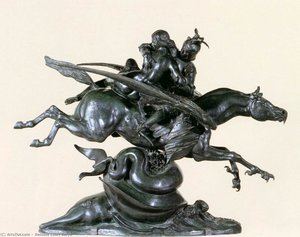 Roger and Angelica - Antoine-Louis Barye
Upon viewing this bronze masterpiece, the eye is immediately arrested by a whirlwind of kinetic energy and anatomical precision. The composition is a dramatic explosion of movement, centered on a rearing creature that blends equine power with celestial grace. Intertwined with this muscular beast are the figures of the knight Roger and the Princess Angelica, their bodies locked in a desperate, beautiful struggle that creates a labyrinth of flowing lines and tensioned sinew. The dark, aged patina of the bronze lends a sense of timelessness to the scene, highlighting the intricate textures of skin, hair, and the rugged, rock-like base upon which the drama unfolds.
Created in 1844, this work is a quintessential example of French art from the 1840s, embodying the height of the Romantic movement. Antoine-Louis Barye, a pioneer of the animalier genre, moves away from the static perfection of Neoclassicism to embrace a visceral, emotional realism. By capturing this mythological moment from Ariosto’s Orlando Furioso through such intense, sculptural dynamism, Barye exemplifies the decade's fascination with the raw, untamed forces of nature and the theatrical grandeur of epic legend.
Study for "The Destruction of Sodom" - Jean-Baptiste-Camille Corot
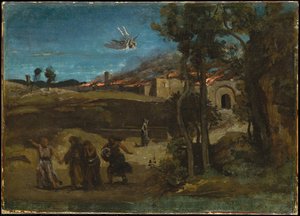 Study for "The Destruction of Sodom" - Jean-Baptiste-Camille Corot
Created in 1843, this evocative oil on canvas serves as a vital compositional study for Corot's larger work, The Destruction of Sodom. As a quintessential example of French art from the 1840s, this piece captures the era's fascination with dramatic, biblical narratives through a lens of Romanticism. The scene depicts the frantic flight of figures escaping a city consumed by fire, their silhouettes etched against a sky heavy with billowing smoke. An angel descends through the chaos, heightening the sense of divine urgency and impending doom.
Corot’s mastery of light is central to the work's emotional weight. He utilizes a sophisticated interplay of chiaroscuro and sfumato to define the volume of the fleeing figures and the atmospheric density of the smoke. The palette is dominated by deep, melancholic tones, including a striking sea green that anchors the composition amidst the fiery devastation. Through loosely dabbed strokes and a delicate handling of light, Corot transforms a moment of intense destruction into a profound study of movement and shadow, embodying the atmospheric depth characteristic of mid-19th-century French painting.
Theseus Slaying the Minotaur - Antoine-Louis Barye
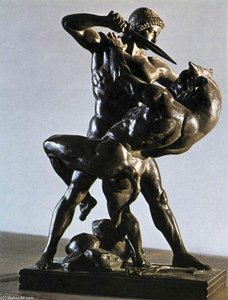 Theseus Slaying the Minotaur - Antoine-Louis Barye
The eye is immediately drawn to the violent, diagonal tension of a life-or-death struggle. In this dramatic bronze composition, the hero Theseus is locked in a ferocious embrace with the Minotaur, a moment of raw, muscular combat captured in mid-action. The sculpture emphasizes anatomical precision, from the bulging muscles of the combatants to the menacing curve of the beast's horns. The scene is set upon a rugged, rocky base, where the interplay of light and deep shadow accentuates the tactile textures of the bronze, heightening the sense of primal urgency and heroic grandeur.
This work is a quintessential representative of French art from the 1840s, a decade where the Romantic movement sought to infuse classical themes with intense emotion and movement. As a pivotal figure in the animalier movement, Antoine-Louis Barye utilized the decade's fascination with naturalism and dramatic struggle to reimagine Greek mythology. By focusing on the brutal, physical reality of the encounter between man and beast, Barye moved beyond static Neoclassicism, embodying the dynamic and powerful spirit that defined French sculptural innovation during this period.
Conclusion
The decade of the 1840s in France served as a profound crossroads where the dramatic intensity of Romanticism began to yield to the grounded, unvarnished truths of Realism. From the ethereal, atmospheric landscapes of Corot to the muscular, social observations of Courbet and the heroic animal studies of Barye, these works capture a nation in transition. Each piece contributes a unique layer to this era, whether through the meticulous academic precision of Cabanel or the sweeping, emotional narratives of Delacroix. Together, they represent a pivotal moment in art history that redefined how light, texture, and human emotion were captured on canvas.
At Mus3ums.com, we invite you to bring this transformative era into your own space. You can explore our full collection to find the piece that speaks to you. Our master artists specialize in creating museum-quality, hand-painted oil reproductions that preserve the soul, visible brushstrokes, and rich tonal depth of these 19th-century masterpieces, allowing you to live with history every day.