Introduction
The 20th century was a period of profound metamorphosis for the artistic landscape of Ukraine, a time when the cradle of Eastern European tradition collided with the radical currents of modernism. This era was defined by a tension between the deep-rooted folk aesthetics of the countryside and the avant-garde movements emerging from the urban centers of Europe. From the sweeping, psychological realism of the late 19th-century legacy to the explosive, geometric abstractions of the early 1900s, these artists navigated a world in constant flux, blending local identity with global innovation.
Throughout this century, Ukrainian painters became architects of new visual languages. They were at the forefront of movements like Suprematism and Cubism, yet they never fully severed their connection to the soulful, rhythmic patterns of traditional embroidery and the vibrant colors of regional life. This unique synthesis allowed them to contribute significantly to the evolution of international art, influencing how we perceive space, color, and form in the modern age. Their work remains vital today because it captures the struggle of the human spirit to maintain cultural continuity amidst radical political and social shifts.
The following selection explores the diverse trajectories of this movement, tracing the journey from the masterful portraiture and landscape traditions to the bold, experimental spirits who redefined the boundaries of the canvas. Through the works of ten essential figures, we witness the evolution of a visual heritage that continues to resonate across borders.
Kazimir Malevich
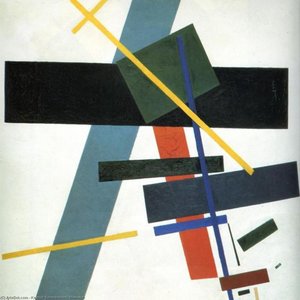
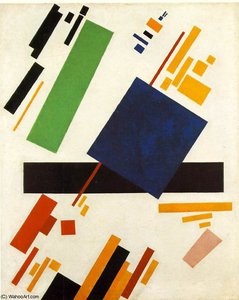 Suprematist Composition - Kazimir Malevich
Born near Kiev in the Kiev Governorate, Kazimir Malevich remains one of the most radical figures of the 20th century Ukrainian painters. His formative years were shaped by the textures of rural Ukrainian life and the folk art of the countryside, a background that provided a profound contrast to his later, starkly minimalist aesthetic. After studying drawing in Kiev, he refined his technical mastery at the Moscow School of Painting, Sculpture and Architecture, eventually moving through the stylistic realms of Impressionism, Symbolism, and Cubism.
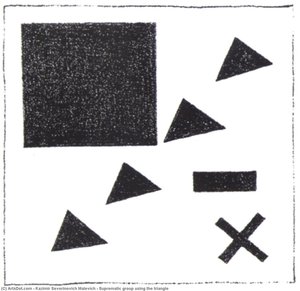
Malevich’s legacy is defined by his role as the pioneer of Suprematism, a movement that sought to liberate art from the burden of the object. His representative work, Suprematist Composition (1916), serves as a landmark of abstract art, utilizing a vocabulary of geometric shapes to prioritize pure artistic feeling over representational reality. By deconstructing the visual world into rectangles and lines, he paved the way for the non-objective art that would define the modern era. His evolution from the structural experiments of the Russian avant-garde to the absolute abstraction of his later years fundamentally altered the trajectory of global modernism.
Ilya Repin
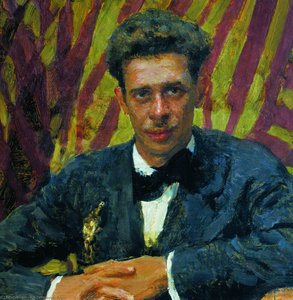 Portrait of Nikolai Remizov - Ilya Repin
A titan of realism whose influence spanned generations, Ilya Repin was born in Chuguev within the Kharkov Governorate, cementing his roots in the Ukrainian landscape. While his career reached its zenith during the transition into the 20th century, his presence in this era is defined by his profound impact on the evolution of modern realism and his ability to capture the psychological complexities of a changing world. His early training in the meticulous tradition of icon painting provided a foundation of discipline that he later translated into secular, monumental masterpieces.
His technical mastery is exemplified in the 1917 Portrait of Nikolai Remizov, a work that demonstrates his unparalleled ability to use chiaroscuro to sculpt the human form. Through subtle modeling and expressive brushwork, Repin moved beyond mere likeness to reveal the internal soul of his subjects. His commitment to portraying the realities of provincial life and the dignity of the individual allowed him to bridge the gap between traditional academic standards and the emotive, social consciousness that would characterize much of the 20th-century art emerging from the region.
Pyotr Konchalovsky
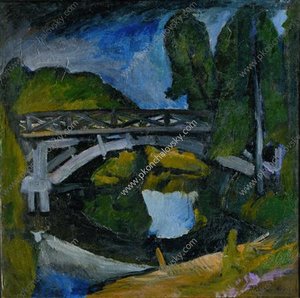 Bridge in Abramtsevo - Pyotr Konchalovsky
Born in the village of Slavianka within the Kharkov Governorate, Pyotr Konchalovsky’s artistic journey is deeply rooted in the Ukrainian landscape. His early years in this region provided a foundational connection to the soil and light that would later inform his expressive palette. His formal training was remarkably diverse, spanning the Moscow School of Painting, Sculpture and Architecture, the Académie Julian in Paris, and finally the Imperial Academy of Arts in Saint Petersburg. This international education allowed him to synthesize Western modernism with his Eastern heritage, establishing him as a pivotal figure in the 20th century Ukrainian painters movement.
Konchalovsky became a central force in the Jack of Diamonds movement, navigating the stylistic shifts from Fauvism to Socialist Realism. His 1911 masterpiece, Bridge in Abramtsevo, serves as a profound testament to his Fauvist sensibilities. In this work, he rejects mere naturalism in favor of vibrant, emotive color and energetic, loose brushwork. By prioritizing the emotional resonance of Phthalo Green and other bold hues over objective accuracy, he transformed a simple rural landscape into a powerful exploration of light and texture, securing his legacy as a master of modern color.
Hryhorii Havrylenko
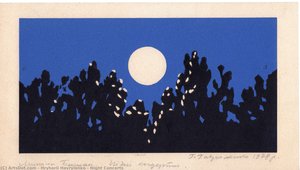 Night Concerts - Hryhorii Havrylenko
A vital force within the Ukrainian avant-garde movement of the 1960s, Hryhorii Havrylenko (1927–1984) represents the restless, experimental spirit of 20th-century Ukrainian art. His journey from the village of Kholopkove to the prestigious Kyiv Art Institute allowed him to master a dual discipline of easel painting and graphic design. This versatility enabled him to navigate the boundaries between intimate book illustrations and expansive, expressive canvases, making him a defining figure of his era.
His technical precision and mastery of light are profoundly captured in the 1978 linocut, Night Concerts. In this monochromatic work, Havrylenko utilizes the stark, rhythmic power of black and white to depict a celestial gathering. A group of silhouettes stands beneath a luminous moon, their forms etched against a nocturnal landscape that feels both communal and spiritual. Through the bold interplay of light and shadow, he achieves a tactile, textured quality that transcends the simplicity of the medium. The piece serves as a serene meditation on human connection, showcasing the sophisticated graphic strength that characterizes his contribution to the 20th-century Ukrainian aesthetic.
Zinaida Serebryakova
 Pierrot (Self portrait in the costume of Pierrot) - Zinaida Serebryakova
In her 1911 self-portrait, Pierrot (Self portrait in the costume of Pierrot), the artist captures a profound sense of theatrical melancholy and quiet introspection. Draped in oversized, pale folds of white fabric, the figure sits amidst a domestic setting, her gaze drifting toward an unseen point. The composition utilizes impressionistic brushstrokes to catch the light, creating a palpable sense of texture and weight against the earthy tones of the floor. This mastery of light and atmosphere defines her unique ability to blend realism with a delicate sense of Intimism.
Born in 1884 at the Neskuchnoye estate near Kharkov, Zinaida Serebryakova’s Ukrainian roots provided the foundation for a life steeped in creative brilliance. As a significant figure in 20th century Ukrainian painters, her work emerged from a lineage of celebrated artists and was shaped by rigorous training under masters like Ilya Repin. Her oeuvre is characterized by a striking ability to portray human emotion through both intimate scenes and formal portraits. Whether exploring the vulnerability of a persona or the simple grace of a seated pose, her paintings remain a testament to the nuanced interplay between the public mask and the private, soulful self.
David Burliuk
 Farm at Bear Mountain - David Burliuk
Born in the Ukrainian village of Semyrotivka, David Burliuk was a force of nature whose very presence challenged the artistic establishment. His mentor in Munich once famously described him as a “wonderful wild steppe horse,” a nod to the untamed energy that would define his role as a pioneer of the avant-garde. This spirited connection to his Ukrainian roots allowed him to synthesize the radical geometries of Cubism and the vibrant palettes of Fauvism with a deep fascination for Scythian art and local folklore, making him a central figure among 20th century Ukrainian painters.
His work often rejected smooth surfaces in favor of a jagged, earthy texture that felt visceral and alive. This approach is strikingly evident in Farm at Bear Mountain, a piece created around 1925 during his time in the United States. In this work, the influence of his expressive, neo-primitivist style is unmistakable, capturing a sense of structural dynamism. By blending the revolutionary spirit of Futurism with his unique cultural heritage, Burliuk transformed the visual language of the early 1900s, ensuring his legacy as a provocateur who reshaped modernism through a distinctly Ukrainian lens.
Oleksandr Aksinin
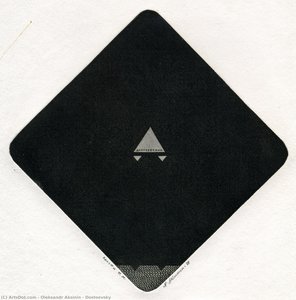 Dostoevsky - Oleksandr Aksinin
Born in Lviv in 1949, Oleksandr Aksinin stands as a profound voice among 20th century Ukrainian painters, specifically through his mastery of the intricate art of printmaking. While many of his contemporaries focused on the canvas, Aksinin carved a unique niche in the Soviet art scene by elevating etching to a level of psychological and technical sophistication. His work is defined by an almost obsessive precision, a quality that earned him the evocative title of the 'Dürer of Lviv.' He possessed a rare ability to translate the atmospheric textures of the Ukrainian landscape—from the quietude of winter scenes to the rhythmic patterns of rural life—into the delicate, biting language of acid and metal.
In his 1981 etching, Dostoevsky, we witness the pinnacle of his geometric and introspective capabilities. This work moves away from the literalism of his landscapes to explore a more abstract, structural realm. Through a sophisticated play of light and shadow, Aksinin utilizes a monochromatic palette to create a sense of volume and weight. The composition relies on the tension between form and void, using sharp, deliberate lines to suggest a profound psychological depth that mirrors the complexity of the human condition.
Louis Lozowick
 Derricks and Men (Riding the Girder) - Louis Lozowick
Born in Ludvinovka, Ukraine, in 1892, Louis Lozowick represents the profound impact of the Ukrainian diaspora on the global modern art movement. His journey from the Russian Empire to the bustling urban centers of New York and Europe allowed him to synthesize his Eastern European roots with the radical aesthetics of the West. As a defining figure of 20th-century Ukrainian painters, Lozowick moved beyond traditional landscapes to capture the rhythmic, mechanical pulse of the modern age, bridging the gap between Constructivist theory and American Precisionism.
His representative work, Derricks and Men (Riding the Girder), serves as a masterclass in this industrial aesthetic. Created in 1939, this lithograph exemplifies his ability to transform the grit of urban labor into a structured, geometric symphony. The composition is dominated by the imposing, gray skeletal framework of a crane, where sharp lines and interlocking shapes emphasize the scale of the machine. Rather than focusing on individual portraiture, Lozowick uses the figures of the workers to highlight the collective energy of the machine age. Through this lens, he translated the dynamism of the 20th century into a visual language of precision and social momentum.
Sonia Delaunay
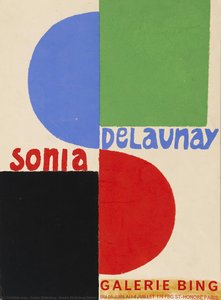 Poster for Galerie Bing, Paris - Sonia Delaunay
Born Sarah Ilinitchna Stern in the vibrant atmosphere of Kiev, Ukraine, Sonia Delaunay emerged as a monumental figure who helped redefine the boundaries of modern art. Her journey from the classical foundations of her early training to the radical frontiers of abstraction marks her as a vital contributor to the 20th century Ukrainian painters group. A visionary architect of color, she was instrumental in spearheading the Orphism movement, a revolutionary departure from traditional representation that prioritized the rhythmic energy of light and pigment over the depiction of reality.
Delaunay’s work is characterized by a multidisciplinary approach, bridging the gap between fine art and the decorative arts through her exploration of textiles and ceramics. Her signature technique, known as Simultaneism, utilizes the juxtaposition of contrasting colors to create a sense of optical vibration and movement. This is masterfully captured in her Poster for Galerie Bing, a striking graphic work that exemplifies the Orphist pursuit of chromatic harmony. Through her use of geometric precision and saturated color blocks, she transformed the visual language of the modern age, ensuring her legacy as a pioneer of abstraction.
Maria Prymachenko
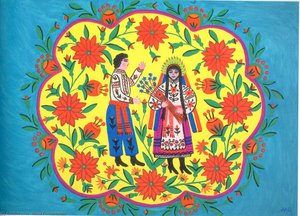 Flax Blooms and a Cossack Goes to a Girl - Maria Prymachenko
A visitor instantly recognizes the work of Maria Prymachenko by its exuberant, rhythmic energy and a color palette that seems to pulse with life. Her canvases are characterized by a sophisticated brand of Naive Art, where the boundaries between the physical world and the realm of folklore dissolve. Eschewing traditional three-dimensional perspective, she utilizes bold, graphic outlines and flat, luminous blocks of color that evoke the intricate patterns of vyshyvanka embroidery and the symbolic language of pysanky eggs. Her subjects—often whimsical animals or stylized human figures—possess an ethereal, dreamlike quality that feels both ancient and startlingly modern.
Born in 1908 in the village of Bolotnya, Prymachenko’s artistic evolution was shaped by the folk traditions passed down by her mother and grandmother. Her journey from a self-taught visionary to a central figure in 20th-century Ukrainian art was solidified through her work with the Kyiv Cooperative Embroidery Association and experimental workshops at the Kyiv Museum of Ukrainian Art. In her representative masterpiece, Flax Blooms and a Cossack Goes to a Girl (1982), she captures this essence perfectly, weaving together themes of love and heritage through a vibrant, circular floral composition that celebrates the enduring soul of her homeland.
Conclusion
The legacy of these masters reflects a profound era of transformation, where the avant-garde spirit of Malevich and Delaunay met the soulful, intimate portraiture of Serebryakova and the vibrant folk-inspired textures of Prymachenko. From the radical abstractions that redefined modernism to the deeply humanistic depictions of life and landscape, these artists collectively forged a visual language that bridged the gap between traditional heritage and the experimental energy of the 20th century. Each painter contributed a unique perspective to this rich cultural tapestry, ensuring that the artistic dialogue of the region resonated far beyond its borders.
For those looking to bring this historical depth into their own living spaces, Mus3ums.com offers the opportunity to own a piece of this movement. We specialize in creating museum-quality, hand-painted oil reproductions that capture the authentic brushstrokes and emotional weight of these iconic works. Whether you are a seasoned collector or looking for a meaningful centerpiece for your home, you can explore our full collection and choose a masterpiece that speaks to you, meticulously crafted by our professional artists on fine cotton canvas.