

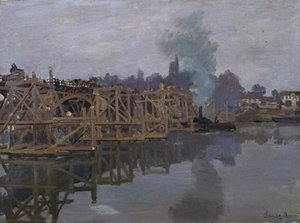


Stand here with me for a second. In front of the water lilies. Close enough that the whole thing stops being a pond and turns into what it actually is — a wall of blue and green and lilac paint shoved about with a brush by a man in his eighties who could barely see.
Now imagine a big carved gold Baroque frame around it.
Feel that? That small internal wince? That's your eye telling you something true before your brain has caught up. All that warm yellow metal, clamped round all that cool blue water, both of them shouting in different keys. It isn't wrong, exactly. It's just loud, and it's loud in a way that has nothing to do with the painting.
Now imagine the same frame — same width, same carving, same everything — in a soft patinated champagne silver.
Oh. Oh. Yes. That's it. That's the one. And it costs exactly the same.
The 30-Second Answer
Choose by palette, not by period. Warm canvases — reds, ochres, ambers, browns, harvest light, sunsets, interiors — take the antique gold. Cool canvases — blues, greys, greens, whites, pastels, water, snow, sky, seaside — take the champagne silver. Both finishes of both moulded frames cost the same: at 50 × 70 cm, H24 is $346–$353 and H36 $422–$431 whichever leaf you pick. Choose the width by size: H24 (10 cm) up to about 50 × 70, H36 (15 cm) from about 50 × 70 up to the 60 × 90 maximum. And the thing everybody repeats — "the Impressionists always used gold" — is only half true, and the half that's false is the interesting half.
The Half-Truth Everybody Repeats
Here is the received wisdom, delivered in a confident voice by someone in a framing shop: Impressionist paintings go in gold frames. That's what they used at the time.
It is not a lie. It's worse than a lie. It's a fact with the reason surgically removed.
The Paris Salon — the only game in town, the one wall that mattered — effectively required a gilt frame for a picture to be hung at all. A gold moulding wasn't a taste. It was a ticket. It was the visual equivalent of a dress code at a restaurant you can't afford to be thrown out of.
And the moment these painters got out from under it, look what they did. Degas was showing work in white frames by 1877. Pissarro went with him. By 1879–80 they were tinting frames deliberately against the canvas — choosing a colour to argue with the picture, which is about as far from "the traditional gold" as it is possible to get without setting the frame on fire.
So when someone tells you the Impressionists demanded gold, the honest reply is: they demanded getting into the exhibition. Given a free hand, half of them went the other way immediately.
Which leaves you free too. The only choice that is reliably, boringly wrong is bright new unpatinated gold — the kind that looks like it was dipped rather than aged. Both moulded profiles here are patinated: the gold sits dark in the recesses and burnished on the raised detail, and the silver is a soft champagne rather than a mirror. That's the difference between a frame that looks old and a frame that looks like it's trying.
So: Gold Or Silver? Read The Painting.
Forget the century. Forget the sofa. Look at what colour the picture actually is, from three metres away, with your eyes half shut. Whatever survives that squint is the dominant temperature, and that's your answer.
| If the painting is… | Take | Because |
|---|---|---|
| Ponds, rivers, rain, snow, winter light, grey Normandy sky, seaside, poplars against blue | H24 / H36 SILVER | Champagne silver lifts cool colour instead of competing with it. The metal and the water agree. |
| Harvest fields, sunsets, autumn, warm interiors, café light, terracotta and ochre | H24 / H36 GOLD | Warm palette, warm metal. The gold picks up the ambers already in the paint and the whole thing glows. |
| Portraits with warm flesh and dark grounds | GOLD | Traditional, and traditional is right here — the picture is a formal object and wants a formal border. |
| Architecture, cathedral façades, misty cityscapes, anything mostly stone-coloured | SILVER | Stone is cool. Silver reads as light on masonry; gold reads as an ornament stuck onto it. |
| Genuinely mixed, or you can't tell | SILVER | The champagne silver is the more forgiving of the two and sits more quietly in a modern room. Gold commits; silver accommodates. |
Two worked examples, so this isn't just theory.
Water Lilies — blue, green, lilac, a bit of pink, no warmth to speak of. Silver. Not a close call.
Impression, Sunrise — the painting that got the whole movement its name, as an insult, from a critic who thought he was being devastating. Grey-blue harbour, and then that one furious orange sun sitting in the middle of it like a dropped coin. Genuinely mixed. And here I'd still say silver, because the sun only works as a shock, and putting gold round it dilutes the one hot thing in the picture by surrounding it with more hot things.
That's the real rule, if you want one: don't repeat the painting's rarest colour in the frame. A frame's job is to hold the picture, not to join in.
What This Actually Costs, Two Independent Sellers
Let's put Monet on the wall properly. Impression, Sunrise as a hand-painted oil at 90 × 60 cm — landscape, near the top of the size window, which is exactly where these frames are happiest.
| 90 × 60 cm hand-painted oil | Mus3ums.com | WahooArt.com |
|---|---|---|
| Painting, no frame | $312 | $315 |
| + P118B (5 cm plastic) | $296 → $608 | $303 → $618 |
| + P919G (7 cm ornate gold plastic) | $324 → $636 | $331 → $646 |
| + W692G (8 cm gold wood) | $351 → $663 | $359 → $674 |
| + H24 (10 cm moulded) — gold or silver | $472 → $784 | $482 → $797 |
| + H36 (15 cm moulded) — gold or silver | $566 → $878 | $579 → $894 |
Every figure is a live quotation with the frame included. Click "gold" or "silver" on any row to open the buy page with the size and that exact finish already selected — and watch the total refuse to change.
Note the wording on those last two rows, because it's the point of this whole article: gold or silver, same price. The cost follows the profile and the finished size, not the colour of the leaf. Nobody is charging you a premium for taste. So the only thing standing between you and the right finish is you making a decision, which is free.
And at the smaller end, for scale:
| Frame | 40 × 50 cm | 50 × 70 cm | 60 × 60 cm | 90 × 60 cm |
|---|---|---|---|---|
| P919G (7 cm plastic) | $163 / $166 | $236 / $241 | $240 / $245 | $324 / $331 |
| W692G (8 cm wood) | $177 / $181 | $256 / $262 | $260 / $266 | $351 / $359 |
| H24 (10 cm moulded) | $240 / $245 | $346 / $353 | $351 / $358 | $472 / $482 |
| H36 (15 cm moulded) | $297 / $304 | $422 / $431 | $427 / $436 | $566 / $579 |
| Hand-painted oil | $209 / $212 | $255 / $258 | $258 / $261 | $312 / $315 |
Mus3ums.com / WahooArt.com, quoted live 11 August 2026.
10 cm Or 15 cm? Proportion, Not Ambition
This is where people go wrong, and they go wrong in a specific and expensive direction: they buy the bigger frame because bigger sounds better.
The frame goes around the picture. So it doesn't just add width — it adds width on all four sides, and it changes what fraction of the object on your wall is painting and what fraction is decoration.
| Painting | In H24 (10 cm) | Painting as % of area | In H36 (15 cm) | Painting as % of area |
|---|---|---|---|---|
| 40 × 50 | 60 × 70 | 48% | 70 × 80 | 36% |
| 50 × 70 | 70 × 90 | 56% | 80 × 100 | 44% |
| 60 × 90 | 80 × 110 | 61% | 90 × 120 | 50% |
Read the bold number. An H36 on a 40 × 50 painting means nearly two-thirds of what hangs on your wall is frame. That's not a picture in a frame. That's a frame that has taken a picture hostage.
So:
- 40 × 50, 50 × 40, 50 × 50 — H24. Always. No debate.
- 50 × 70, 60 × 60, 52 × 75 — either. H24 if the room is calm and modern, H36 if the painting is the whole point of the wall.
- 60 × 90, 90 × 60 — H36. This is what the 15 cm profile was designed for, and a 10 cm frame on a piece this size looks slightly under-dressed, like a big man in a jacket a size too small.
The Sizes Accepted, Precisely
Shorter side 40–60 cm. Longer side 50–90 cm. Portrait and landscape variants both made, in both finishes.
Smallest: 40 × 50. Largest: 60 × 90 or 90 × 60. A 45 × 45 falls out (long side under 50). A 70 × 70 falls out (short side over 60). A 100 × 70 falls out (long side over 90).
And yes, the portrait and landscape versions are genuinely different frames rather than the same one turned sideways. Ornament designed to travel up a tall rail behaves differently travelling along a wide one, which is precisely why a seascape gets its own version.
Where Else Can You Get This? Almost Nowhere.
I checked, because you're going to.
TOPofART won't frame a hand-painted oil at all — their FAQ says so plainly, prints only, and nothing over 71 cm regardless. That rules out every landscape format above 71 cm on the nose, which is most Impressionist subjects worth having. AllArtClassic doesn't frame as standard and directs you to a local frame shop. Reproduction Gallery hands you a list of recommended framers in New Jersey, Los Angeles and Singapore, which is charming if you live in one of those places.
Art Prints on Demand is the serious one — a real Baroque catalogue made in Italy, Austria and Germany, no plastic or aluminium, with profiles at 14.0 cm (LE ROI, LA REINE), 10.7 cm (VENIZIANO), 10.6 cm (BOTTICELLI), 9.2 cm (BAROCCO) and 4.7 cm (FRESCO). Genuinely good frames. Unique-Canvas runs a big catalogue too, with a virtual preview tool.
But both are catalogues of mouldings — profile milled by the metre, sawn at 45 degrees, joined at four corners. What you cannot easily buy anywhere on that list is a frame moulded as a single continuous run of wood and gesso at your size, with the relief turning the corner instead of being amputated by it. And critically for this article: I have not found a competitor offering a wide moulded profile in a patinated champagne silver at all. Gold, gold, gold, gloss black, gloss white. The cool-palette buyer is simply not being served.
The Verdict
If your Impressionist painting is cool — and most of the good ones are, because these people were obsessed with water, weather and light on things that aren't warm — then the silver is not a compromise or a second choice. It is the correct answer, it costs the same as the gold, and it is quietly very hard to buy anywhere else.
Pick the finish from the paint. Pick the width from the size. And then stop reading about frames and go and look at the painting, which is, after all, the only part of this that a man went blind making.
Frequently Asked Questions
Should an Impressionist painting go in gold or silver?
Let the palette decide. Warm canvases — reds, ochres, ambers, harvest and sunset light — take the antique gold. Cool canvases — blues, greys, greens, whites, pastels, water, snow, stone — take the champagne silver. If it's genuinely mixed, take silver: it accommodates, gold commits.
Did the Impressionists actually use gold frames?
Under duress. The Salon effectively required gilt for a picture to hang at all, so gold was the price of admission rather than a preference. Once they exhibited independently, Degas and Pissarro were showing in white frames from 1877 and in deliberately tinted frames by 1879–80. The one finish that's reliably wrong is bright new unpatinated gold.
Does the silver cost more than the gold?
No. Identical. At 50 × 70 cm an H24 is $346–$353 and an H36 $422–$431 in either finish, because price follows the profile and the finished size, not the leaf.
H24 or H36 — how do I choose?
By proportion. At 40 × 50, take H24: an H36 there leaves you with an object that is nearly two-thirds frame. At 60 × 90, take H36: it's what the 15 cm profile is for. At 50 × 70, either — H24 for a calm room, H36 when the painting is the point of the wall.
Are there separate portrait and landscape versions?
Yes, in both finishes and both widths. Ornament that runs up a tall rail reads differently running along a wide one, so a seascape gets a frame designed for a seascape rather than a portrait frame lying on its side.
Sources
- Live quotations and frame specifications from Mus3ums.com and WahooArt.com, read 11 August 2026.
- Degas's white frames from the 1877 Impressionist exhibition and the tinted frames of 1879–80; the Salon's effective gilt-frame requirement — standard Impressionist exhibition record.
- Monet, Impression, Sunrise, 1872, 48 × 63 cm, Musée Marmottan Monet, Paris — the painting Louis Leroy's 1874 review mocked, giving the movement its name.
- TOPofART FAQ — prints framed, hand-painted reproductions not; 71 cm maximum framed length.
- AllArtClassic FAQ; Reproduction Gallery framing services.
- Art Prints on Demand baroque frame catalogue; Unique-Canvas framing studio; Fabulous Masterpieces; MFA archival replicas.
Prices quoted live on 11 August 2026 and change with size, currency and date. Competitor terms are as published on their own sites on that date.


