A Master of the Baroque Portrait
In the grand tapestry of seventeenth-century European art, few painters captured the essence of aristocratic prestige as effectively as Anselmus van Hulle. A Flemish master born in Gent, his brush possessed a unique ability to translate the rigid hierarchies of Northern European courts into luminous, breathing portraits. His life was one of movement and high-stakes diplomacy, characterized by a career that bridged the gap between the intimate studio and the most significant political stages of his era. As a painter whose works were highly prized by the nobility, he did not merely record faces; he sculpted status through the meticulous rendering of silk, lace, and light.
The foundations of his artistry were likely laid in the prestigious traditions of the Southern Netherlands. It is believed that he may have studied under Gaspar de Crayer, a leading Baroque painter whose influence would have provided Van Hulle with the technical vocabulary necessary to navigate the complex textures of high-society portraiture. This training allowed him to master the chiaroscuro effect—the dramatic interplay of light and shadow—which became a hallmark of his work. His ability to manipulate light to create depth, particularly in the heavy folds of dark fabrics or the delicate translucency of lace, gave his subjects an undeniable presence and a sense of timelessness.
Diplomacy and the Art of Presence
Van Hulle’s career reached its zenith through his association with the highest echelons of power. Serving as the court painter to the Prince of Orange, he occupied a position of immense cultural importance. His talent was not confined to the studio; he was an artist of the moment, famously serving as one of the few portrait painters permitted to attend the peace negotiations for the Peace of Münster in 1648. This rare access allowed him to witness history unfolding, and he utilized this opportunity to cement his international reputation. By having the portraits of the various delegates engraved and published, he ensured that the faces of diplomacy were immortalized across the continent.
To manage such a monumental undertaking, Van Hulle established an expansive workshop in Münster. This industrious environment allowed him to produce both original works and high-quality copies, ensuring that the likenesses of the era's most influential figures could be disseminated widely. His work during this period was not merely about individual likeness but about creating a visual record of political legitimacy. Through his eyes, the delegates of the Peace of Münster were transformed from mere negotiators into icons of enduring historical significance.
Legacy and Artistic Significance
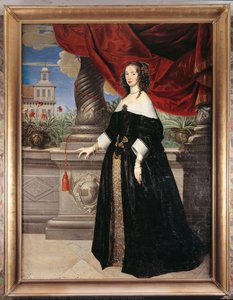
The legacy of Anselmus van Hulle resides in his ability to blend the technical rigors of the Flemish tradition with the theatrical demands of the Baroque era. His portraits, such as the exquisite depiction of The Countess Wrangel, born von Haugwitz, demonstrate a profound understanding of how material wealth and social standing could be communicated through paint. In these works, every element—from a crisp white collar to a sweeping crimson curtain—serves to ground the subject within a framework of power and permanence.
Beyond his individual paintings, his contribution to the visual history of Northern Europe remains profound. Through his workshop and his strategic use of printmaking, he helped shape the collective memory of the seventeenth century. His life, moving from the Guild of St. Luke in Gent to the courts of the Dutch Republic and the halls of international diplomacy, reflects the interconnectedness of art and politics in the Baroque age. He remains a vital figure for understanding how portraiture functioned not just as art, but as a powerful instrument of social and political identity.
Вопросы и ответы
В каком городе и стране родился(ась) Anselmus Van Hulle?
Anselmus Van Hulle родился в городе Gent, страна — Belgium.
Из какой страны Anselmus Van Hulle?
Anselmus Van Hulle родился в Belgium.
Известен ли Anselmus Van Hulle под какими-либо другими именами или псевдонимами?
Anselmus Van Hulle также известен под другими именами: Anselm Van Hulle.