A Bridge Between Worlds: The Soul of Kiyoshi Hasegawa
In the quiet intersection where Eastern tradition meets Western modernism, the life of Kiyoshi Hasegawa (1891–1980) emerges as a profound testament to artistic synthesis. Born in Yokohama, Japan, Hasegawa’s journey was one of movement and metamorphosis. While his roots were firmly planted in the soil of Japanese craftsmanship, his spirit found its true resonance in France. Moving to Paris in 1919, he embarked on a lifelong mission to bridge the aesthetic gap between the delicate sensibilities of the Orient and the bold, experimental energies of the European avant-garde. His work does not merely exist in two worlds; it creates a third, a singular space where the precision of Japanese woodblock traditions dances with the atmospheric depth of French printmaking.
Hasegawa’s early training was steeped in the classical foundations of Japanese art, studying under masters such as Fujishima Takeji, Okada Saburosuke, and Kuroda Seiki. These mentors introduced him to the nuances of Impressionism, a light-filled movement that would later inform his approach to texture and atmosphere. Yet, even as he embraced Western aesthetics, he remained deeply connected to the legacy of Edo-period masters like Hokusai. This duality is perhaps most evident in his experimentation with konshi kinzuri—the exquisite technique of gold printing on indigo-dyed paper—which allowed him to evoke the sacredness of ancient Buddhist sutras through a modern, painterly lens.
The Resurrection of Light and Shadow
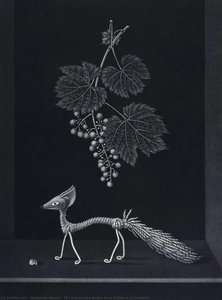
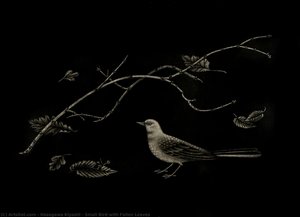
Perhaps Hasegawa’s most enduring technical achievement lies in his mastery of the mezzotint. When he arrived in Paris, the mezzotint technique was widely considered an obsolete relic of a bygone era. Driven by a tireless dedication to craftsmanship, Hasegawa undertook the strenuous effort to revive this "black manner" (*manière noire*). Unlike traditional etching, which relies on black lines drawn upon a white surface, Hasegawa’s mastery of mezzotint allowed him to work from a deep, velvety blackness toward a luminous white. He discovered a way to coax light out of the darkness, creating gradients that felt almost tactile, as if the light were rising through a soft mist.
This technical prowess extended into his wood engravings, where he found an unparalleled power in the depth of black. His ability to manipulate texture allowed him to create works that possessed a mysterious, still atmosphere—a quality that made his prints feel less like mere reproductions and more like windows into a dreamscape. Whether interpreting the fables of La Fontaine or capturing the subtle nuances of a landscape, Hasegawa utilized the contrast between deep shadows and ethereal highlights to evoke an emotional response that transcends language.
A Legacy of Innovation and Connection
Hasegawa was not merely a solitary craftsman; he was a visionary leader who understood the importance of community in the evolution of art. He played a pivotal role in establishing the Nihon Hanga Kyokai, an organization dedicated to promoting modernist printmaking, and famously spearheaded the inaugural sosaku hanga (creative printmaking) exhibition in Paris in 1934. This landmark event was a crucial moment for Japanese artists on the global stage, showcasing a movement that emphasized the artist as both designer and printer, breaking away from the traditional division of labor.
His artistic lineage is a tapestry of great influences, drawing inspiration from the whimsical dreamscapes of Chagall, the fluid lines of Dufy, and the structural boldness of Picasso. Through these connections, Hasegawa’s work became a dialogue between eras and continents. His accolades—including the Légion d’honneur and the Order of the Sacred Treasure—reflect a life spent in service to the beauty of the print. Today, his legacy remains etched in the history of modern art as a master who found the infinite within the subtle, proving that true innovation often arises from the most profound respect for tradition.