Franz Ritter von Stuck: The Last Prince of Munich’s Art
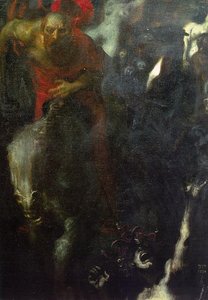
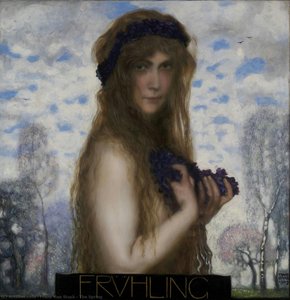
Franz Ritter von Stuck, a name that echoes through the halls of German Symbolism and Art Nouveau, was more than just an artist; he was a cultural phenomenon, a “Prince of Art” as he was affectionately known during his lifetime. Born in 1863 in the tranquil Bavarian village of Tettenweis, nestled amidst rolling hills near Passau, Stuck’s journey from a young caricature artist to a celebrated painter, sculptor, and architect is a testament to both innate talent and an unwavering commitment to artistic innovation. Initially destined for a life following his father as a forester, a path dictated by the rural traditions of his upbringing, young Franz quickly revealed an undeniable passion for drawing – a spark that would irrevocably alter the course of his destiny. This early aptitude led him to Munich, a city brimming with artistic energy and opportunity, where he first enrolled at the School of Applied Arts in 1878 and later pursued formal training at the prestigious Academy of Fine Arts from 1882-1884, absorbing the influence of Arnold Böcklin’s hauntingly beautiful mythological scenes – a formative experience that would profoundly shape his artistic vision. Stuck wasn't merely an imitator; he skillfully synthesized these influences into something uniquely his own, forging a distinctive style characterized by classical precision blended with Symbolist mystery and a profound exploration of human emotion.The Rise to Prominence: A Master of Myth and Emotion
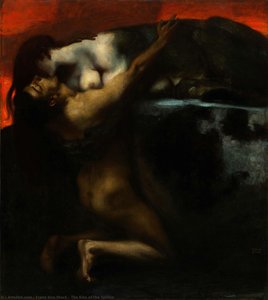
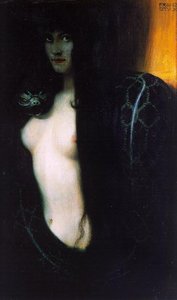
Stuck’s ascent to artistic prominence was remarkably swift and dramatic. His breakthrough arrived in 1889 with *The Guardian of Paradise*, an arresting painting exhibited at the Munich Glass Palace, instantly captivating critics and securing him a gold medal – a recognition that catapulted him into the heart of Munich's vibrant art scene. This wasn’t simply a technically proficient work; it was a declaration of artistic intent – a bold assertion of a new voice blending classical rigor with mythological subject matter and an undercurrent of Symbolist intrigue. He quickly became a central figure in challenging the conservative norms of the time, co-founding the Munich Secession in 1892 alongside like-minded artists determined to break free from the constraints of academic tradition and champion modern artistic expression. This act of rebellion coincided with his exploration into sculpture, debuting with *Athlete* (1892), a dynamic bronze figure that demonstrated his remarkable versatility as an artist. However, it was *The Sin* (1893) – a visceral depiction of temptation and moral struggle – that truly cemented his reputation as a master of Symbolist painting, captivating audiences with its dramatic intensity, psychological depth, and unsettling beauty. This period marked the full flowering of Stuck’s unique style—a potent combination of sensuality, classical form, and symbolic resonance, reflecting both his fascination with ancient myths and his exploration of the darker aspects of human nature.Themes and Influences: A World of Desire and Myth
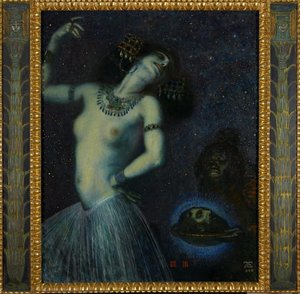
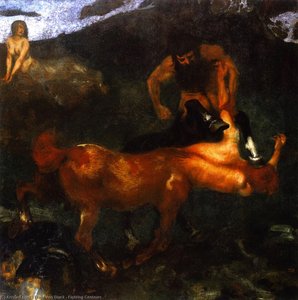
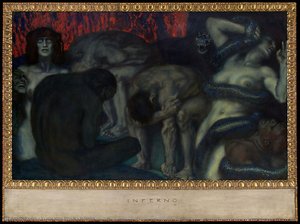
The artistic universe of Franz von Stuck is profoundly shaped by recurring motifs that reveal his deep engagement with timeless themes. Mythology served as a constant source of inspiration, drawing from Greek, Roman, and biblical narratives which he reimagined with a distinctly personal flair – transforming familiar stories into hauntingly beautiful allegories. These weren’t mere retellings; they were explorations of the human condition filtered through the lens of ancient myths, imbued with his own emotional intensity and symbolic language. Equally prominent was his fascination with sensuality and the *femme fatale*—a recurring figure in his paintings, powerfully embodied in numerous depictions of Salome – a character representing desire, danger, and moral ambiguity. These works weren’t simply about physical beauty; they delved into the psychological complexities of female power and its potential for both allure and destruction. Underlying all this was a deep reverence for classical art—evident in his meticulous technique, anatomical accuracy, and compositional rigor, influenced by artists like Arnold Böcklin and Gustave Moreau. However, Stuck wasn’t merely an imitator; he skillfully synthesized these influences into something uniquely his own, forging a distinctive style that resonated with the spirit of the age.A Knight of Art: Honors and Legacy
In 1895, Franz von Stuck took on another crucial role – that of teacher at the Munich Academy, where he became a highly respected instructor, not only imparting technical skills but also encouraging his students to explore their individual artistic visions. Among those who benefited from his guidance were luminaries such as Paul Klee, Hans Purrmann, and Josef Albers—demonstrating the breadth of his influence. His dedication to art was further recognized in 1905 when he was ennobled, becoming “Ritter von Stuck” – a testament to his growing prestige and contribution to German culture. He continued to receive accolades throughout Europe, solidifying his position as one of the leading artists of his time. His Villa Stuck in Munich, designed by himself, stands as a lasting monument to his life and work—a stunning example of Art Nouveau architecture that showcases his artistic vision and technical mastery. The villa’s interior design, furniture, and overall aesthetic reflect his deep understanding of art and its potential to transform the everyday world. Franz von Stuck died on August 30, 1928, in Munich; his funeral address memorialized him as “the last prince of art of Munich’s great days.” His legacy endures not only through his paintings and sculptures but also through the countless artists he inspired—ensuring that the spirit of Franz von Stuck continues to resonate within the art world today.Major Works and Enduring Significance
- The Guardian of Paradise (1889): A seminal work showcasing his early mastery of color, composition, and mythological themes.
- Dissonance (1893): An unsettling portrayal embodying emotional turmoil through a woman playing the violin – a powerful example of his Symbolist style.
- Salome (various versions): Perhaps his most iconic work, depicting the biblical story with striking sensuality and psychological depth, exploring themes of desire, temptation, and destruction.
- Athlete (1892): A dynamic bronze sculpture demonstrating his skill in three-dimensional form and capturing a sense of movement and power.
Вопросы и ответы
Где и в каком году родился Франц Риттер фон Штук?
Франц Риттер фон Штук родился в Теттенвей в 1863 году.
Известен ли Франц Риттер фон Штук под какими-либо другими именами или псевдонимами?
Франц Риттер фон Штук также известен под именами Франц Штук, Фрэнц Штук.
Откуда Франц Риттер фон Штук?
Франц Риттер фон Штук родился в Германия.