

Introduction
The 20th century marked a transformative era for Danish art, as the nation's creative spirit navigated the tension between profound naturalism and the radical abstractions of the modern age. Throughout this period, Danish painters were united by a unique ability to translate the specific, often melancholic light of the Nordic landscape and the intimacy of domestic life into a diverse visual language. From the quiet, atmospheric interiors that defined the turn of the century to the bold, geometric experiments of the avant-garde, these artists captured a society in transition, moving from traditional agrarian roots toward a sophisticated, modern European identity.
This era was characterized by a remarkable stylistic breadth. While some masters sought to distill the essence of color and form through Expressionism and Surrealism, others remained deeply rooted in the subtle interplay of light and shadow, creating works that resonate with a timeless, psychological depth. This duality—the pull between the tangible world and the abstract idea—is what makes their legacy so enduring. Today, their works continue to influence contemporary aesthetics, offering a masterclass in how to balance emotional intensity with technical precision.
To understand the evolution of Northern European modernism, one must look closely at the individuals who shaped it. The following selection explores ten pivotal figures, including the evocative works of Vilhelm Hammershøi, the vibrant color palettes of Emil Nolde, and the structural innovations of Richard Mortensen, each representing a vital chapter in the storied history of Danish painting.
Emil Nolde
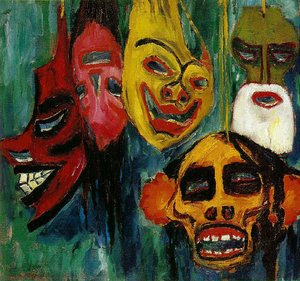
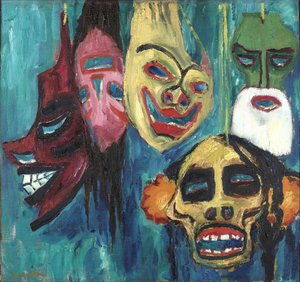 Masks - Emil Nolde
Born in 1867 in the Duchy of Schleswig to Danish and Frisian parents, Emil Nolde emerged as a transformative force in the 20th century Danish painting landscape. His journey from a rural, agrarian upbringing to the forefront of the Expressionist movement represents a profound shift from the physical labor of woodcarving to the psychological depth of fine art. As a key figure in the Die Brücke group, Nolde moved beyond mere representation, seeking to capture the primal and subjective truths of the human experience through intense, emotive color and form.
His masterpiece, Masks (1911), exemplifies this radical approach. In this work, Nolde utilizes a kaleidoscope of colors and bold, visceral brushwork to present a haunting arrangement of faces that seem to pulse with an internal, spiritual life. The composition, featuring figures that act as silent witnesses to the theatricality of the masks, creates a dreamlike space where reality and the unknown dissolve. By prioritizing the internal landscape over the external surface, Nolde secured his legacy as a vital voice among the 20th century painters from Denmark, using art to reach for the deepest recesses of the human soul.
Vilhelm Hammershøi
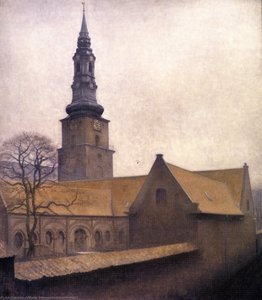 St. Peter's Church, Copenhagen - Vilhelm Hammershøi
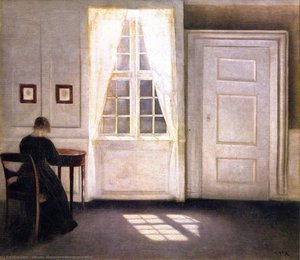
Vilhelm Hammershøi (1864–1916) stands as a profound bridge between the traditions of the 19th century and the psychological depth of 20th-century Danish art. His work is defined by an almost palpable silence, transforming domestic interiors and urban landscapes into meditative spaces of introspection. As a master of the Danish tradition, his presence in the early 20th-century canon is cemented by his unique ability to treat light not merely as illumination, but as a tangible, atmospheric substance that dictates the emotional weight of a scene.
His technical brilliance is exemplified in his 1906 work, St. Peter's Church, Copenhagen. In this oil on canvas, Hammershøi captures the quiet majesty of the city's architecture, using a muted palette of grays and soft tones to create a sense of timelessness. The composition utilizes a masterful interplay of light and shadow, where the diffused daylight highlights the textures of brick and stone while allowing deep, mysterious shadows to define the space. Through this sophisticated handling of chiaroscuro, Hammershøi moves beyond simple architectural depiction, offering instead a profound exploration of presence, absence, and the serene stillness that characterizes his enduring legacy.
Peder Mørk Mønsted
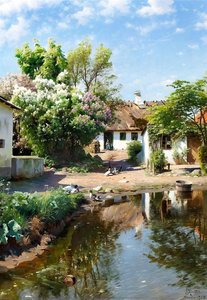 Spring day at a thatched house with blooming lilacs - Peder Mørk Mønsted
Peder Mørk Mønsted remains a cornerstone of Danish realism, a master whose career spanned the transition into the 20th century, leaving a profound impact on the era's landscape tradition. His work is defined by an unwavering dedication to meticulous observation and a sophisticated command of light that captured the very essence of the Northern spirit. Having refined his academic identity at the Royal Danish Academy of Fine Arts under masters like Niels Simonsen and Julius Exner, Mønsted developed a technical precision that allowed him to translate the subtle nuances of the Scandinavian countryside onto canvas with unparalleled clarity.
His ability to balance structural permanence with the ephemeral beauty of nature is perfectly exemplified in his 1925 masterpiece, Spring day at a thatched house with blooming lilacs. In this work, Mønsted utilizes a luminous palette to orchestrate a symphony of springtime serenity. The painting captures a pastoral idyll where dappled sunlight filters through a lush garden, casting a rhythmic play of light and shadow across a charming thatched-roof cottage. Through his legendary mastery of detail, every petal and blade of grass becomes a testament to his ability to freeze a fleeting, tranquil moment in time, securing his legacy among the most significant Danish painters of the 20th century."
Michael Ancher
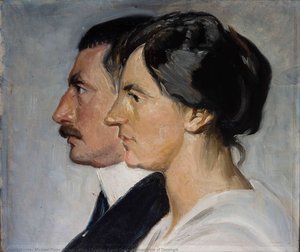 King Christian X and Queen Alexandrine of Denmark - Michael Ancher
Michael Ancher stands as a cornerstone of Danish realism, a master whose creative soul was inextricably linked to the rugged Skagen colony. His work, spanning the transition into the 20th century, captures the visceral essence of life where the Baltic and North Seas converge. Ancher’s art is defined by a profound connection to the human experience, portraying the quiet dignity of fishing communities and the unpredictable forces of the Jutland coast. His departure from the strict academic formality of the Royal Danish Academy of Art allowed him to embrace a more authentic, lived-in realism that resonated through the early 1900s.
A significant example of his ability to capture regal presence is his 1915 work, King Christian X and Queen Alexandrine of Denmark. In this portrait, Ancher moves beyond mere likeness to create a moment of intimate connection. The composition utilizes a soft, outdoor setting where the subtle interplay of light and form brings the royal couple to life, freezing a quiet, contemplative moment in time. Through his mastery of light and his dedication to the atmospheric shifts of the North, Ancher remains a vital figure among 20th century Danish painters.
Richard Mortensen
 The Fifth Posthumous Letter to Clara Jensen - Richard Mortensen
A central figure in the evolution of Danish abstraction, Richard Mortensen (1910–1993) redefined the visual language of the 20th century through a commitment to pure form. His work is instantly recognizable by its departure from representational imagery, favoring instead a rhythmic interplay of expansive color surfaces and decisive geometric structures. Influenced by the color theories of Wassily Kandinsky, Mortensen’s aesthetic is characterized by a tension between sharp, interlocking planes and sweeping curves, often defined by heavy, graphic outlines that organize the pictorial space.
Mortensen’s career was marked by his role as a founder of the Linien school in Copenhagen, a movement dedicated to liberating art from illusionism. His time in Paris during the late 1930s further expanded his horizons, introducing elements of surrealist thought into his evolving abstract style. In his 1968 masterpiece, The Fifth Posthumous Letter to Clara Jensen, this legacy is vividly realized. The work utilizes a sophisticated architecture of saturated hues—deep blues, bright yellows, and vibrant oranges—set against muted lavender backgrounds. Through these flat, decisive layers, Mortensen achieves a profound sense of balance, proving that color and shape alone can communicate complex emotional sensations.
Anna Ancher
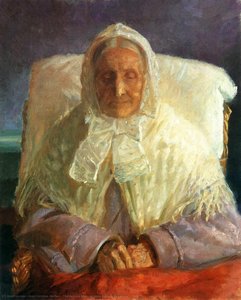 The Artist's Mother, Anna Hedvig Brøndum - Anna Ancher
A central figure in the evolution of Danish art, Anna Ancher (1859–1935) remains a cornerstone of the 20th century Danish painters group due to her profound influence on Northern Impressionism. Born in the fishing village of Skagen, she was not merely an observer of the region but a native whose identity was inextricably linked to its unique light. Her formal training at the Vilhelm Kyhn College of Painting in Copenhagen and her subsequent studies in Paris under Pierre Puvis de Chavannes allowed her to blend sophisticated French techniques with a deeply Nordic sensibility.
Her work is characterized by an exquisite sensitivity to light and the quiet dignity of domestic life. In her representative masterpiece, The Artist's Mother, Anna Hedvig Brøndum (1913), she demonstrates her mastery of capturing fleeting atmospheric sensations. Through loose, expressive brushstrokes, she avoids rigid realism to instead prioritize the diffused glow of sunlight and the subtle nuances of color within a room. This ability to translate the ephemeral qualities of light into permanent pigment ensures her enduring legacy among the most significant painters from Denmark during the 20th century."
Harald Giersing
 The Judgment of Paris - Harald Giersing
In his 1909 masterpiece, The Judgment of Paris, Harald Giersing captures a profound sense of modernist ambiguity that defines his contribution to 20th century Danish painters. This work moves beyond mere mythological storytelling, utilizing deliberate, unsettling compositions and broad, dark blue outlines to challenge traditional perspectives. Through such experimentation, Giersing emerged as a pivotal figure in the evolution of classic modernism within Denmark, helping to shift the national aesthetic toward more radical, expressive forms.
Born in Copenhagen in 1881, Giersing received his foundational training at the Royal Danish Academy of Fine Arts. His artistic journey was marked by a restless search for beauty and a desire to capture the essence of change. Influenced by the structural clarity of Paul Cézanne and the vibrant energy of the Fauvists, his style evolved from a fascination with Gauguin toward a more spontaneous, vigorous approach. Whether rendering the dramatic, cool-toned figures in his studio-like tableaux or the wild, uninhibited landscapes of Forest Path Sorø, Giersing’s work is characterized by a powerful use of color and form. His leadership in the Grønningen association further cemented his legacy as a driving force behind the innovative spirit of early 20th-century Danish art."
Harald Slott-Møller
 Paolo and Francesca - Harald Slott-Møller
A central figure in the transition toward modernism, Harald Slott-Møller represents the sophisticated evolution of 20th century Danish painters. His career, which spanned the turn of the century, was marked by a profound shift from traditional academic training to a deeply evocative Symbolist style. After studying at the Royal Danish Academy of Fine Arts under Peder Severin Krøyer, Slott-Møller moved away from naturalism toward a more decorative and psychological approach to composition.
His 1905 masterpiece, Paolo and Francesca, serves as a quintessential example of this period. In this oil on canvas, the artist moves beyond mere representation to capture a moment of eternal sorrow. The composition is defined by vertical, elongated forms that rise against a dark, cavernous background, emphasizing the emotional entanglement of the two lovers. This dramatic use of shadow and the intimate, tight embrace of the figures highlight the Symbolist preoccupation with themes of love and loss. Whether through his striking canvases or his celebrated ceramic designs for the Aluminia factory, Slott-Møller’s work remains a testament to the rich, multifaceted artistic identity of Denmark at the dawn of the 20th century.
Wilhelm Freddie
 Portrait of Richard Wagner - Wilhelm Freddie
In Portrait of Richard Wagner (1961), the canvas becomes a site of profound psychological tension. A dark, moody background swallows the space, allowing a human profile to emerge from the shadows. This organic form is intersected by the rigid, sweeping arcs of salmon-colored wooden clothes hangers, which cast subtle shadows and anchor the composition in a tangible, three-dimensional reality. The work thrives on the collision between the human contour and geometric objects, utilizing a heavy impasto technique that creates a rugged, sculptural texture across the surface.
Wilhelm Freddie (1909–1995) stands as a central figure among 20th century Danish painters due to his defiant role in the Danish avant-garde. A multifaceted creator who worked in painting, sculpture, and film, Freddie navigated the shifting currents of the twentieth century with a restless pursuit of new visual languages. His career was defined by a transition from early abstract explorations toward a provocative, realistic surrealism. Often at odds with the social and political constraints of his era, his bold explorations of the subconscious frequently led to legal challenges and the confiscation of his work. His legacy remains a testament to the power of art to challenge the status quo through complex, layered imagery.
Vilhelm Lundstrøm
 Portrait of Emil Bønnelycke - Vilhelm Lundstrøm
A central figure in the evolution of Danish modernism, Vilhelm Lundstrøm (1893–1950) redefined the visual language of 20th century Danish painters by introducing the radical geometries of French Cubism to his homeland. His work is instantly recognizable through a bold, structural approach to composition, where subjects are distilled into essential forms. Whether depicting still lifes of bottles and jugs or complex nudes, Lundstrøm utilized a sophisticated interplay of vibrant color contrasts and clear, bright lines to move beyond mere representation.
In his 1921 Portrait of Emil Bønnelycke, we see this transformative period in action. The work eschews photographic precision in favor of a heavy, tactile application of paint. The subject is anchored by a deep cobalt blue suit against a warm, ochre-toned background, utilizing a shallow perspective that pushes the figure toward the viewer. His technique is characterized by:
- Thick impasto that creates a visible, rhythmic surface texture.
- Simplified, blocky shapes that prioritize the essence of form over anatomical detail.
- Gestural lines that define the contours of the face and hands with modernist intensity.
From his studies at the Royal Danish Academy of Art to his later role as a professor, Lundstrøm’s career remains a testament to the experimental spirit of the 20th century.
Conclusion
The legacy of 20th century Danish painters is defined by a profound tension between the quiet, introspective light of the North and the bold, disruptive energy of modernism. From the atmospheric, silent interiors of Hammershøi to the vibrant, expressive color palettes of Nolde and Giersing, these artists collectively navigated the transition from traditional realism to the avant-garde. Whether through the structured abstraction of Mortensen or the evocative landscapes of Mønsted, this group of masters captured the evolving soul of a nation through shifting perspectives and innovative techniques.
At Mus3ums.com, we invite you to bring this rich Scandinavian heritage into your own living space. Our artisans specialize in creating museum-quality, hand-painted oil reproductions that preserve the tactile brushstrokes and deep tonal ranges of these iconic works. You can explore the diverse styles of this era by browsing our full collection and find the perfect masterpiece to transform your home.


