Early Life, Family and Training
Alexej von Jawlensky was born on 13 March 1864 in Torzhok, Russia. He was the fifth child born to Georgi von Jawlensky and his wife, Alexandra. His early years were marked by movement, as his family eventually moved to Moscow when he was ten years old. This change in environment was a significant part of his upbringing, shaping his perspective long before he ever picked up a brush for professional study.
His path toward art was not immediate. Before committing to a life of painting, he spent time in military training. However, a visit to the 1882 Moscow World Exposition changed his direction. The visual energy of the exhibition sparked a passion that eventually led him away from his military obligations. By 1889, he had secured a position in Saint Petersburg, which allowed him to begin formal training at the art academy. He remained a student there until 1896, balancing his studies with his remaining military duties.
During his time in Saint Petersburg, Alexej von Jawlensky came under the influence of the Russian realist painter Ilya Repin. This period of study provided him with a foundation in classical techniques before he began to move toward more experimental styles. It was also during these years that he met Marianne von Werefkin, a fellow artist who would become a significant presence in his life and career.
The Munich Years and Artistic Evolution
The move to Munich in 1894 changed everything for Jawlensky. He left behind the structured life he had known to enroll in the private school of Anton Ažbe. This was a place of experimentation, far from the rigid rules of the academies. He spent these years absorbing new ideas, moving away from the realistic training of his youth. By 1907, his path led him to work in Henri Matisse's studio, an experience that deepened his understanding of how color could function on a canvas. He was no longer interested in merely copying the world; he wanted to find a way to translate nature into something more personal.
As the years passed, Jawlensky became a central figure in the radical circles of Munich. He was a key member of the Neue Künstlervereinigung München, a group that pushed the boundaries of what art could be. His connections grew as he became involved with the Der Blaue Reiter group, working alongside other innovators who sought to express the spiritual through form. Later, his influence extended through his membership in Die Blaue Vier. Through these associations, his work shifted from lush, detailed compositions toward a more simplified and rhythmic style. He began to strip away the unnecessary, focusing on the essential shapes and colors that define his unique visual language.
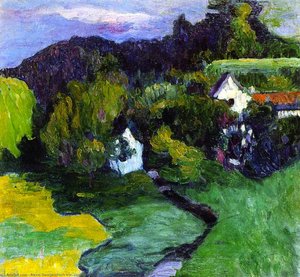
- 1908: View of Murnau Village
- 1909: The Yellow House
Technique and Artistic Style
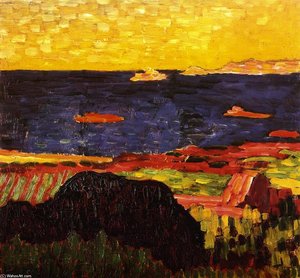
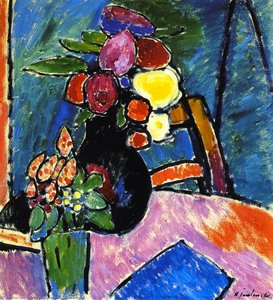
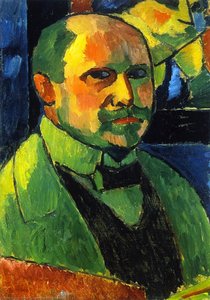
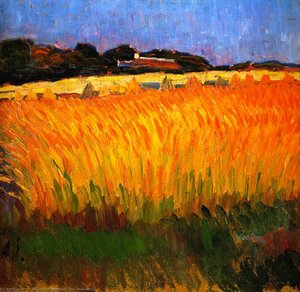
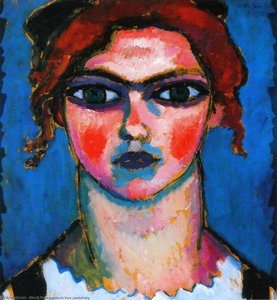
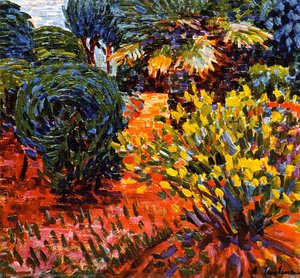
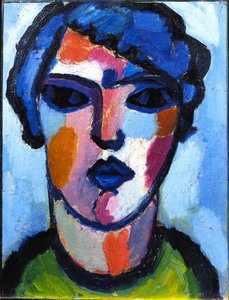
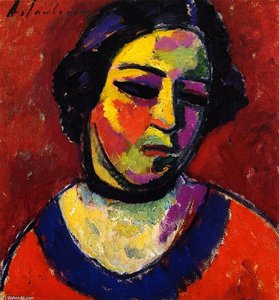
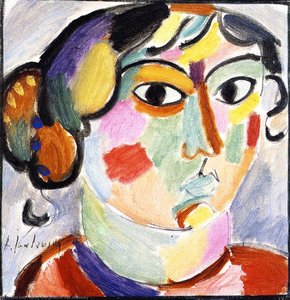
Jawlensky moved away from the strict rules of academic realism, choosing instead to prioritize the immediate emotional impact of a piece. He was less interested in replicating the physical world and more focused on capturing the essence of human experience. This led him to use intense color fields to convey what lay beneath the surface of his subjects. His brushwork was physical and direct, characterized by thick impasto and bold strokes that gave the canvas a tangible, textured presence.
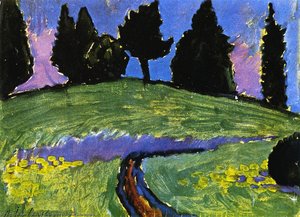
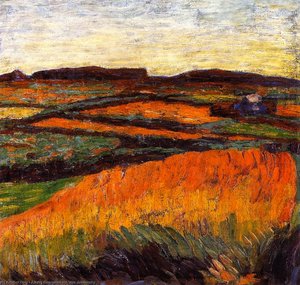
As his style evolved, his compositions became more stripped down. He often utilized flattened planes and a deliberate avoidance of traditional perspective, which pushed his work toward abstraction. In his most recognizable periods, he relied on heavy outlines and saturated hues to define his forms. This approach allowed him to distill faces and landscapes into their most fundamental elements, using color as an autonomous tool to communicate feeling rather than merely describing a scene.
- Still Life with Colored Tablecloth (1909)
- Girl with Green Face (1910)
- The Blue Mantilla (1913)
- Variation: Sound of Summer (1916)
The Mystical Heads and Meditations
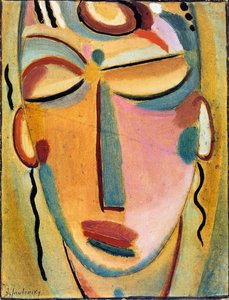
Between 1917 and 1919, Jawlensky turned his attention to a series of works known as the Mystical Heads. In these pieces, he moved away from the complexities of the physical world to focus on the essence of the human face. He stripped away unnecessary details, using simplified forms and color to reach for something deeper than a mere likeness. The faces became symbols of an inner life, stripped of the distractions of the external world.
As the years passed, his physical health began to decline, bringing significant changes to how he worked. By 1934, when he began the Meditations series, severe stiffness in his elbows and wrists made it difficult to manage large canvases. This physical struggle forced him to work in a much smaller format. Despite these limitations, his focus on the human spirit only intensified. In the Meditations, the face was reduced even further to its most fundamental elements. He worked with a sense of urgency, using color as an autonomous tool to express the emotions he could no longer capture through traditional means.
- Mystical Head: Meditation (1918)
- Mystical Head: Earth (1918)
- Variation: Sound of Summer (1916)
Later Years and Death
The onset of World War I brought sudden upheaval to his life. Because of his Russian origins, he was expelled from Germany in 1914. He sought refuge in Switzerland, a period marked by significant changes in his circumstances. During these years, he found a dedicated supporter in Emmy Scheyer, who worked to promote his work in the United States and helped secure his international recognition.
As the years passed, his physical health began to decline. Severe arthritis progressively limited his ability to paint, making the act of creation a struggle against his own body. Despite this immense physical hardship, he continued to produce art. His focus shifted toward smaller formats, such as the Meditations, which he worked on with great intensity as his strength waned. He felt the urgency of his situation, working as if possessed to leave his final visions behind for those who would follow.
He passed away on 15 March 1941 in Wiesbaden, Germany. His final years were a period of profound isolation and physical pain, yet they remained deeply connected to his search for spiritual clarity through color and form.
Legacy and Influence
Alexej von Jawlensky left behind a body of work that helped define the direction of Expressionism. His contribution to the movement was marked by a specific, inward-looking quality. Rather than focusing on the external world, his paintings often felt like a quiet, meditative reflection on the human spirit. This focus on the internal landscape allowed him to move beyond the strict rules of academic realism, finding a way to communicate through the weight of color and the simplicity of form.
His influence can be seen in how he stripped away the unnecessary to reach the essence of his subjects. By using heavy outlines and saturated hues, he created a visual language that felt both ancient and modern. This approach helped bridge the gap between traditional portraiture and the more radical, abstract frontiers of the early twentieth century. His ability to distill a face or a landscape into its most fundamental elements remains a significant part of his contribution to modern art.
Today, his presence is felt in many major museum collections across the globe. His works continue to be studied and admired for their emotional depth and their unique way of capturing the soul through color. His legacy is preserved in various institutions, ensuring that his specific vision of the world remains accessible to those who seek to understand the roots of Expressionism.
Where to See the Works Today
Finding the traces of Jawlensky's life requires traveling through several European cities where his presence remains felt. In Germany, the Museum Wiesbaden holds a significant portion of his output, with a collection of over 90 works. This large gathering offers a way to see how his focus shifted as his physical strength waned. Other important collections can be found in the Museum Ostwall in Dortmund and the Städtische Galerie im Lenbachhaus in Munich.
His reach extends beyond Europe to the United States. The Art Institute of Chicago holds his paintings, allowing viewers to encounter his specific use of color and form in a different setting. These various locations preserve the visual language he developed through years of experimentation and personal struggle.
- Still Life with Kulich (about 1905)
- Portrait of a Man (about 1912)
- The Blue Mantilla (about 1913)
- Yellow House (about 1914)
Vprašanja in odgovori
Kje in leta se je rodil/a Alexej Von Jawlensky?
Alexej Von Jawlensky se je rodil/a v mestu Toržok leta 1864.
V katerem zgodovinskem obdobju je delal/a Alexej Von Jawlensky?
Alexej Von Jawlensky je deloval v obdobju 19. stoletje. To obdobje umetnikovo dejavnost umešča v zgodovinski okvir.