


Introduction
The 20th century marked a seismic shift in the global art landscape, as the center of creative gravity moved from the traditional salons of Europe to the vibrant, bustling streets of the United States. This era was defined by a spirit of radical experimentation and a desire to capture the pulse of a rapidly modernizing world. From the quiet, evocative landscapes of the turn of the century to the explosive, chaotic energy of Abstract Expressionism, American painters spent these hundred years breaking the rules of perspective, color, and form to find a new visual language.
As the nation transitioned through industrialization, two World Wars, and the rise of consumer culture, its artists responded with diverse movements. Some sought to find beauty in the stark reality of the American landscape, while others embraced the bold, graphic aesthetics of Pop Art or the raw, emotional spontaneity of action painting. This period was not just about a change in style, but a fundamental rethinking of what a canvas could represent—moving from a window into a scene to a direct expression of the human psyche and the modern experience.
Today, these works remain vital because they continue to challenge our perceptions of reality and identity. The influence of these masters can be seen in everything from contemporary digital art to modern architecture, proving that their visual breakthroughs were not just trends, but permanent shifts in human expression. To understand the soul of modern art, one must look to the pioneers who dared to redefine the boundaries of the possible.
In the following sections, we trace this incredible evolution through ten essential figures, exploring the lives and legacies of the artists who shaped the American aesthetic from the early 1900s through the end of the century.
Andy Warhol
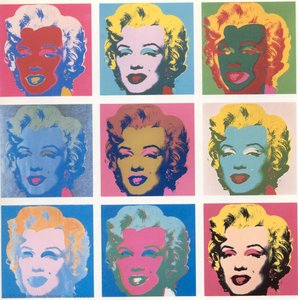
A visitor recognizes the work of Andy Warhol by its immediate connection to the pulse of mass media and consumerism. His aesthetic is defined by bold, saturated colors and a mechanical precision that often eschews traditional painterly texture in favor of the flat, repetitive look of commercial printing. This style captures the essence of the 20th century American experience, documenting the transition from industrial grit to the glossy, manufactured spectacle of celebrity culture. Born in 1928 in Pittsburgh, Pennsylvania, Warhol’s perspective was shaped by the stark realities of a working-class immigrant household and a childhood spent observing the vibrant, distant faces of Hollywood through magazines.
His 1962 masterpiece, Marilyn Diptych, serves as a profound exploration of fame and mortality. Through the use of silkscreen techniques, Warhol creates a rhythmic repetition of Marilyn Monroe’s image, mirroring the relentless cycle of media consumption. The work oscillates between vibrant, artificial hues and fading, monochromatic tones, effectively turning a human icon into a commodified object. By embracing the aesthetics of mass production, Warhol fundamentally redefined the boundaries of fine art in the United States during the 1900s."
Winslow Homer
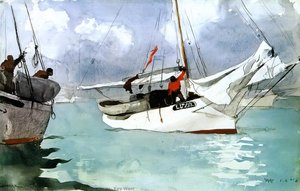 Fishing Boats, Key West - Winslow Homer
Winslow Homer stands as a monumental figure in the lineage of American Realism, bridging the gap between the late 19th century and the dawn of the 20th century. His inclusion in this group of 20th century American painters is defined by his profound influence on the visual language of the United States during this transformative era, setting the stage for the modern movements that followed. A viewer can instantly recognize a Homer masterpiece through his masterful command of light and his ability to capture the raw, untamed power of the natural world.
His work often evokes a sense of tranquil nostalgia, characterized by fluid, impressionistic brushwork and a sophisticated use of color. In his evocative piece, Fishing Boats, Key West, he utilizes a serene palette of muted blues, whites, and grays to depict anchored vessels under a soft, cloudy sky. This piece exemplifies his ability to balance composition and atmosphere, using loose, expressive strokes to convey the movement of water and the quiet dignity of maritime life. From his early training in lithography to his deep connection to the sea, Homer’s legacy remains etched in the very spirit of American landscape and maritime art.
James McNeill Whistler
 Charles Lang Freer - James McNeill Whistler
A pivotal figure whose influence echoed well into the 20th century, James McNeill Whistler was born in Massachusetts in 1834. His journey from the United States to the Imperial Academy of Arts in St. Petersburg, and later to the studios of Paris under Sébastien Bouré and Gleyre, allowed him to bridge the gap between American origins and European sophistication. As a leader of the Aestheticism movement, his focus on tonal harmony and atmospheric beauty laid the groundwork for the modern sensibilities that would define much of 20th-century American art.
In his representative work, Charles Lang Freer, we witness the profound mastery of light and shadow. The subject emerges from a somber, indistinct background, his presence defined by a penetrating, introspective gaze. The painting is a study in restraint, utilizing a palette of deep browns and muted blacks to create a sense of quiet gravity. Rather than focusing on literal detail, Whistler employs energetic, spontaneous brushwork and thick impasto to prioritize the essence of the sitter. This emphasis on mood and the dissolution of boundaries between subject and space remains a testament to his revolutionary approach to composition.
Jasper Johns
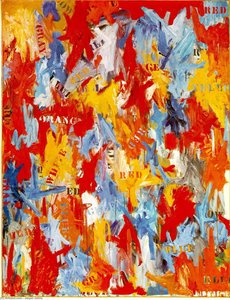 False Start - Jasper Johns
Jasper Johns stands as a transformative figure among 20th century painters from United States, acting as a vital bridge between the raw emotion of Abstract Expressionism and the iconic imagery of Pop Art. Born in 1930 in Georgia and raised in South Carolina, his journey to the forefront of the New York art scene was shaped by his formal studies at the Parsons School of Design and a period of military service in Japan. His ability to reimagine familiar symbols through a modern lens solidified his status as a pioneer of mid-century American art.
His 1959 masterpiece, False Start, serves as a profound example of this stylistic evolution. In this work, Johns moves away from traditional representation to explore a chaotic yet balanced composition. The piece is characterized by:
- Dynamic Abstraction: A sense of spontaneity achieved through overlapping layers of paint.
- Tactile Texture: The use of thick impasto brushstrokes that emphasize the physical act of creation.
- Vibrant Palette: A high-contrast arrangement of red, yellow, blue, and white that creates immense visual energy.
Through works like False Start, Johns redefined the boundaries of the canvas, proving that even the most spontaneous gestures can possess a deep, structural logic.
Roy Lichtenstein
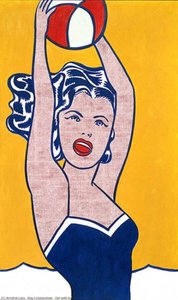
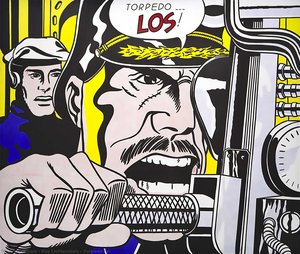
A central figure in the mid-century shift of the American art scene, Roy Lichtenstein redefined the boundaries of fine art by looking outward at the glossy, mechanical surfaces of mass culture. Born in Manhattan in 1923, his work emerged as a radical departure from the heavy, emotional brushwork of the Abstract Expressionists, choosing instead to embrace the visual shorthand of the everyday. As a leading pioneer of the Pop Art movement, he transformed the ephemeral language of comic books and commercial advertising into something monumental and sophisticated.
His 1963 masterpiece, Whaam!, serves as a definitive example of this stylistic revolution. In this work, Lichtenstein captures the explosive energy of aerial combat through a highly stylized, almost clinical lens. He meticulously recreated the Ben-Day dot system—the tiny, repetitive dots used in industrial printing—to create areas of solid color, effectively bridging the gap between high-end gallery prestige and the pulse of the street. By adopting these industrial aesthetics, Lichtenstein challenged viewers to consider how media shapes our perception of reality, securing his legacy as one of the most influential 20th century painters from the United States."
William Merritt Chase
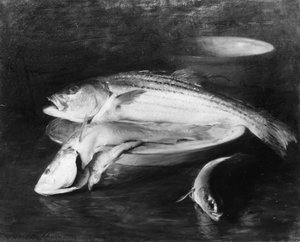 Fish - William Merritt Chase
A pivotal figure in the evolution of American art, William Merritt Chase bridged the gap between rigorous academic traditions and the burgeoning modern movements that would define the 20th century. His journey from the practical discipline of his early years in Indiana to the prestigious academies of New York and Munich allowed him to master a technical precision that he later infused with the light-drenched sensibilities of American Impressionism. This transition is essential to understanding his place among the 20th century painters from United States, as his stylistic shifts paved the way for the expressive freedom seen in later generations.
His 1910 masterpiece, Fish, serves as a profound testament to this technical mastery. In this still life, Chase moves beyond mere representation to capture a sense of vitality through remarkable tonal control. The work utilizes a dramatic, almost melancholic use of light and shadow, reminiscent of the Spanish masters, yet it is executed with a loose, expressive brushwork that feels strikingly modern. By focusing on the palpable texture of scales and the interplay of gray tones against a dark background, Chase transformed a simple subject into a sophisticated study of light and form.
Georgia O'Keeffe
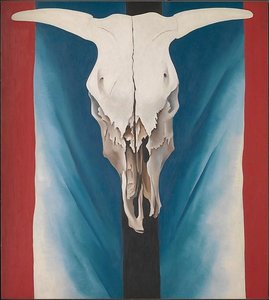 Cow's Skull Red, White, and Blue - Georgia O'Keeffe
A central figure in the evolution of 20th century American art, Georgia O'Keeffe redefined the boundaries of modernism through her profound connection to form and color. Born in 1887 in Wisconsin, her journey from a rural farmhouse to the studios of the Art Students League in New York City marked the rise of a uniquely American aesthetic. Her departure from strict academic realism was catalyzed by the teachings of Arthur Wesley Dow, who encouraged her to prioritize personal expression and the essential balance of line and hue over mere imitation.
Her masterpiece, Cow's Skull Red, White, and Blue (1931), serves as a definitive testament to her place among the most influential painters from the United States in the 20th century. In this work, she achieves a striking synthesis of meticulous detail and bold abstraction. The stark, textured bone of the skull is rendered with precision, yet it is set against a vibrant, geometric backdrop of red, white, and blue. This juxtaposition of organic mortality and modern, flat color planes creates a dramatic, melancholic tension that captures the very spirit of American modernism.
Mary Cassatt
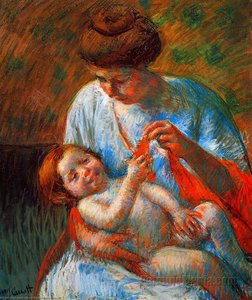 Baby Lying on His Mother s Lap, reaching to hold a scarf - Mary Cassatt
Born in Pennsylvania in 1844, Mary Cassatt emerged as a vital force in American art, bridging the gap between traditional academic training and the revolutionary Impressionist movement. Her journey began at the Pennsylvania Academy of the Fine Arts before she sought the rigorous discipline of Paris, studying under masters like Jean-Léon Gérôme. This deep immersion in French technique, combined with her time studying the Old Masters in Italy, allowed her to develop a sophisticated visual language that would define her career well into the early 20th century. As a prominent figure among 20th century painters from United States, her work remains essential for its ability to elevate the private, domestic sphere into the realm of high art.
Cassatt is celebrated for her profound ability to capture the quiet, tender complexities of maternal bonds. In her evocative work, Baby Lying on His Mother s Lap, reaching to hold a scarf, she moves beyond mere portraiture to create a meditation on connection. Through visible, spontaneous brushwork and a soothing palette of soft blues and natural greens, she transforms a fleeting domestic interlude into a timeless, serene masterpiece of late Impressionism.
Jackson Pollock
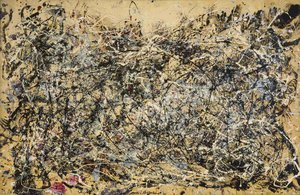 Number 1, 1949 - Jackson Pollock
Born in 1912, Jackson Pollock emerged from the rugged landscapes of the American West to become a defining figure of the 20th century American painters. His journey from the nomadic life of a surveyor's son to the intense urban energy of New York City shaped a style that would forever alter the course of modern art. After studying under Thomas Hart Benton at the Art Students League, Pollock moved away from traditional narrative forms to explore the subconscious through movement.
His revolutionary approach is epitomized in Number 1, 1950, a monumental work that captures the essence of Abstract Expressionism. By laying his canvas directly on the floor, Pollock transformed the act of painting into a physical performance, often referred to as "action painting." In this piece, he utilizes his signature drip technique, creating a complex, swirling network of lines that eschews a central focal point in favor of an all-over composition. The result is a raw, energetic landscape of black, ochre, and white, punctuated by subtle reddish-pink tones, reflecting the existential intensity of post-war American creativity.
Childe Hassam
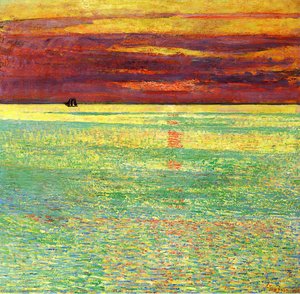 Sunset at Sea - Childe Hassam
Frederick Childe Hassam stands as a pivotal figure among 20th century American painters, having transitioned from a disciplined draftsman into a leading light of the American Impressionist movement. Born in 1859 in Boston, Massachusetts, Hassam’s early professional years as an illustrator provided him with a rigorous understanding of composition and line. This foundational training allowed him to master the delicate interplay of light and atmosphere that would define his mature style during the early decades of the 1900s.
His work is celebrated for its ability to capture the shifting textures of both urban environments and serene coastal landscapes. In his 1911 masterpiece, Sunset at Sea, Hassam demonstrates the essence of his artistry through a vibrant, tranquil seascape. The piece utilizes a sophisticated palette of warm oranges and reds in the sky, contrasted against the cool turquoise and blue tones of the ocean. Through a gestural, impasto technique, he employs thick, visible brushstrokes to evoke the ephemeral quality of twilight. By documenting the energy and light of a nation in transition, Hassam secured his legacy as a vital voice in the American art canon of the 20th century."
Conclusion
From the delicate, intimate impressions of Mary Cassatt to the explosive, rhythmic energy of Jackson Pollock, the 20th century was a transformative era that redefined the boundaries of American creativity. These artists did more than just paint; they captured the shifting soul of a nation, whether through the bold, graphic pop of Andy Warhol and Roy Lichtenstein or the soulful, sweeping landscapes of Georgia O'Keeffe. Each master brought a unique visual language to the table, evolving from the traditional textures of the turn of the century into the radical abstractions and vibrant colors that define modern life.
At Mus3ums.com, we believe that such profound artistry should be accessible to everyone, not just those behind museum velvet ropes. Whether you are looking to add a touch of mid-century modernism to a first home or seeking a statement piece for a curated collection, our full collection offers a way to bring these iconic visions into your own living space. We invite you to experience the tactile beauty of these legends through our museum-quality, hand-painted oil reproductions, crafted by skilled artists to ensure every brushstroke honors the spirit of the original masterpiece.


