
Introduction
Emerging from the social and political shifts of mid-19th century France, French realist painters sought to strip away the idealized illusions of Romanticism and the rigid constraints of Neoclassicism. Instead of depicting mythological gods or heroic legends, these artists turned their gaze toward the tangible, the mundane, and the unvarnished truth of everyday life. They captured the grit of labor, the quiet dignity of the peasantry, and the raw textures of the natural world, asserting that the contemporary moment was a subject worthy of high art in its own right.
This movement represented a profound cultural pivot, reflecting a society undergoing rapid industrialization and profound social change. By documenting the reality of the working class and the subtle nuances of domestic life, these painters challenged the traditional hierarchies of the Academy. Their commitment to visual honesty—painting exactly what they saw without embellishment—paved the way for the radical shifts in perception that would eventually lead to Impressionism and modernism.
Today, the legacy of these masters remains vital for their psychological depth and their unflinching observation of the human condition. Their works offer a window into a vanished era, providing a tactile connection to the textures of history. In the following sections, we examine ten essential figures of this movement, from the monumental landscapes of Jean-François Millet to the intricate social observations of Gustave Courbet, tracing the diverse ways they redefined the boundaries of truth on canvas.
Gustave Courbet
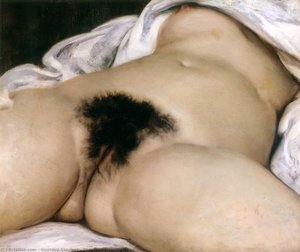 The origin of the world - Gustave Courbet
A central figure of the French realist movement, Gustave Courbet (1819–1877) fundamentally altered the trajectory of 19th-century art by rejecting the idealized myths favored by the academies. Born in Ornans, his early life in the Doubs region deeply informed his artistic vision, leading him to focus on the unvarnished truth of the human condition. Rather than seeking the divine or the mythological, Courbet turned his gaze toward the tangible, capturing the grit of the earth and the heavy fatigue of the working class. This commitment to depicting life exactly as it was—without embellishment or romanticization—cemented his status as a revolutionary leader of Realism.
His technical mastery is perhaps most provocatively displayed in his 1866 masterpiece, The origin of the world. In this striking work, Courbet eschews traditional contextualizing elements to present a raw, unapologetic depiction of the female form. By stripping away the veneer of idealized beauty, he asserted a bold naturalism that challenged the very foundations of high art. His defiant approach and focus on the physical reality of existence paved the way for subsequent movements, ensuring his legacy as a pioneer who forced the art world to confront the world as it truly appeared.
Jean-François Millet
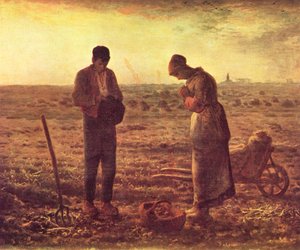
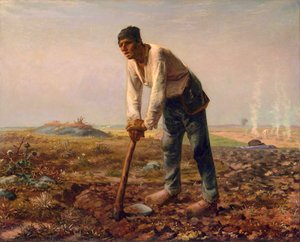
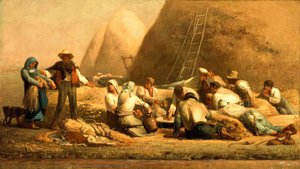
Jean-François Millet stands as a foundational figure of the French Realism movement, distinguished by his refusal to romanticize the hardships of the working class. Unlike many of his contemporaries who sought to beautify the countryside, Millet brought a profound, visceral authenticity to his canvases, rooted in his own upbringing in a Norman farming family. This direct connection to the soil allowed him to capture the mechanics of survival—the sowing, reaping, and the physical toll of labor—with a gravity that defined the Realist ethos. His work does not merely observe the peasant; it honors the dignity found in the struggle of everyday existence.
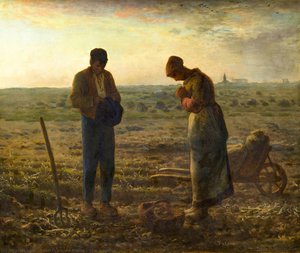
His masterpiece, The Angelus, serves as a quintessential example of this commitment. In this evocative scene, two peasants pause their potato harvest at dusk to observe a moment of spiritual devotion. Through a sophisticated use of light and atmospheric color, Millet elevates a simple rural moment into a study of quiet contemplation. By focusing on the textures of worn clothing and the vastness of the landscape, he ensures the viewer feels the weight of the tools and the rhythm of the land, cementing his legacy as a painter who found the sublime in the ordinary.
William-Adolphe Bouguereau
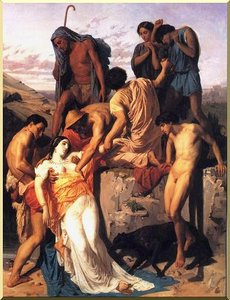 Zenobia Found by Shepherds on the Banks of the Araxes - William-Adolphe Bouguereau
William-Adolphe Bouguereau (1825–1905) stands as a preeminent figure of French realism, specifically within the academic tradition. While many realists sought to depict the grit of modern life, Bouguereau applied the movement's commitment to precise, unembellished observation to the human form, refining anatomy into an idealized, luminous perfection. His work is instantly recognizable by its extraordinary technical precision, smooth brushwork that leaves almost no trace of the tool, and a sophisticated use of light that grants skin a translucent, ethereal quality.
A master of the École des Beaux-Arts, where he studied under François-Edouard Picquenot, Bouguereau bridged the gap between classical discipline and the realistic depiction of human emotion. His Zenobia Found by Shepherds on the Banks of the Araxes serves as a profound example of this mastery. In this work, he utilizes a structured, three-level perspective to ground a dramatic historical narrative in a tangible, realistic setting. By focusing on the physical vulnerability and emotional depth of his subjects, he elevated the realist impulse to a level of sublime, academic grandeur, ensuring his place among the most influential French painters of the 19th century."
James Tissot
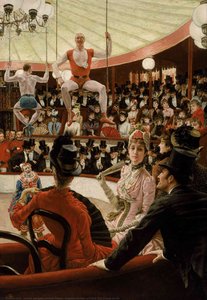 English Women of Paris The Circus Lover - James Tissot
Born in the port city of Nantes in 1836, James Tissot developed a profound sensitivity to the textures of daily life, a trait likely inherited from his parents—a drapery merchant and a milliner. This early exposure to the tactile nuances of fine fabrics and fashion became a cornerstone of his artistic identity. After moving to Paris around 1854, he underwent rigorous academic training at the École des Beaux-Arts, studying under masters such as Louis Lamothe and Hippolyte Flandrin, while absorbing the disciplined influence of Jean-Auguste-Dominique Ingres and Alexandre Cabanel.
Tissot’s place within the French realist movement is defined by his commitment to documenting the contemporary social fabric of the Belle Époque. Rather than idealizing his subjects, he applied a meticulous, observational lens to the manners and fashions of the era. In his representative work, English Women of Paris The Circus Lover, he captures a lively, crowded interior with remarkable precision. Through his ability to render the specific postures of onlookers and the intricate details of their attire, Tissot transforms a fleeting social spectacle into a permanent chronicle of 19th-century life, blending the accuracy of realism with a sophisticated sense of atmosphere.
Henri Fantin-Latour
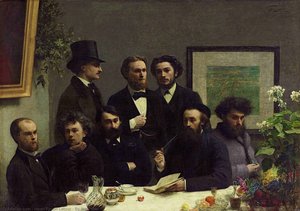 By the Table - Henri Fantin-Latour
Henri Fantin-Latour (1836–1904) occupies a unique position among French realist painters, bridging the gap between meticulous observation and a subtle, poetic symbolism. Born in Grenoble, he received his foundational training from his father, Théodore, before refining his technique at the École des Beaux-Arts under Louis-Alexandre Péron and Horace Lecoq de Boisbaudran. The latter’s unconventional emphasis on drawing from memory deeply influenced Fantin-Latour’s ability to capture the essence of a subject with photographic precision, a hallmark of his realist approach.
His work is defined by a disciplined, traditionalist hand that sought to render the textures of life—from the delicate petals of a floral still life to the complex contours of a human face—with remarkable clarity. He belongs to the realist movement through his commitment to depicting the world exactly as it appeared, avoiding the grandiosity often found in academic art. This is masterfully demonstrated in his 1872 masterpiece, By the Table. In this significant group portrait, he captures a literary gathering with an intimacy that feels both spontaneous and carefully composed, immortalizing the camaraderie of 19th-century intellectual circles through a lens of profound, quiet realism.
Honoré Daumier
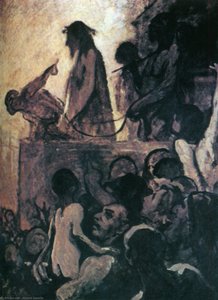 Honoré Daumier Nous voulons Barabbas (Ecce Homo) We want Barabbas (Ecce Homo) - Honoré Daumier
Honoré Daumier (1808–1879) stands as a formidable force within the French realist movement, utilizing his art as a sharp instrument for social and political critique. Unlike those who sought to idealize their subjects, Daumier focused on the raw, unvarnished truths of 19th-century French life, often lampooning the bourgeoisie and the legal establishment through scathing caricature and expressive draftsmanship. His work is instantly recognizable by its vigorous, gestural brushwork and a somber, earthy palette dominated by deep browns, blacks, and ochres, which lend a profound psychological weight to his compositions.
His commitment to realism is perhaps most poignantly captured in his 1852 masterpiece, Nous voulons Barabbas (Ecce Homo). In this work, Daumier moves beyond mere satire to explore the depths of human suffering and spiritual empathy. Through loose, layered textures and dramatic chiaroscuro, he transforms a biblical scene into a powerful commentary on injustice and collective emotion. Whether through his lithographs or his heavy, textured oil paintings, Daumier’s ability to document the tensions of his era ensures his place as a vital architect of modern visual storytelling.
Jean-Louis Ernest Meissonier
 Soldier Playing the Theorbo - Jean-Louis Ernest Meissonier
Jean-Louis Ernest Meissonier (1815–1891) stands as a master of meticulous detail, bridging the gap between academic tradition and the burgeoning French Realism movement. While his training began under Léon Cogniet, his true artistic soul was forged through the study of Dutch masters like Gerard Douw. This influence led him to a style defined by an almost microscopic accuracy, where he did not merely paint scenes but reconstructed entire historical worlds with breathtaking fidelity.
Meissonier belongs to the Realism movement through his unwavering commitment to depicting the textures of reality. Rather than idealizing his subjects, he focused on the tangible essence of life, whether through the quiet dignity of a bourgeois interior or the precise military details of a bygone era. His work captures the weight of leather, the grain of wood, and the soft sheen of fabric with a precision that feels tactile.
In his evocative work Soldier Playing the Theorbo, Meissonier exemplifies this dedication. The painting presents a reflective, nostalgic moment, capturing a soldier in seventeenth-century attire. Through subtle, soft lighting and a muted palette of espresso and earth tones, he renders the intricate strings of the lute and the heavy folds of the doublet, turning a small-scale composition into a profound study of historical presence.
Rosa Bonheur
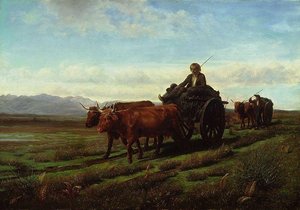 Going to Market - Rosa Bonheur
Rosa Bonheur (1822–1899) stands as a formidable figure among French realist painters, distinguished by her profound ability to capture the raw, unadorned essence of the natural world. While many of her contemporaries sought to idealize their subjects, Bonheur embraced the core tenets of Realism by portraying animals and rural laborers with uncompromising anatomical accuracy and dignity. Her work eschews the grandiosity of Romanticism in favor of a meticulous, observational approach that celebrates the dignity of manual labor and the vitality of working creatures.
Her upbringing in a progressive, artistic household allowed her to bypass many of the societal constraints of 19th-century France, enabling a life of intense study and direct observation. This dedication is vividly realized in her 1851 masterpiece, Going to Market. In this work, she presents a dynamic tableau of rural life, where a team of oxen pulls a heavy wagon through a landscape of grazing cattle. Through her masterful command of light and form, Bonheur elevates the mundane activities of the countryside into a powerful testament to the harmony between humanity and the animal kingdom, cementing her legacy as a pioneer of the realist movement.
Jean-François Raffaelli
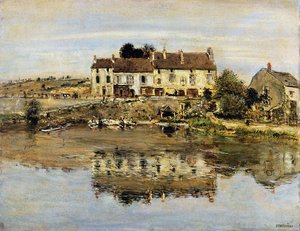 Small Houses on the Banks of the Oise - Jean-François Raffaelli
Jean-François Raffaëlli stands as a pivotal figure in French Realism, distinguished by his commitment to what he termed caractérisme. Unlike artists who sought to idealize their subjects, Raffaëlli focused on the unvarnished essence of human experience, capturing the specific social contexts of the people he observed. His work often bridges the gap between the grounded observations of Realism and the atmospheric sensibilities of Impressionism, making him a unique voice in late 19th-century French art.
A viewer can recognize a Raffaëlli at a glance through his meticulous attention to detail and his preference for the marginalized and the mundane. Whether depicting the ragpickers of the Parisian suburbs or the quietude of rural life, his brushwork avoids grandiosity in favor of authenticity. In his representative work, Small Houses on the Banks of the Oise, this approach is masterfully evident. Painted in 1912, the piece avoids picturesque clichés, instead using a muted palette of ochres and blues to render modest dwellings and everyday tasks with a sense of quiet dignity.
Born in Paris in 1850, Raffaëlli received brief but foundational training under Jean-Léon Gérôme at the École des Beaux-Arts. However, he quickly moved beyond academic traditions to become a specialist in portraying the true character of both individuals and landscapes.
Émile Friant
 All Saints' Day - Émile Friant
In his evocative 1888 masterpiece, All Saints' Day, Émile Friant captures a somber procession of mourners moving through the cold, winter air at the Préville cemetery in Nancy. The work exemplifies his ability to freeze a fleeting, photographic moment, where dark silhouettes of figures cut through a desaturated, snowy landscape under a diffused, overcast sky. This mastery of atmosphere and the quiet tension between movement and stillness defines his contribution to the French realist movement.
Born in 1863, Friant’s artistic identity was deeply shaped by the social upheavals of his era, specifically the displacement caused by the Franco-Prussian War. This personal history fueled his dedication to capturing the authentic essence of French life. Trained under Louis-Théodore Devilly and later in Paris under Alexandre Cabanel, Friant moved away from rigid academic constraints to embrace a style rooted in direct observation. His realism is characterized by a profound psychological depth and a meticulous attention to detail, often imbuing everyday genre scenes with a latent, dramatic symbolism. Through his precise brushwork and ability to render heavy textures—from the weight of black garments to the uneven surface of frost—Friant bridged the gap between traditional realism and the evolving sensibilities of the early 20th century.
Conclusion
The legacy of these French realist painters lies in their courageous commitment to the truth of the human condition, whether through the rugged landscapes of Millet, the social commentary of Daumier, or the meticulous detail of Meissonier. By stripping away the idealized veneer of Romanticism, these masters captured the dignity of labor, the grit of urban life, and the quiet intensity of the everyday, forever changing the trajectory of modern art. Their collective work serves as a profound reminder that there is immense beauty and complexity to be found in the unvarnished reality of our world.
For those looking to bring this sense of historical depth and authentic texture into their own living spaces, Mus3ums.com offers a way to connect with these masters. Our artisans specialize in creating museum-quality, hand-painted oil reproductions that honor the specific brushwork and tonal depth of these iconic works. You can explore our full collection to find the perfect piece and invite the enduring spirit of French Realism into your home through a bespoke, handmade masterpiece.