Introduction
The decade of the 1930s in Russia represents a profound period of artistic tension, where the avant-garde spirit of the previous era met the rigid, monumental demands of a changing social landscape. This era was defined by a complex interplay between abstraction, spiritualism, and a burgeoning sense of social realism, as artists navigated the shift from the experimental freedom of the early Soviet years toward more structured, often heroic, visual languages. It was a time when the canvas became a battlefield for identity, capturing the pulse of a nation in transition through diverse lenses ranging from the ethereal to the industrial.
Within this turbulent period, masters such as Wassily Kandinsky, Nicholas Roerich, and Aleksandr Deyneka offered vastly different interpretations of reality. While some sought to transcend the physical world through color and form, others focused on the rhythmic movement of modern life and the enduring power of the human figure. These works remain vital today because they encapsulate the struggle of the individual creator against the currents of history, offering a visual record of how art can both reflect and resist the pressures of its time.
The following selection explores ten significant works from this decade, tracing the stylistic evolution and the profound emotional depth that characterizes Russian art during these transformative years.
Composition IX - Wassily Kandinsky
 Composition IX - Wassily Kandinsky
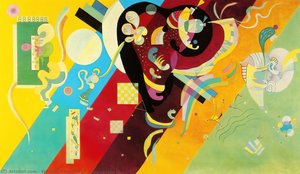
Wassily Kandinsky's Composition IX, created in 1936, stands as a profound testament to the evolution of Russian abstraction during the 1930s. This work exemplifies the period's shift toward a mature, highly sophisticated non-representational language, heavily influenced by the artist's pedagogical experiences at the Bauhaus. The canvas is a complex, energetic arrangement of geometric and organic forms that eschews traditional perspective in favor of a flattened, layered spatiality.
The palette is a masterful study in tension and harmony, dominated by warm hues of gold, red, and orange that clash and coalesce with deep blues and greens. Through a deliberate interplay of angular black lines and fluid, sweeping shapes, Kandinsky achieves a sense of "energetic chaos" that is, in reality, a carefully constructed symphony of color. His technique utilizes varied brushwork to create a textured surface, where smooth areas of pigment contrast with more tactile, layered sections. This rhythmic distribution of mass and void reflects the spiritual and mystical explorations central to the era's avant-garde, transforming the canvas into a visual manifestation of inner resonance and movement.
Study for Chacun pour soi - Wassily Kandinsky
 Study for Chacun pour soi - Wassily Kandinsky
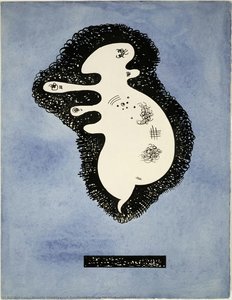
Wassily Kandinsky's 1934 work, Study for Chacun pour soi, serves as a profound testament to the evolution of abstraction during the 1930s. Created during a period of intense introspection, this piece exemplifies the decade's shift toward exploring the psychological and spiritual dimensions of form. Rather than observing the external world, Kandinsky sought to render his internal landscape through a complex interplay of color and line.
The composition is dominated by a striking blue background that provides a serene stage for a central, almost monstrous figure. This entity is not a realistic depiction but an assemblage of fragmented limbs, arms, and a head, constructed from a mixture of organic curves and geometric shapes. Meticulously outlined in stark white, the creature appears to float within a mystical space, accented by scattered dots that add a layer of rhythmic texture. By deconstructing the human form into these essential elements, Kandinsky’s study captures the mysterious and emotive essence of the era, moving beyond mere representation to achieve a visual symphony of pure expression.
Color triangle - Wassily Kandinsky
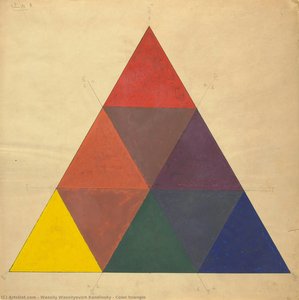 Color triangle - Wassily Kandinsky
Wassily Kandinsky’s 1933 work, Color Triangle, serves as a profound testament to the intellectual and spiritual rigor characterizing Russian-born abstraction during the 1930s. Moving beyond mere representation, this piece functions as a visual treatise on the relationship between chromatic harmony and geometric form. The composition is anchored by a bold, central triangle, its sides defined by the primary triad of vibrant red, deep blue, and luminous yellow. These colors are not merely applied; they are orchestrated to create a sense of rhythmic balance and depth, reflecting Kandinsky's belief in the musicality of art.
The palette, dominated by a sense of golden light and primary intensity, illustrates the era's shift toward a pure, non-objective language. By utilizing a structured, almost diagrammatic approach—where specific shades are identified—Kandinsky bridges the gap between scientific color theory and emotional resonance. The work captures a moment of calm, meditative precision, where the interplay of simple lines and intense pigment transforms a geometric shape into a vessel for spiritual expression, marking a definitive peak in the evolution of modern abstract thought.
Sacred Himalayas - Nicholas Roerich
 Sacred Himalayas - Nicholas Roerich
Upon first glance, the viewer is met with the overwhelming majesty of the snow-capped peaks that stretch across the entire width of the canvas. Nicholas Roerich’s 1934 masterpiece, Sacred Himalayas, captures a crystalline panorama where the deep, steel blue of the sky meets the brilliant, dazzling whites of the mountain ridges. This composition creates a profound sense of altitude and serene, spiritual grandeur. Scattered throughout the lower slopes and higher paths, small human figures provide a vital sense of scale, acting as anchors that remind us of life’s journey amidst such sublime, immutable nature.
This work is a quintessential example of Russian art from the 1930s, reflecting the period's deep engagement with Symbolism. Roerich, a prominent Russian Symbolist, uses this decade's characteristic focus on spiritual landscapes to transcend mere topography. Through his masterful use of color and light, the painting moves beyond a simple landscape to become a visual hymn, capturing the intersection of the terrestrial and the divine that defined much of the era's profound, searching aesthetic.
Mount Fuji - Nicholas Roerich
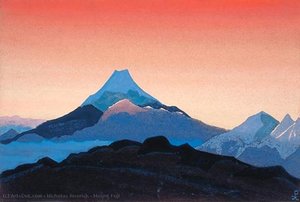 Mount Fuji - Nicholas Roerich
The eye is immediately drawn to the imposing, snow-capped silhouette of the peak, which dominates the composition with an almost architectural stability. This monumental presence is softened by a luminous, warm orange sky, suggesting the ethereal glow of dawn or sunset. Through a delicate application of color, the landscape achieves a tranquil, dreamlike quality, where the cool whites of the mountain's mantle contrast beautifully with the vibrant atmosphere. Subtle silhouettes of trees and secondary peaks add rhythmic depth, guiding the viewer through a scene that feels both grounded and transcendent.
Created in 1936, this work is a quintessential example of Russian art from the 1930s, reflecting the era's profound interest in spiritual and symbolic landscapes. As a Russian Symbolist, Nicholas Roerich utilizes this period to explore the intersection of the terrestrial and the divine. His mastery of light and color transforms a topographical subject into a visionary encounter, capturing the very breath of the mountain through a sophisticated, graphic composition that defines the aesthetic sensibilities of the decade.
Naked Young Man (B. Snezhkovsky) - Konstantin Somov
 Naked Young Man (B. Snezhkovsky) - Konstantin Somov
Created in 1937, Naked Young Man (B. Snezhkovsky) serves as a profound testament to the sophisticated visual language of Russian Modernism during the 1930s. Konstantin Somov, a master known for his Rococo-inspired elegance and symbolic undertones, moves away from the rigid strictures of realism to embrace a more lyrical, decorative sensibility. This work is a quintessential example of the Symbolist movement, where the physical form is utilized to reach toward a realm beyond mere surface representation.
The composition focuses on the delicate interplay of light and shadow across the human form. Two figures are positioned amidst the soft, textured folds of bedsheets, their bodies stripped of clothing to emphasize a sense of quiet intimacy. The palette is characterized by subtle, clay-toned hues that enhance the romantic and contemplative atmosphere of the scene. Through controlled, precise lines and a focus on aesthetic grace, Somov captures a moment of absolute stillness. The painting avoids the chaotic energy of the era, opting instead for a refined precision that defines the subject's silhouette against a muted background, embodying the sophisticated, introspective spirit of Russian art in the late 1930s.
The girl at the desk - Kuzma Petrov-Vodkin
 The girl at the desk - Kuzma Petrov-Vodkin
Created in 1934, The girl at the desk serves as a profound example of the introspective and symbolic direction taken by Russian art during the 1930s. In this genre painting, Kuzma Petrov-Vodkin moves away from mere representation to explore a deeply reflective psychological state. The subject, a young woman seated at a wooden desk, is captured in a moment of intense contemplation, her head resting heavily on her hand as she gazes downward toward the papers before her.
The composition utilizes a frontal perspective that draws the viewer into the stillness of the room. Petrov-Vodkin employs a sophisticated use of space, notably through a mirror affixed to the wall that reflects a partial, secondary view of the girl, adding a layer of complexity to her presence. The environment is rendered in a palette of muted, earthy tones—dominated by walnut hues—which enhances the dramatic and somber atmosphere. On the shelves behind her, objects such as a globe and a doll provide subtle narrative clues to her world, while the presence of books suggests a life of study and thought. This work exemplifies the era's ability to blend everyday scenes with a sense of timeless, symbolic depth.
Girl with book - Aleksandr Deyneka
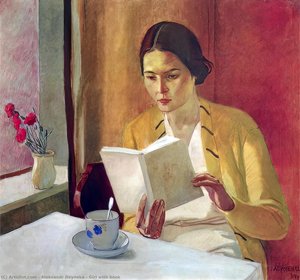 Girl with book - Aleksandr Deyneka
Aleksandr Deyneka’s 1934 work, Girl with Book, stands as a profound study of stillness amidst the transformative energy of the 1930s. While much of the era's art focused on the monumental scale of labor and industry, this portrait captures a private, introspective sanctuary. The subject is seated at a dining table, her focus entirely surrendered to her reading, creating a sense of serene isolation. The composition is anchored by a delicate interplay of light and shadow, as natural light streams from a nearby window to illuminate a cup of tea and the soft textures of the room.
Deyneka utilizes a palette that balances warmth with structural clarity, incorporating organic elements like a potted plant and elegant vases to ground the scene. His technique demonstrates a rhythmic fluidity, where sunlight dances across the tabletop, lending a tangible, three-dimensional depth to the domestic setting. This mastery of atmosphere—using soft light to define the woman's form—highlights a shift in Russian art toward capturing the quiet, human dimensions of modern life through a lens of calm and contemplative grace.
Open Door on a Garden - Konstantin Somov
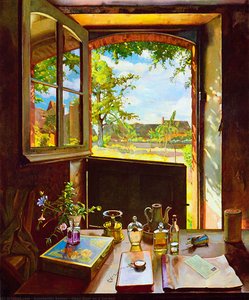 Open Door on a Garden - Konstantin Somov
In the landscape of Russian art from the 1930s, Konstantin Somov’s 1934 work, Open Door on a Garden, stands as a profound testament to the era's enduring fascination with aestheticism and quietude. This masterpiece exemplifies the artist's ability to merge the intimacy of a private interior with the expansive vitality of the natural world, a hallmark of his sophisticated modernist approach.
The composition is anchored by a large, arched window that serves as a luminous portal. Through this frame, the viewer is invited into a lush, verdant garden under a clear blue sky, where the soft, golden light of a peaceful afternoon spills into the room. Somov utilizes the flowing, organic lines characteristic of the Art Nouveau style to harmonize the indoor sanctuary with the outdoor scenery. On a table bathed in natural light, a curated collection of books, delicate bottles, and a small timepiece suggests a life of contemplative leisure. By blending these domestic details with the vibrant greenery outside, Somov creates a serene, dreamlike atmosphere that captures the essence of 1930s Russian elegance.
Local - Maxim Vorobiev
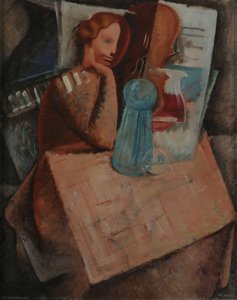 Local - Maxim Vorobiev
Maxim Vorobiev’s 1933 work, <Local, serves as a profound example of the expressive shifts occurring in Russian art during the 1930s. This oil on canvas composition moves away from strict realism, opting instead for a stylized, almost expressionistic approach to domestic life. The scene features a woman seated at a table, her posture suggesting a state of quiet contemplation, surrounded by an asymmetrical arrangement of objects including a violin, glasses, and bottles.
The painting is characterized by a flattened perspective and a palette dominated by warm, earthy tones that evoke a sense of reflective intimacy. Vorobiev utilizes loose, expressive lines and a painterly technique, where visible brushstrokes and a tactile, impasto-like surface create a rich texture. By simplifying shapes and reducing depth cues, the artist emphasizes the two-dimensional arrangement of forms over spatial accuracy. This stylistic choice, combined with soft, diffused lighting, creates a gentle glow that heightens the tension between the physical presence of the objects and the introspective, emotional mood of the subject.
Conclusion
The era of the 1930s in Russian art represents a profound intersection of avant-garde legacy and the emerging tension of a changing social landscape. From the spiritual abstractions of Kandinsky to the rhythmic, monumental compositions of Deyneka, these works capture a decade defined by intense stylistic shifts and a search for new visual languages. Whether through the dreamlike intimacy of Somov or the structural clarity of Petrov-Vodkin, each artist contributed a unique perspective to this complex period, leaving behind a legacy of profound aesthetic depth.
At Mus3ums.com, we invite you to bring this transformative era into your own space. Our master artists specialize in creating museum-quality, hand-painted oil reproductions that preserve the authentic texture and soul of these historical masterpieces. You can explore our full collection to find the perfect piece and experience the enduring power of these works through a bespoke, handmade creation.