The Maritime Soul of Rotterdam
In the salt-sprayed ports of the eighteenth-century Netherlands, a profound talent was quietly taking shape. Hendrik Kobell was born in Rotterdam in 1751, a child of a family steeped in the artistic traditions of Europe. His father, a merchant of pottery, provided a stable foundation for the young man, though it was not a life of professional artistry. Instead, the elder Kobell trained his son in the fundamentals of drawing, nurturing a fascination that would eventually define the boy's life. While the family business focused on ceramics, the young Hendrik found his true calling in the crowded harbors of his native city, where he spent his early years sketching the masts and rigging of ships that moved through the Dutch sky.
The trajectory of his life shifted in 1769 when a business venture led by his father brought him to London. Amidst the fog and the towering rigging of the Thames, the young draughtsman honed his ability to capture the structural complexity of vessels with precision. This period of exposure to the English maritime scene proved to be a crucible for his development. He was not merely observing the sea; he was translating its rhythmic power and the intricate architecture of its vessels onto paper and canvas. When he returned to the Northern Netherlands in 1770, he abandoned the pottery trade to commit himself fully to the study of art in Amsterdam.
Academic Ascent and Technical Mastery
Kobell’s arrival in Amsterdam marked a period of intense academic rigor. He sought instruction from esteemed masters, including Jacob de Vos and Cornelis Ploos van Amstel. His talent was immediate. He was elected a member of the Stadstekenacademie, the prestigious Amsterdam drawing academy, a recognition that solidified his status among the artistic elite. His technical skill extended across various media, allowing him to move between the precision of a draftsman and the fluid expression of a painter.
His repertoire was defined by several specific technical focuses:
- The use of oils and watercolors to depict landscapes and marine scenes.
- The execution of numerous drawings using pen and India ink.
- A specialized focus on the structural details of ships and boats.
- The application of etching to capture maritime subjects.
By 1772, after a period in Paris, he settled back in Rotterdam. He became an active participant in the local art scene, helping to establish the Genootschap Hierdoor tot Hooger drawing academy. His work was characterized by a unique synthesis of topographical accuracy and atmospheric emotion, breathing life into the wood and canvas of the maritime world.
A Brief and Productive Life
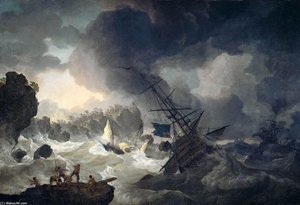
The life of Hendrik Kobell was cut short, leaving behind a body of work that captured a specific era of maritime history. He died in Rotterdam in 1779 at the age of 27. Despite the brevity of his career, his influence extended through his pupils, such as Carel Frederik Bendorp and Gerrit van der Pals. He was also a teacher to his son, Jan Kobell II, who would continue the family's artistic tradition. His ability to manipulate light and detail remains evident in his surviving depictions of storms at sea and the quiet presence of ships along the coast.
Pitanja i odgovori
U kom istorijskom periodu je stvarao/la Hendrik Kobell?
Hendrik Kobell je radila u periodu Early Modern. Ovaj period smešta umetnikov rad u istorijski kontekst.
Otkud je Hendrik Kobell?
Hendrik Kobell je rođen/a u Netherlands.
Gde je i kada je rođen/a Hendrik Kobell?
Hendrik Kobell je rođen/a u gradu Rotterdam godine 1751.