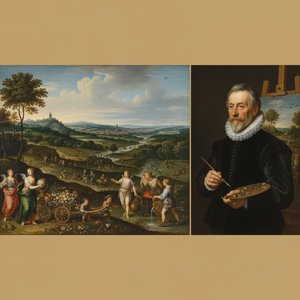
The Flemish Landscape and the Weight of Tradition
Jan Frans Beschey did not merely paint scenery; he constructed environments where the atmosphere held as much weight as the earth itself. Born in Antwerp, he operated within a lineage of Flemish talent, specifically under the guidance of his brother, Balthasar. This connection was not a mere coincidence of birth but a direct transmission of technical rigor. While many of his contemporaries treated figures as mere afterthoughts—small, decorative additions to a larger view—Beschey treated his subjects with a specific, grounded intent. His figures and animals possess a physical presence that prevents them from becoming mere staffage.
His technical command extended beyond the simple depiction of trees or hills. He mastered the subtle interplay between the ground, the vegetation, and the shifting light of the atmosphere. This was not a superficial imitation of nature. It was a calculated, structural approach to the landscape that demanded a high level of precision in both oil and wood mediums.
Professional Standing and Technical Focus
Beschey’s career was defined by a steady ascent through the institutional structures of Antwerp. His skill was recognized by his peers, leading to his appointment as the dean of the Antwerp St. Lukes guild in 1767. This position confirms his status as a central figure in the local artistic community during the 18th century. His work often focused on specific thematic elements:
- The depiction of southern landscapes featuring traveling herdsmen.
- Religious subject matter, such as his rendering of Saint Paul of Thebes.
- The integration of cattle and goats into wooded river settings.
- The use of wood as a primary support for his oil compositions.
A Legacy of Substance
To look at a Beschey is to see the difference between a decorative sketch and a deliberate composition. His ability to balance the human element with the natural world is what prevents his work from fading into the background of art history. He avoided the common trap of the 18th-century landscape painter by ensuring that every element, from the smallest plant to the largest animal, contributed to a cohesive, heavy reality. His paintings remain significant because they refuse to be light or trivial; they are anchored by the very soil they depict.
Pitanja i odgovori
U kom gradu i državi je rođen/a Jan Frans Beschey?
Jan Frans Beschey je rođen/a u gradu Antwerp, u državi Belgium.
Otkud je Jan Frans Beschey?
Jan Frans Beschey je rođen/a u Belgium.
U kom istorijskom periodu je stvarao/la Jan Frans Beschey?
Jan Frans Beschey je radila u periodu Early Modern. Ovaj period smešta umetnikov rad u istorijski kontekst.