
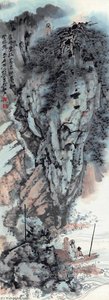
Introduction
The 20th century marked a profound metamorphosis for the visual language of the People's Republic of China, as artists navigated the complex intersection of ancient tradition and rapid modern transformation. This era was defined by a dynamic tension between the classical mastery of ink wash and calligraphy and the bold, expressive possibilities of Western oil painting and modernism. As the nation underwent seismic social and cultural shifts, painters sought to redefine what it meant to capture the essence of the landscape, the spirit of the people, and the evolving identity of a civilization in flux.
What unites these masters is their ability to synthesize the past with the present. Whether through the delicate, rhythmic brushwork of traditional literati styles or the heavy, textured impasto of contemporary oil techniques, these artists bridged the gap between the scholarly elegance of the old world and the visceral energy of the new. Their work serves as a visual chronicle of a century that redefined global aesthetics, making their contributions essential for understanding the evolution of modern Asian art.
Today, the legacy of these painters continues to resonate in galleries and private collections worldwide, offering a profound dialogue between historical continuity and avant-garde experimentation. By examining the lives and techniques of these influential figures, we gain insight into a period of unparalleled creative courage. The following selection highlights ten pivotal artists—from the masters of ink and brush to the pioneers of modern oil portraiture—who shaped the artistic soul of 20th century Chinese painting.
Xu Beihong
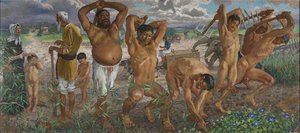 The Foolish Old Man Moves a Mountain - Xu Beihong
A monumental figure in the evolution of modern Chinese art, Xu Beihong (1895–1953) stands as a bridge between ancient traditions and Western innovation. His career, which spanned the transformative decades of the 20th century, was defined by a relentless drive to modernize the visual language of his homeland. After receiving classical training in China, his artistic vision underwent a profound metamorphosis during his studies at the École Nationale Supérieure des Beaux-Arts in Paris. This European awakening allowed him to master Western principles of perspective and realism, which he later synthesized with traditional ink techniques to create a unique, contemporary aesthetic.
His representative work, The Foolish Old Man Moves a Mountain (1940), serves as a powerful testament to this synthesis. Created during a period of profound influence from humanist philosophy, this oil painting utilizes a striking panoramic composition to depict the legendary fable of perseverance. Through a blend of meticulous realism and expressive depth, Xu captures the spirit of unwavering resolve, cementing his legacy as a pioneer who reshaped the trajectory of 20th-century painters from the People's Republic of China."
Chang Ta-chien
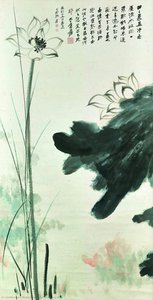
 Lotus - Chang Ta-chien
A titan of the 20th century Chinese painters, Chang Ta-chien (1899–1983) achieved a profound synthesis of ancient heritage and avant-garde innovation. His journey began with a precocious talent that saw him engaged in fortune-telling at age twelve, a spiritual beginning that informed his deep connection to symbolism. His artistic evolution was marked by a radical reimagining of form, moving from the disciplined mastery of calligraphy and traditional ink wash toward a pioneering role in geometric abstraction. A pivotal moment in his development was his immersion in the magnificent Buddhist cave murals of Dunhuang, which provided a spiritual and technical foundation that resonated through his entire oeuvre.
In his later years, as vision loss challenged his perception, his work transitioned into a powerful exploration of abstraction. His representative work, Lotus (1980), exemplifies this metamorphosis. Created just three years before his death, the piece eschews painstaking detail for the unerring strength of the hand. Large, unruly daubs of ink and color form the leaves, while towering stems and strategically placed details create a rhythmic tension against bold color fields. The result is a work of immense tactile power and quiet prestige.
Wu Chang-shuo
 Spring Offerings - Wu Chang-shuo
A towering figure in the transition of Chinese aesthetics, Wu Chang-shuo (1844–1927) remains a cornerstone of the 20th century painters from People's Republic of China. His career bridged the waning years of the Qing Dynasty and the dawn of the modern era, profoundly influencing the stylistic direction of the century's art. He is celebrated for his masterful fusion of calligraphy and landscape painting, a technique that revitalized traditional genres through a unique, expressive spontaneity.
His approach was deeply rooted in rigorous calligraphic training, specifically the early scripts like Xiao Shu, which granted him an unparalleled command over brushwork and tonal harmony. This scholarly foundation allowed him to move beyond mere imitation, prioritizing mood and atmosphere over meticulous detail. In his representative work, Spring Offerings (1919), Wu demonstrates his "antiquarian epigrapher's taste," utilizing a style derived from archaic stone engravings. The composition—featuring the lingzhi mushroom, narcissus, and nandina berries—is not a literal depiction of nature but an abstract, rhythmic arrangement of forms and blank space. Through bold, centered-tip brushwork and strong diagonal movements, he transformed traditional emblems of longevity into a modern, emotive visual language.
Xie Zhiliu
 Vegetables and Fruits - Xie Zhiliu
A master of the Shanghai School tradition, Xie Zhiliu (1910–1997) remains a cornerstone of 20th century painters from the People's Republic of China. His life's work was a profound dialogue between rigorous classical training and the vibrant energy of modern Chinese art. Beginning his journey at just nine years old, Xie mastered the art of direct observation and the meticulous copying of Ming dynasty masters like Chen Hongshou, a discipline that granted his brushwork a delicate, rhythmic precision.
One of his most captivating explorations of form and composition is seen in Vegetables and Fruits. In this work, Xie demonstrates a sophisticated command of spatial arrangement, subtly shifting the placement of a lily bulb between a pomegranate and a turnip to find the perfect equilibrium. This experimentation reveals the quiet prestige of his technique, where every stroke captures the ephemeral essence of nature. His artistic evolution was further enriched by his travels to the Mogao Caves, where the ancient murals of Dunhuang met his refined, modern sensibility. Through his bird-and-flower compositions, Xie Zhiliu transformed the traditional into the timeless, securing his legacy as a vital voice in the 20th century Chinese canon.
Tristram Hillier
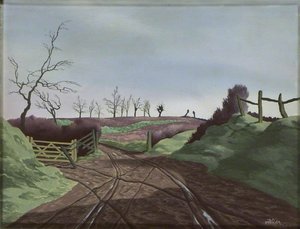 Trott's Lane - Tristram Hillier
In the evocative landscape of "Trott's Lane," painted in 1944, we encounter a moment of profound stillness. This work invites the viewer into a tranquil rural world, where a winding dirt road acts as a silent guide through a verdant expanse toward an unseen horizon. The composition is masterfully anchored by a rustic fence and a solitary figure, lending a poignant sense of scale and human connection to the vastness of the landscape. The atmosphere is defined by soft, diffused light filtered through an expansive, overcast sky, bathing the scene in a muted, melancholic glow and a harmonious palette of earthy tones and celadon greens.
Tristram Hillier, born in Beijing, belongs to this group of 20th-century painters from the People's Republic of China due to his formative beginnings in the capital. An influential English surrealist, his vision was shaped by a unique tapestry of international influences. After studying at Cambridge and immersing himself in the vibrant energy of Paris, he became a member of the Unit One group led by Paul Nash. His artistry is defined by a masterful ability to blend the tangible with the ethereal, navigating the delicate boundary between realism and the subconscious through meticulous detail and captivating, dreamlike imagery.
Gu Wenda
 Mythos of Lost Dynasties Series—I Evaluate Characters Written by Three Men and Three Women - Gu Wenda
In his seminal 1985 work, Mythos of Lost Dynasties Series—I Evaluate Characters Written by Three Men and Three Women, Gu Wenda engages in a profound interrogation of linguistic and cultural authority. By presenting variations of the character for "quiet" (jing) and marking them with traditional red pigments, he evokes the heavy-handed evaluations of the Cultural Revolution, transforming a pedagogical tool into a powerful commentary on political and social judgment. This experimental approach to the written word defines his position as a pivotal figure among 20th century painters from the People's Republic of China, as he navigates the tension between ancient heritage and modern upheaval.
Born in Shanghai in 1955, Gu Wenda’s practice is deeply rooted in the shifting landscapes of his youth. His work often bridges the gap between traditional Chinese calligraphy and avant-garde conceptualism, sometimes incorporating unconventional materials like human hair to explore themes of identity and globalism. His palette frequently leans toward sophisticated grays and ink tones, emphasizing the structural elegance of the characters he deconstructs. Through his provocative use of fabricated ideograms and historical motifs, Gu challenges the very foundations of language and the vulnerability of cultural memory.
Chen Wen Hsi
 Gibbons - Chen Wen Hsi
In his evocative 1989 work Gibbons, the vitality of the natural world is captured through a sophisticated lens of abstraction. Born in Guangdong, China, in 1906, Chen Wen Hsi emerged as a pivotal figure among 20th century painters from the People's Republic of China, later becoming a foundational architect of the Nanyang Style in Singapore. His artistic journey began at the Xinhua Academy of Fine Arts in Shanghai, where he mastered the delicate discipline of traditional Chinese ink painting.
Chen’s genius lies in his ability to bridge disparate worlds, fusing the rhythmic grace of Chinese brushwork with the structural boldness of Western modernism. Influenced by the cubist geometries of Picasso and the chromatic language of Paul Klee, he moved beyond mere representation to explore the essence of form. His palette often dances between earthy, rosy browns and vibrant, unexpected hues, applied with a precision that honors both the ink tradition and the tactile depth of oil. Whether depicting the spirited movement of animals or the quiet majesty of a landscape, his work remains a testament to the harmonious tension between heritage and innovation.
Cheong Soo Pieng
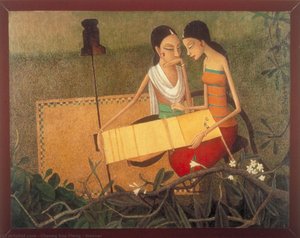 Weaver - Cheong Soo Pieng
In his 1981 work Weaver, Cheong Soo Pieng captures a rhythmic, meditative moment of communal life, depicting women engaged in the ancient art of cloth weaving. The composition utilizes a sophisticated arrangement of forms, where the subjects are anchored to a lush, sun-drenched landscape. Through thin, diluted oil paint, the artist achieves a specific lightness, allowing the figures to appear both grounded and ethereal within their tropical environment.
Born in 1917 in Amoy, Cheong Soo Pieng is a pivotal figure among 20th century painters from People's Republic of China due to his profound synthesis of Eastern heritage and Western modernism. After receiving a rigorous foundation in Chinese ink painting at the Xiamen Academy of Fine Art and in Shanghai, he moved to Singapore in 1946, where he became a primary architect of the Nanyang style. His work is characterized by a unique dialogue between the geometric precision of Cubism and the organic essence of Southeast Asian life. He often employed bold, saturated colors contained within thick black contours, frequently stylizing his subjects with elongated limbs and almond-shaped eyes to create a graceful, mythic quality that celebrates regional identity.
Jenny Sages
 Nancy Borlase and Laurie Short - Jenny Sages
Born in Shanghai in 1933, Jenny Sages represents a significant link in the lineage of 20th-century painters from the People's Republic of China. Her formative years in Shanghai provided a cultural foundation that she carried with her after relocating to Australia in 1948. Her artistic evolution is marked by a transition from her early studies and work as an illustrator to a profound mastery of texture and light. A defining moment in her career was a 1983 expedition to the Kimberley region, which infused her work with an enduring fascination for indigenous culture and the raw essence of landscape.
Sages is celebrated for her ability to merge contemporary realism with an almost tactile abstraction. She frequently employs a unique technique involving layered encaustic wax and pigment, which allows for a remarkable depth of surface while maintaining a sense of minimal, expressive brushwork. Her 1991 work, Nancy Borlase and Laurie Short, serves as a masterful example of her ability to capture human intimacy. Through a soft, diffused light and a palette of warm tones, she transforms a domestic scene into a quiet meditation on companionship and the dignity of shared life.
Liu Dan
 Study for Ink Handscroll - Liu Dan
Born in Nanjing in 1953, Liu Dan represents a profound evolution within the lineage of 20th century painters from the People's Republic of China. His artistic identity is a sophisticated synthesis of deep-rooted Confucian traditions and a rigorous engagement with Western realism. After receiving a foundational education in calligraphy and poetry, he refined his mastery of guohua at the prestigious Jiangsu Academy of Chinese Painting in Hangzhou. A pivotal shift occurred following his move to Hawaii in 1981, where his study of Renaissance drawings allowed him to bridge the gap between Eastern ink sensibilities and Western structural precision.
His work often captures the Daoist essence of the natural world, reviving the ancient appreciation for scholar-stones through a contemporary lens. In his Study for Ink Handscroll (1990), one observes his meticulous technical process. This piece serves as a vital precursor to his monumental handscrolls, utilizing a precise grid system to transfer intricate pencil sketches into expansive, textured ink compositions. Through his ability to harmonize turbulent seascapes with the stillness of traditional landscape art, Liu Dan has secured his place as a master of contemporary ink wash technique.
Conclusion
The 20th century was a transformative era for Chinese art, a period where the traditional ink-wash legacies of masters like Wu Chang-shuo and Xie Zhiliu met the evolving sensibilities of a modernizing world. From the sweeping, academic realism of Xu Beihong to the bold, experimental abstractions of Chen Wen Hsi and Cheong Soo Pieng, these artists redefined the visual language of the People's Republic of China. Whether through the delicate precision of Liu Dan or the expressive, cross-cultural dialogues of Jenny Sages, this group of painters bridged the gap between ancient heritage and contemporary innovation, leaving behind a profound legacy that continues to resonate in global art history.
At Mus3ums.com, we invite you to bring this rich cultural history into your own living space. Our artisans specialize in creating museum-quality, hand-painted oil reproductions that capture the unique textures and spirit of these masterpieces. You can explore our full collection and find the perfect piece to transform your home with the timeless elegance of 20th-century Chinese artistry.


