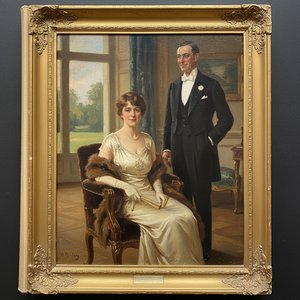
A Legacy of Lineage and Light
Born into the very heart of the British artistic aristocracy on the first of October, 1861, Sir Philip William Burne-Jones carried a name that was synonymous with the ethereal beauty of the Pre-Raphaelite movement. As the eldest son of the legendary Sir Edward Burne-Jones and the accomplished Georgiana Macdonald, his life was woven into a tapestry of profound creative influence. Growing up in London, surrounded by the whispers of myth and the vibrant colors of his father’s romantic visions, Philip was destined for a life shaped by the aesthetic ideals of his era. Though his early academic path at Oxford University did not culminate in a degree, this departure from traditional scholarship led him toward a more visceral engagement with the canvas, as he sought to honor his family's formidable artistic heritage through dedicated study in the studios of London.
His development as a painter was marked by a transition from the shadow of his father’s monumental style into a professional career that gracefully spanned the twilight of the Victorian era and the dawn of the Edwardian age. While he inherited the technical prowess required to navigate the prestigious halls of the Royal Academy, Philip carved out a distinct space for himself. His oeuvre, consisting of more than sixty significant works, demonstrated a versatile mastery over diverse genres. He moved with ease between the intimate psychological depth of portraits, the sweeping serenity of landscapes, and the evocative, dreamlike realms of poetic fantasies. This breadth allowed him to capture not only the likenesses of his contemporaries but also the shifting moods of a society moving toward modernity.
Mastery of the Canvas and Global Recognition
The technical brilliance of Burne-Jones was frequently recognized by the most discerning critics of his time. His ability to command attention in the competitive art markets of Europe led to numerous exhibitions at some of the world's most esteemed institutions. Between 1898 and 1918, the Royal Academy showcased his talent on eleven separate occasions, a testament to his enduring relevance within the British art establishment. Furthermore, his reach extended far beyond the English Channel; his participation in the Paris Salon of 1900 signaled his arrival as an artist of international standing, capable of competing with the finest painters of the fin de siècle.
One of his most poignant achievements was his ability to bridge the gap between personal tribute and public art. His portrait of his father, Sir Edward Burne-Jones, remains a significant piece of art history, now preserved within the National Portrait Gallery. Through such works, Philip did more than merely record a face; he captured the essence of a lineage. His paintings often possessed a certain narrative weight, where every brushstroke served to deepen the storytelling, whether through the subtle play of light on a landscape or the complex emotional layers found in his character studies.
Historical Significance and Enduring Spirit
Beyond the individual merits of his paintings, Philip Burne-Jones holds a unique position in the historical narrative of British art. As a 2nd Baronet, he embodied the intersection of the landed aristocracy and the bohemian creative class. His life was inextricably linked to other titans of the age, including his cousin, the famed author Rudyard Kipling, and the statesman Stanley Baldwin. This web of connections placed him at the center of a cultural zeitgeist that valued both tradition and the burgeoning explorations of the new century.
Though the title of his family line became extinct upon his death in June 1926, the artistic imprint he left behind remains a vital chapter in the story of late Victorian painting. He did not merely exist as an heir to a great name; he was a painter who navigated the complexities of his era with grace, contributing a unique voice to the evolution of British portraiture and landscape art. His work stands as a bridge between the romanticized medievalism of the Pre-Raphaelites and the more grounded, observational styles that would follow, ensuring that the Burne-Jones legacy continued to resonate long after the Victorian sun had set.
Frågor och svar
Vilka andra namn eller alias använder sig Philip Burne-Jones av?
Philip Burne-Jones är även känd under namnen Sir Philip Burne-Jones, Sir Burne-Jones, Philip, Sir Burne-Jones, Philip, Sir, 2nd Bart. Burne-Jones, Philip Burne-Jones Sir 2nd Bart..
Var och när föddes Philip Burne-Jones?
Philip Burne-Jones föddes i London år 1861.
Under vilken historisk period verkade Philip Burne-Jones?
Philip Burne-Jones verkade under perioden 19th Century, vilket placerar konstnärens gärning i ett historiskt sammanhang.