What is David Hockney's style?
 A bigger splash
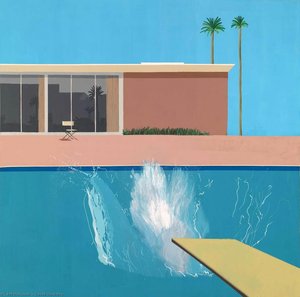
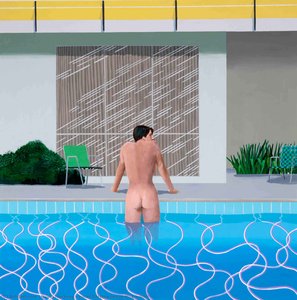
A bigger splash, David Hockney
David Hockney is defined by a vivid, stylized realism that emphasizes bold lines, bright palettes, and a unique approach to perspective. His work often captures a sense of serene tranquility or dynamic motion, utilizing flat planes of color and expressive brushstrokes to translate the visual experience of the world.
In his iconic 1966 painting, A Bigger Splash, the artist captures the sun-drenched atmosphere of California. The work uses a bright palette of cobalt blue and Naples yellow to depict a modernist house and a swimming pool. The composition relies on a contrast between the flat, even surfaces of the architecture and the intricate, heavily worked splash of water in the pool.
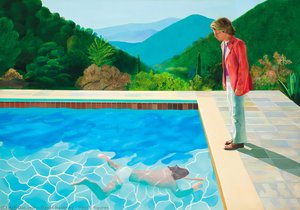
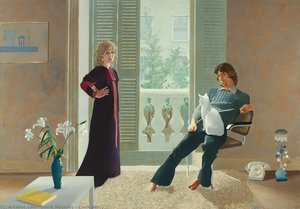
His portraiture is equally distinctive, characterized by a strong linearity and a focus on capturing the essence of his subjects. From 1968, he began painting portraits and double portraits of friends and family in a realistic style that adroitly captured their likenesses. His body of work is vast and varied, including:
- Over 300 self-portraits exploring his own figure.
- Intimate portraits of lovers and relatives, such as Peter Schlesinger.
- "Joiner" photographs, which are collage-like compositions made from multiple photographs to challenge singular viewpoints.
How did his use of color and composition evolve?
Hockney’s approach to color and composition moved from the structured, high-contrast aesthetics of 1960s Pop Art toward more experimental, fragmented, and digital explorations. He transitioned from depicting static, sun-drenched Californian landscapes to creating complex, multi-faceted narratives through photography and modern technology.
During his time in Los Angeles, his compositions often focused on the bright, high-contrast light of the American West. These early works utilized saturated colors to capture the aspirational lifestyle of the era. As his interests shifted, he began experimenting with how we perceive space and time, leading to his "joiner" photographs. These works assemble multiple perspectives into a single, dynamic composition, moving away from the traditional, singular viewpoint of a standard camera.
In his later years, Hockney embraced the digital age, utilizing iPads as a primary tool for creation. This evolution shows a lifelong commitment to experimentation, proving that his vision is not confined to a single medium. Whether working with acrylics, etchings, or digital drawings, his work remains a continuous exploration of how we see the world around us.
Which art movements and techniques influenced him?
Hockney was a pivotal contributor to the Pop Art movement of the 1960s, blending Pop sensibilities with a uniquely British perspective. His work is also shaped by technical innovations, including the use of optical aids and specialized printmaking methods like the sugar lift technique.
His technical repertoire is remarkably diverse, reflecting a deep curiosity about the mechanics of sight. In his 2001 book, Secret Knowledge: Rediscovering the Lost Techniques of the Old Masters, he posited that Renaissance painters used optical aids like the camera obscura and camera lucida to achieve their level of naturalism. This interest in the intersection of art and optics has informed his own investigations into perception and reality.
His printmaking and technical collaborations further highlight his versatility:
- Sugar Lift Technique: Adopted from Aldo Crommelynck, a collaborator who was Picasso's preferred printer.
- Wooden Frame System: A method devised by Crommelynck to ensure precise color separation on plates.
- The Blue Guitar: A suite of 20 etchings created between 1976 and 1977, filled with references to Picasso.
- Cubist Influences: His landscapes often evoke the spirit of Cubism through vibrant colors and stylized imagery.
Frequently asked questions
Where was David Hockney born?
David Hockney was born in the industrial heartland of Yorkshire, specifically in Bradford, United Kingdom.
How many self-portraits has David Hockney made?
David Hockney has created more than 300 self-portraits throughout his career.
What is David Hockney's most famous Pop Art work?
His 1966 work A Bigger Splash is considered a landmark of Pop Art.
What technique did David Hockney use?
He used the sugar lift technique from Aldo Crommelynck.
Learn more
- 1937 –David HockneyExplore the life and career of this influential British artist.
- David Hockney · 1967A Bigger SplashDiscover the history behind the iconic Pop Art masterpiece.