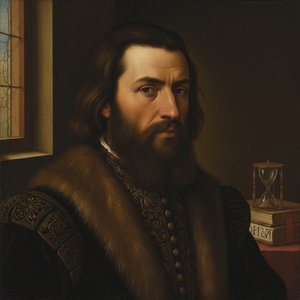
The Painter of Ferrara’s Shadows
Giovanni di Niccolò de Luteri, known to history as Dosso Dossi, lived a life defined by the courtly rhythms of Ferrara and Modena. Born around 1489 in Tramacchio, Italy, his early years were shaped by the influence of Lorenzo Costa. This apprenticeship provided him with a foundation in the traditions of the School of Ferrara, yet his spirit moved toward the luminous, atmospheric qualities found in Venetian painting. He did not merely replicate the styles of Giorgione or Titian; he absorbed their light and reconfigured it through a more enigmatic lens.
His professional existence was closely tied to the Este dukes, serving as a court artist under Alfonso I d'Este and later Ercole II d'Este. This position allowed him to inhabit a world of mythological narratives and complex allegories. Alongside his brother, Battista Dossi, he participated in a creative environment where classical legends were transformed into something more personal and often unsettling. His work frequently featured:
- Mythological scenes set within lush, idealized landscapes.
- The use of cryptic allegorical symbols to convey hidden meanings.
- A technique involving the careful layering of oil paint to create texture.
- Deliberate distortions in proportion that challenged traditional perspective.
A Style of Light and Distortion
The brushwork of Dosso Dossi possessed a peculiar ability to blend color and space. He utilized the soft, ethereal qualities of nature to create landscapes that felt more like dreams than physical places. While his roots were in the precision of the early Renaissance, he moved toward a style that anticipated Mannerism through his use of striking disharmonies in color and unusual figure poses. His portraits often departed from the expected decorum of courtly art, presenting subjects with expressions that felt strikingly human.
In works such as The Trojans Repairing Their Ships in Sicily, one sees his attention to the minute details of costume and setting, from the brick-red and canary-yellow turbans to the way light hits a gilded sleeve. He had a talent for placing figures within environments where the boundaries between the heroic and the supernatural were blurred. This approach made him a central figure in the Ferrarese school, bridging the gap between the structured clarity of his predecessors and the more emotive, color-driven innovations of the later sixteenth century.
The End of an Era
By the time of his death in 1542, Dosso Dossi had left a distinct mark on the artistic landscape of Northern Italy. His influence reached beyond his immediate circle, touching pupils such as Gabriele Capellini and Jacopo Panicciati. He remained a painter of the court, yet his true legacy lies in the way he manipulated light and myth to create a visual language that was entirely his own. He did not seek to perfect reality, but rather to interpret it through a lens of mystery and profound psychological depth.
Soru ve Cevaplar
Dosso Dossi hangi ülkede doğdu?
Dosso Dossi, Italy doğumludur.
Dosso Dossi hangi şehir ve ülkede doğmuştur?
Dosso Dossi, Mirandola, Italy doğumludur.
Dosso Dossi başka hangi isimlerle tanınır?
Dosso Dossi, Giovanni di Niccolò de Lutero, Dosi da Ferrara, Giovanni Di Lutero Dossi, Luteri Dossi, Giovanni isimleriyle de tanınmaktadır.