Early Life, Family and Training
Emil Kosa Jr. was born in Paris, France, on November 28, 1903, into a family defined by technical and musical discipline. His father, Emil Kosa Sr., was a Czech artist, while his mother, Jeanne Mares Kosa, performed as a pianist for the Paris Opera. This lineage of craft and performance shaped his early environment, though the family's stability was disrupted early on. Following the death of his mother when he was only three, the family relocated to Bohemia.
His formal artistic foundation was built in Europe. Emil Kosa Jr. trained at the Academy of Fine Arts in Prague, a rigorous environment that provided the technical grounding necessary for his later versatility. This European education provided a sharp contrast to the American landscape he would eventually help define. After moving to the United States in 1921 to rejoin his family, he continued to refine his skills through specialized instruction. He took art courses at the California Institute of the Arts in Valencia, bridging the gap between his classical training and the specific demands of the American West Coast art scene.
Career in California and Special Effects
After moving to the United States in January 1921 and becoming a naturalized American citizen in 1927, Kosa Jr. transitioned from mural work into the machinery of the Hollywood studio system. His entry into the film industry arrived in 1933 when he joined the special effects department at 20th Century Fox. This was not a brief stint; he maintained his position as an art director for 35 years, a tenure that saw the studio evolve through significant industry shifts. His technical precision helped define the visual identity of the era, including his contribution to the creation of the first logo for 20th Century Pictures.
His influence extended beyond mere set design into the realm of high-stakes visual illusion. Kosa Jr. achieved significant industry recognition when he won an Academy Award for his work on the film Cleopatra. This achievement solidified his status as a technician capable of managing the complex visual demands of large-scale productions. While his fine art paintings continued to circulate in galleries, his professional legacy remains anchored in this ability to manipulate light and perspective for the screen.
Technique and Artistic Style
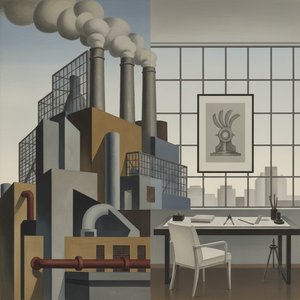
Kosa Jr. was a central figure in the California Scene Painting movement, a style defined by its focus on the specific topography and changing environments of the West Coast. He did not shy away from the friction of modernization. While many of his contemporaries sought purely idyllic landscapes, his work frequently documented the industrial reality of a developing state. He captured trains, oil wells, and the grit of urban settings with a directness that avoided sentimentality. His ability to find order in these industrial city scenes made him a leading West Coast watercolor artist during the 1930s.
His technical versatility allowed him to move between the precision required for watercolor and the weight of oil painting. In watercolor, he achieved a level of proficiency that earned him a national reputation, sending dozens of works annually to major museum exhibitions across America. His approach to both mediums remained grounded in the observation of light and structure. Whether he was rendering a landscape or a commissioned portrait of a political figure, the work remained focused on the physical reality of the subject rather than an idealized version of it.
Key Works and Collections
Kosa’s legacy is anchored by a duality between fine art and cinematic utility. His technical precision is evident in early works like Považský Castle with Church, dated about 1912, and Old Chinese Gulch, dated about 1940. These pieces demonstrate a command over landscape and urbanity that predates his major Hollywood contributions. The Smithsonian American Art Museum holds one of his works, confirming his place within the established American canon. His ability to manipulate light and space was not merely a studio skill but a functional necessity for the film industry.
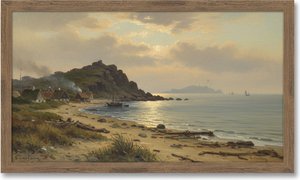
In the realm of cinema, his most significant contribution remains the matte painting of the Statue of Liberty for the film Planet of the Apes. This specific visual achievement remains a benchmark in the history of special effects. Beyond the screen, his fine art output remains substantial. The Hilbert Museum features over 40 of his fine art pieces, ranging from watercolors to oils. These works provide a direct look at his ability to capture the changing California landscape without the artifice of studio lighting.
Запитання та відповіді
До якого історичного періоду належить творчість Emil Kosa Jr.?
Emil Kosa Jr. працював у період Modern. Цей період визначає місце творчості митця в історії.
Звідки родом Emil Kosa Jr.?
Emil Kosa Jr. народився у France.
Де і в якому році народився/народилася Emil Kosa Jr.?
Emil Kosa Jr. народився/народилася в Paris у 1903 році.