The Dual Legacy of Johann Dietrich Carl Kreul
Johann Dietrich Carl Kreul remains a fascinating figure in the annals of German art history, embodying a rare intersection of creative vision and industrial innovation. Born in Ansbach, he was a man whose life was defined by both the delicate brushstroke and the mechanical gear. As a genre and portrait painter, Kreul possessed a profound ability to capture the essence of his subjects, blending the meticulousness of classical training with the emerging sensibilities of Romantic Realism. His work often sought to bridge the gap between outward appearance and inner temperament, creating portraits that served as meditations on character and intellect.
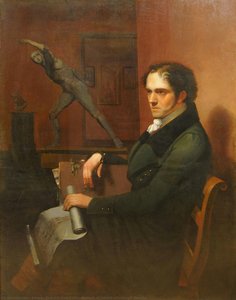
In his paintings, such as the compelling 1824 portrait of Albert Christoph Reindel, Kreul demonstrated a masterful command over light and shadow. He had a particular talent for constructing narratives within a single frame, using meticulously rendered interiors—filled with books, musical instruments, and classical statues—to suggest the contemplative nature of his subjects. His genre scenes were equally evocative, capturing the rhythms of everyday life with a careful reproduction of color and detail that invited viewers to engage deeply with the unfolding stories on canvas.
An Inventor’s Vision and Industrial Triumph
Beyond the easel, Kreul was a gifted craftsman and an ingenious inventor. During an era when every artist had to act as their own chemist—painstakingly grinding pigments and mixing them with oils by hand—Kreul recognized a way to revolutionize the medium. He developed a sophisticated color rubbing machine designed to simplify the production of oil paints while maintaining an exceptionally high standard of quality. This technical breakthrough was not merely a convenience for himself but a gift to his contemporaries, as it eased the laborious preparation process that had long burdened the artistic community.
This spirit of entrepreneurship led to one of his most enduring historical contributions. In 1838, he founded the first German artists' paint factory, C. Kreul. From its beginnings in Nürnberg and later expansion to Forchheim, the factory established a reputation for excellence that resonated throughout Europe. The manufacturing principles he established were so robust that they continued to define the production of high-quality oil paints for generations. Through this venture, Kreul transitioned from a solitary creator to a foundational figure in the material history of art, ensuring that his influence would be felt through the very tools used by countless painters following in his footsteps.
Запитання та відповіді
У якому місті та країні народився/народилася Йоганн Дітріх Карл Кройль?
Йоганн Дітріх Карл Кройль народився/народилася у Ансбах, Німеччина.
Звідки родом Йоганн Дітріх Карл Кройль?
Йоганн Дітріх Карл Кройль народився у Німеччина.
Які псевдоніми або інші імена має Йоганн Дітріх Карл Кройль?
Йоганн Дітріх Карл Кройль також відомий під іншими іменами: Йоганн Кройль, Johann Dietrich Carl Kreul.