A Life Shaped by the Old Masters
The story of Friedrich Bury is one deeply intertwined with the cultural currents of late eighteenth and early nineteenth-century Europe. Born in Hanau, Germany, his artistic journey began under the watchful eye of his father, Jean Jacques Bury, a goldsmith and engraver who provided his first lessons in drawing. This foundational training was soon expanded through studies with Anton Wilhelm Tischbein, setting the stage for a career defined by academic rigor and a profound reverence for the past. His early travels took him to the Kunstakademie Düsseldorf, where he immersed himself in the study of masters like Peter Paul Rubens, a pursuit that would later inform his delicate handling of light and form.
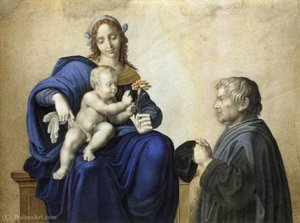
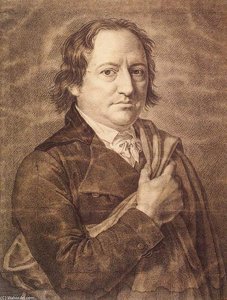
In 1782, Bury embarked on a transformative journey to Italy alongside his friend Heinrich Lips. This period in Rome was perhaps the most formative of his life, as he lived amidst the echoes of antiquity and the Renaissance. It was during these years that he encountered the legendary Johann Wolfgang von Goethe, a connection that would prove pivotal for his professional standing. Living in the very spaces where Goethe once resided, Bury found himself part of an intellectual circle that valued the preservation and study of classical beauty. His role as a copyist, recreating works from the fourteenth century under the patronage of figures like Duchess Anna Amalia of Saxe-Weimar, allowed him to internalize the techniques of Perugino, Fra Bartolommeo, and Andrea Mantegna.
The Art of Introspection and Courtly Grace
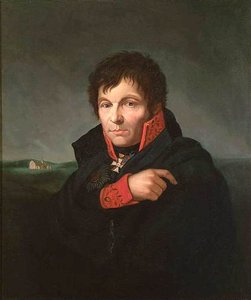
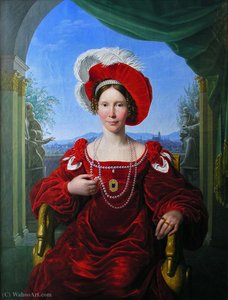
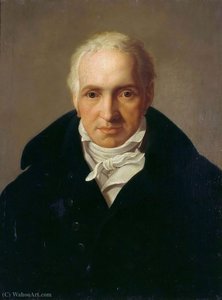
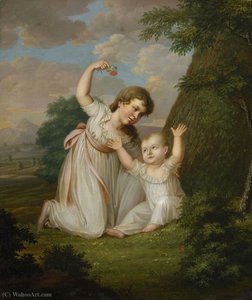
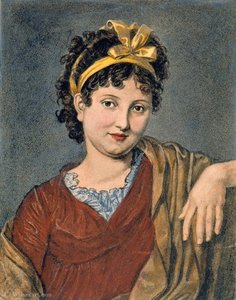
As his career progressed, Bury transitioned from a student of the masters to a respected portraitist and court painter. His appointment to the royal courts of Kassel and Brussels speaks to his ability to capture not just the likeness, but the very essence of his subjects. In his portraiture, one finds a masterful command of texture and a sophisticated use of muted tones—deep charcoals, soft ivories, and subtle earth hues that lend an air of quiet dignity to his compositions. His work often transcends mere representation, offering what can be described as a meditation on status and character.
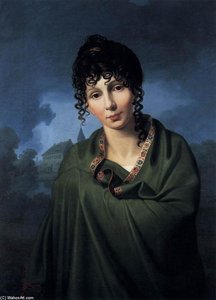
A notable example of his skill is seen in his depiction of Countess Luise von Voss. In this work, Bury achieves a sense of arresting stillness, where the subject's gaze, subtly directed away from the viewer, suggests a rich, unfolding inner life. The technical execution—the liquid grace of dark fabrics and the meticulous rendering of lace—demonstrates an artist deeply concerned with verisimilitude and the tactile splendor of the era. Through his brush, the formal portraiture of the early nineteenth century evolved into something more nuanced, capturing the thoughtful melancholy and introspective spirit of the age.
Legacy and Historical Significance
The trajectory of Bury's life eventually led him to Berlin, where he was presented to the Prussian royal family. His role as a teacher to figures such as Princess Augusta of Prussia and Wilhelmine of Prussia (later Queen of the Netherlands) solidified his position within the highest echelons of European society. Though his life was marked by the political upheavals of his time, including the occupation of Rome by French troops which forced his return to Hanau, his artistic contribution remained steadfast.
Bury’s significance lies in his ability to bridge the gap between the classical traditions he studied in Italy and the evolving sensibilities of the Biedermeier period. He was more than a mere copyist; he was an artist who breathed new life into ancient forms, translating the grandeur of the Old Masters into the intimate, psychological language of his contemporary era. His legacy survives through the portraits that continue to invite observers to wonder at the narratives held within shadowed eyes and the quiet dignity of a bygone age.
问答详情
弗里德里希·布里 的创作时期属于哪个历史阶段?
弗里德里希·布里 的创作活跃于 近代早期 时期,这一时期确立了艺术家在艺术史上的地位。
弗里德里希·布里 出生于何时何地?
弗里德里希·布里 于 1763 出生于 哈瑙。