A Life Etched in Ink: The World of Jo Heeryong (趙熙龍)
Born amidst the vibrant cultural landscape of Hanyang, present-day Seoul, in 1789, Jo Heeryong – also known by his art name, Woobong – emerged as a significant figure within the late Joseon Dynasty’s artistic sphere. His life was one interwoven with both imperial patronage and personal hardship, ultimately shaping a distinctive style that blended traditional Korean aesthetics with subtle yet compelling innovations. While biographical details remain somewhat fragmented, piecing together accounts from historical records, scholarly analyses, and his own works reveals a dedicated artist deeply connected to the natural world and profoundly influenced by the intellectual currents of his time. He was not merely a painter; he embodied a trifecta of artistic mastery, excelling in poetry, calligraphy, and painting – a testament to the holistic approach to art valued during the Joseon period.The Brushstrokes of Loyalty and Exile
Jo Heeryong’s career reached a pivotal moment when King Heonjong, himself an enthusiastic patron of the arts, commissioned him and others to undertake a journey to Mount Kumgang in 1849. This expedition, intended as a display of Korean diplomatic strength and artistic prowess, resulted in a series of paintings documenting the mountain's breathtaking beauty – works that remain highly prized today. The experience clearly resonated with Woobong, influencing his later depictions of landscapes and botanical subjects. However, this period of imperial favor was abruptly curtailed by political turmoil. In 1851, he faced banishment to Imja Island in Sinan County, a remote and harsh location, due to circumstances that remain somewhat obscure within historical accounts. This exile, lasting until 1853, undoubtedly impacted his artistic output, though it also provided him with an opportunity for introspection and a deeper connection with the natural world surrounding him. It is speculated that this period of isolation fostered a refinement in his technique, allowing him to focus on capturing subtle nuances of nature with even greater precision.A Harmony of Tradition and Innovation
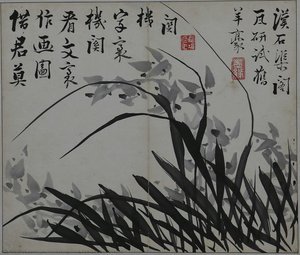
Woobong’s artistic style firmly rooted itself within the established traditions of Korean painting, particularly the *oriental* tradition, drawing heavily from Chinese ink wash techniques (*Chinese Ink Style*). He demonstrated a particular affinity for depicting plum blossoms, orchids, bamboo, and pine trees – subjects laden with symbolic meaning in Korean culture. Plum blossoms, for instance, represent resilience and perseverance through adversity, while bamboo symbolizes integrity and humility. However, Woobong’s work wasn't simply a replication of existing forms; he subtly infused his paintings with a unique sensibility. While adhering to the meticulous detail characteristic of Joseon landscape painting, he often employed a looser, more expressive brushstroke, particularly in depicting foliage, creating a sense of movement and vitality that distinguished him from some contemporaries. His ability to capture the essence of these subjects—the delicate curve of a plum blossom branch, the weathered texture of ancient pine bark—demonstrates an acute observational skill and a profound understanding of natural forms.Legacy and Lasting Influence
Jo Heeryong’s artistic legacy extends beyond his surviving paintings. As a member of the *Byeokosisa* group – a collective of artists dedicated to preserving traditional Korean painting styles – he played a crucial role in transmitting these techniques to subsequent generations. His work has been showcased in numerous exhibitions, both domestically and internationally, and frequently appears at auctions, attesting to its enduring appeal among collectors and art enthusiasts. The National Museum of Korea houses several significant examples of his oeuvre, including the celebrated “Mokjukdo” (Painting of Trees and Bamboo), which exemplifies his mastery of composition and brushwork. Though he passed away in 1866, Jo Heeryong’s contribution to Korean art remains undeniable – a testament to an artist who navigated political upheaval with grace and channeled his experiences into works of enduring beauty and profound cultural significance. His paintings offer a window into the world of the late Joseon Dynasty, revealing not only its artistic conventions but also the spirit of resilience and appreciation for nature that defined the era.问答详情
Jo Heeryong(趙熙龍, 1789-1866) 的创作时期属于哪个历史阶段?
Jo Heeryong(趙熙龍, 1789-1866) 的创作活跃于 19th Century 时期,这一时期确立了艺术家在艺术史上的地位。
Jo Heeryong(趙熙龍, 1789-1866) 出生于何时何地?
Jo Heeryong(趙熙龍, 1789-1866) 于 1789 出生于 Seoul。
Jo Heeryong(趙熙龍, 1789-1866) 来自哪里?
Jo Heeryong(趙熙龍, 1789-1866) 出生于 South Korea。