The Wandering Brush of Symeon Savvidis
Born in Tokat, Turkey, the life of Symeon Savvidis, also known by his name Sabbides, was a journey through the heart of European academic tradition and personal discovery. Though he began his formal education at the School of Commerce on the island of $\text{Heybeliada}$, his innate passion for sketching eventually led him toward the architectural halls of Athens Polytechnic University. It was during this formative period between 1878 and 1880 that his destiny as a painter truly took shape, fueled by an undeniable talent that could not be contained by commerce or construction.
The trajectory of Savvidis's career was profoundly shaped by the prestigious Munich School. With the support of benefactors, he traveled to the Academy of Fine Arts Munich, where he immersed himself in the rigorous techniques of masters such as Wilhelm von Diez, Ludwig von Löfftz, and Nikolaos Gyzis. For over forty years, Munich served as his artistic home, a period during which he refined a style that would later evolve from academic precision into something far more vibrant. His presence in the European art scene was felt across major cultural hubs; he exhibited his works in Berlin, Leipzig, Hamburg, Vienna, Paris, and London, bringing a unique perspective to the international stage.
Themes of Anatolia and the Evolution of Light
While deeply rooted in the German academic tradition, Savvidis maintained a profound connection to his origins. He frequently undertook travels to Anatolia, seeking inspiration in the landscapes and cultures that informed his most recognizable subject matter. His works often centered on Turkish themes, capturing the essence of a world that sat at the crossroads of East and West. This fascination with the exotic and the familiar allowed him to create a body of work that felt both deeply personal and broadly accessible.
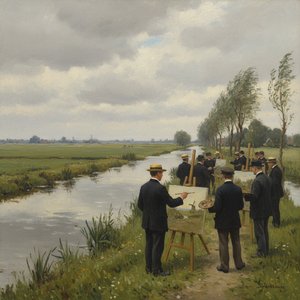
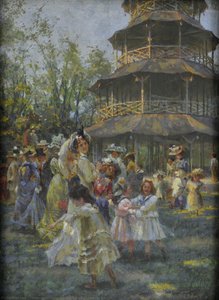
As time progressed, the artist underwent a remarkable stylistic metamorphosis. The disciplined, structured approach of his Munich training gradually gave way to a more luminous and spontaneous expression. In his later years, Savvidis embraced a colorful, Impressionistic style, moving away from rigid forms toward the capture of fleeting light and atmosphere. This period of his life was marked by an almost scientific fascination with the natural world; he even developed a unique method for predicting the weather by observing the specific hues found in the dawn and sunset, demonstrating that for him, color was not merely an aesthetic tool but a language of nature itself.
Legacy and Final Years
Despite his immense talent and international reach, the later years of Savvidis's life were marked by hardship. The devastation of the First World War severed many of his professional ties and brought him close to poverty. In 1925, facing both illness and financial struggle, he moved to Athens, where he would eventually pass away in February 1927. Though he did not achieve widespread commercial success during his lifetime, his artistic contribution has been recognized by posterity.
The enduring significance of his work is evidenced by the retrospective honors bestowed upon him long after his death. Major exhibitions, such as the large-scale presentation at the National Gallery of Greece in 2006 and a significant retrospective in Athens in 1931, have allowed scholars and art lovers to rediscover the depth of his vision. Today, his paintings remain a testament to a life spent chasing the light, bridging the gap between the structured traditions of Munich and the vibrant, emotive possibilities of Impressionism.
问答详情
Symeon Savvidis 的创作时期属于哪个历史阶段?
Symeon Savvidis 的创作活跃于 19th Century 时期,这一时期确立了艺术家在艺术史上的地位。
Symeon Savvidis 出生于哪个国家和城市?
Symeon Savvidis 出生于 Turkey 的 Tokat。
Symeon Savvidis 是否还有其他别名或曾用名?
Symeon Savvidis 也被称为 Sabbides。