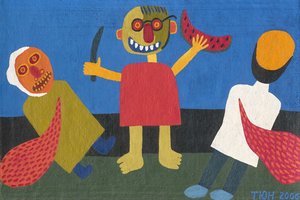
The Dreamscapes of Yury Tatianin: A Journey Through the Subconscious
Born in Lipetsk, Russia, in 1963, Yury Tatianin has carved a singular path in the contemporary art world, one that bypasses formal academic structures in favor of a deeply personal, self-taught odyssey. His work does not merely seek to replicate the visible world; instead, it acts as a bridge to the unseen, delving into the profound depths of isolation, memory, and the human subconscious. Tatianin’s artistic identity is rooted in a lifelong fascination with art history, allowing him to weave the legacies of past masters into a modern, surrealist tapestry that feels both ancient and strikingly immediate.
The foundations of his visual language were laid through an intimate encounter with the radical spirits of the early 20th century. The emotive intensity of Vincent van Gogh and the geometric provocations of Kazimir Malevich served as more than mere influences; they became the pillars upon which he built his own symbolic architecture. From these titans, Tatianin inherited a belief that art must transcend literal depiction to achieve emotional resonance. His style emerged from this intersection of Post-Impressionist passion and Suprematist abstraction, resulting in a unique aesthetic that blends the dream-logic of Surrealism with the haunting, spiritual undertones of Russian Symbolism.
Symbolism and the Architecture of Solitude
To gaze upon a Tatianin canvas is to enter a psychological landscape where reality is perpetually dissolving. His technique is characterized by a masterful manipulation of texture and color, often utilizing muted palettes to evoke a sense of melancholic stillness. He frequently employs recurring motifs—solitary figures, unexpected objects, and void-like settings—to explore the weight of personal experience and the fragility of human connection. In his work, even the most mundane elements are imbued with a heavy, symbolic significance, turning every painting into a cryptic cipher waiting to be decoded by the viewer.
One of his most profound explorations of this theme is found in his celebrated works, which often feature:
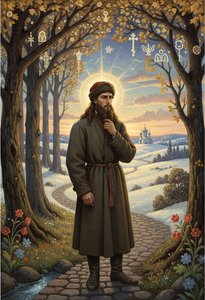
- Self-Portrait with Malevich and Van Gogh: A breathtakingly surreal encounter where the artist places himself within a temporal bridge, confronting his own identity against the monumental ghosts of modernism. The inclusion of unsettling details, such as a knife held in stillness, injects a sense of latent danger into the historical dialogue.
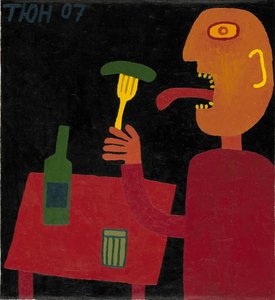
- Dinner Alone: A poignant application of Surrealist Expressionism that utilizes haunting imagery to communicate the visceral sensations of anxiety and profound isolation.
A Legacy of Idea and Ambivalence
Tatianin’s place in the contemporary canon is marked by a deliberate embrace of what some might call "naïve art," yet his work possesses an intellectual rigor that defies simple classification. He operates with the philosophy that art is the power of the idea, not merely the material, echoing the tenets of conceptualism. This approach allows him to navigate the tension between the primitive and the incomprehensible, creating works that are intentionally ambivalent and open to a multitude of interpretations.
His achievements have earned him significant recognition within the Russian art scene, most notably through his inclusion in the permanent collection of the Erarta Museum. The fact that his work has been featured in personal exhibitions at such prestigious institutions underscores his importance as a visionary who can bridge the gap between highbrow conceptualism and raw, emotive expression. Through his meticulous attention to detail and his fearless exploration of the psyche, Yury Tatianin continues to invite us into a contemplative dialogue about what it means to exist within the beautiful, unsettling shadows of our own memories.
问答详情
Yury Tatianin 是否还有其他别名或曾用名?
Yury Tatianin 也以 Tatianin Yury 等其他名称为人所知。
Yury Tatianin 的创作时期属于哪个历史阶段?
Yury Tatianin 的创作活跃于 Contemporary 时期,这一时期确立了艺术家在艺术史上的地位。
Yury Tatianin 出生于何时何地?
Yury Tatianin 于 1963 出生于 Lipetsk。