


The History and Origins of Augusteum
The Augusteum exists as a German art museum within the city of Oldenburg. The building was commissioned by Grand Duke Peter II of Oldenburg in 1873. It was named in honor of his father, Augustus, Grand Duke of Oldenburg. While the structure was completed in 1867, it officially opened in 1876 as the first art museum in Oldenburg. This opening marked a significant moment for the region, establishing a dedicated space for the public to encounter art.
For several decades, the building functioned as a public museum, maintaining its role through the turn of the century until 1918. Following a period of transition, the site underwent extensive refurbishment. In 1981, the Augusteum re-opened as a constituent part of the State Museum. It remains a central location for the study of the Old Masters within the local landscape.
Architecture and Design of the Building
The Augusteum occupies a position near the northeast corner of the Schlossgarten Oldenburg. Designed by architect Ernst Klingenberg, the structure reflects the principles of the Neo-Renaissance style. Its form is often identified as a Florentine palace style, appearing as a yellow brick Italian Renaissance palazzo. The building's presence is defined by these specific proportions and the deliberate use of masonry.
Inside, the architecture directs attention toward the grand staircase. This central feature is decorated with paintings by Christian Griepenkerl, which were commissioned by the Grand Duke. The interplay of light and the verticality of the staircase create a sense of order within the interior. The design maintains a dialogue between the structural elements and the decorative surfaces provided by the commissioned works.
The Old Masters Collection
The Augusteum houses the Old Masters Gallery, a space where the presence of historical painting remains central to the building's purpose. Since 1981, the collection of Dutch and Flemish masters has been on display within these walls. The selection spans from the 15th to the 18th centuries, bringing together works from Dutch, Italian, German, and French traditions. These paintings exist here as quiet witnesses to the shifting aesthetics of several centuries.
The weight of the Dutch and Flemish influence is particularly felt in the selection of landscapes and portraits. One finds the works of Barent Avercamp and Jan Wy among the holdings, alongside the dramatic intensity of Rembrandt van Rijn. These canvases occupy the gallery as physical entities, their surfaces holding the light and shadow of a bygone era. The arrangement allows for a direct encounter with the specificities of Northern European brushwork.
- Musical company in an interior, 1630 - Jan Miense Molenaer
- Ships off the coast, in the foreground a man on the shore, 1689 - Ludolf Bakhuizen
- Veit Dietrich on his Deathbed, 1655 - Lucas Cranach the Elder
- Portrait of a Boy, 1540 - Francesco Salviati
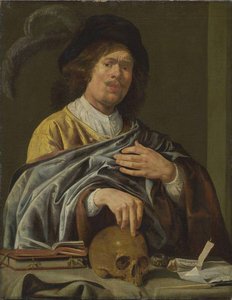
- Tronie of a man with a beret, 1653 - Christopher Paudiß
Major Acquisitions and Collection Foundations
The foundation of the collection was laid in 1804. During this year, Duke Peter I of Oldenburg acquired eighty-six paintings from Johann Heinrich Wilhelm Tischbein. This acquisition provided the nucleus for what would become the Grand Ducal collection of paintings. The presence of these works established a lineage of ownership that defined the museum's early holdings.
Grand Duke Peter II later expanded this assembly, establishing it as a public picture gallery. This transition moved the works from a private ducal sphere into a space of broader accessibility. The collection grew through these deliberate additions, building upon the initial Tischbein acquisition to form a cohesive body of art.
The stability of the collection faced a significant disruption following the abdication of Frederick Augustus II. During the subsequent period, a third of the former Grand Ducal Picture Gallery was sold and exported to the Netherlands. This loss altered the scope of the holdings, though the remaining works continue to represent the historical core of the institution.


