

Introduction
The transition from the rigid formality of the Byzantine tradition to a more lyrical, human-centered expression found its most profound expression in the workshops of medieval Italy. During this era, a distinct aesthetic emerged, characterized by a shift toward elegance, courtly grace, and a newfound sense of spatial depth. These painters moved away from the static, iconographic stiffness of the past, instead embracing slender, flowing figures and the luminous, ethereal beauty of gold-leaf backgrounds that seemed to dissolve the boundaries between the earthly and the divine.
This movement flourished within the vibrant urban centers of the Italian peninsula, where the rise of powerful merchant classes and the influence of monastic orders fueled a demand for sophisticated religious and secular narratives. It was a period of intense spiritual devotion expressed through visual splendor, where the use of tempera and gold was not merely decorative but a way to evoke the light of heaven. The works of this period represent a crucial bridge in art history, marking the vital steps toward the naturalism and perspective that would eventually define the Renaissance.
Today, these masters remain essential for understanding the evolution of Western visual language. Their ability to balance profound spiritual symbolism with a burgeoning interest in human emotion and physical grace continues to captivate viewers. By studying their delicate line work and rich color palettes, we gain insight into the very foundations of European painting. The following profiles examine ten pivotal figures—from the pioneering masters of Siena to the influential sculptors and painters of Florence—who defined this exquisite era of Italian art.
Duccio di Buoninsegna
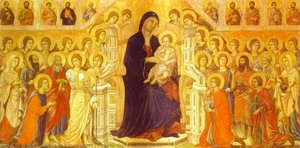
A central figure of the Sienese school, Duccio di Buoninsegna (c. 1255–1319) stands as a master of the Italian Gothic movement. His work epitomizes the era's aesthetic through a sophisticated marriage of spiritual symbolism and a burgeoning sense of three-dimensional form. Unlike the more rigid Byzantine traditions, Duccio introduced a graceful, courtly elegance characterized by slender, flowing figures and a profound sense of serenity.
His technical mastery of egg tempera and gold leaf allowed him to create luminous, glowing surfaces that seem to radiate divine light. This is most breathtakingly realized in his monumental Maestà (1308–1311), a masterpiece that defines the Gothic ideal. In this work, the Madonna and Child are enveloped in a celestial assembly, rendered with soft, organic lines and a rich palette of bronze and warm earthy tones. Through his ability to infuse sacred subjects with human tenderness and architectural depth, Duccio transformed the visual language of Tuscany, leaving an indelible mark on the evolution of medieval religious art.
- Movement: Italian Gothic
- Key Technique: Tempera and gold leaf on panel
- Primary Focus: Sacred iconography and graceful human forms
Simone Martini
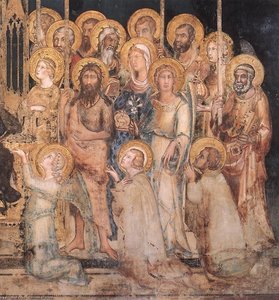 Maestà (detail) - Simone Martini
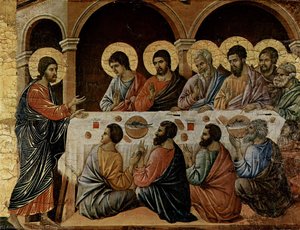
A central figure of the Sienese school, Simone Martini (c. 1284–1344) epitomizes the refined elegance of the Italian Gothic movement. Likely trained under the master Duccio di Buoninsegna, Martini transitioned from the foundational Sienese traditions to a style defined by unparalleled courtly grace and lyrical fluidity. His work is a testament to the Gothic aesthetic, characterized by slender, elongated figures and a sophisticated use of decorative detail that moves away from the heavy naturalism of his contemporaries toward a more ethereal, spiritual realm.
His mastery of tempera and gold ground is vividly realized in the Maestà (detail) of 1315. In this work, Martini demonstrates the quintessential Gothic preoccupation with rhythmic, flowing drapery and a luminous, celestial atmosphere. His ability to marry precise, delicate linework with a sophisticated palette of contemplative blues and greens allows his subjects to appear weightless, as if suspended in a state of perpetual adoration. From the religious centers of Italy to the papal courts of Avignon, Martini’s influence helped shape the visual language of the fourteenth century, blending sacred devotion with the high-style sensibilities of the European aristocracy.
Taddeo Gaddi
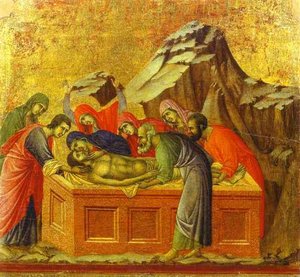
 The Lamentation over the Dead Christ - Taddeo Gaddi
A visitor can immediately recognize the hand of Taddeo Gaddi through his masterful command of luminous light and intricate, architectural storytelling. A prominent pupil of the legendary Giotto, Gaddi expanded the Giottesque tradition by infusing monumental naturalism with a delicate, ornamental elegance. His works are characterized by a sophisticated use of light that transforms flat surfaces into radiant, divine windows, often set within complex, detailed environments that bridge the gap between the medieval and the early Renaissance.
Gaddi’s place within the Italian Gothic movement is defined by this very synthesis: he maintained the slender, graceful figures and sacred narratives typical of the era while introducing a new sense of spatial depth and human emotion. His ability to organize complex theological scenes within grand, structured settings exemplifies the courtly elegance of the Gothic style.
In his representative work, The Lamentation over the Dead Christ (c. 1337), this dramatic sensibility is on full display. The composition captures a moment of profound spiritual transition, using a tight, intimate arrangement of figures to evoke a somber, palpable grief. Through his expert handling of drapery and chiaroscuro, Gaddi creates a scene where the divine meets the human in a moment of intense, sacred sorrow.
Agnolo Gaddi
 The Coronation of the Virgin with Six Angels - Agnolo Gaddi
Agnolo Gaddi (1350–1396) represents a vital evolutionary link within the Italian Gothic movement, serving as a bridge between the monumental traditions of the 14th century and the burgeoning Early Renaissance. As the son of Taddeo Gaddi and a descendant of the stylistic lineage of Giotto, Agnolo was born into the very heart of Florentine innovation. While he inherited the narrative clarity and emotional resonance of his predecessors, his work distinguishes itself through a refined, courtly elegance that is quintessential to the late Gothic sensibility.
In his representative work, The Coronation of the Virgin with Six Angels (1370), this stylistic transition is vividly realized. Unlike the robust, heavy forms of earlier Florentine masters, Gaddi employs a more slender and graceful figure style, characterized by a gentle sweetness in the facial expressions. The painting utilizes the characteristic Gothic gold ground to create a shimmering, non-material space, where light does not cast shadows but seems to emanate from the divine subjects themselves. Through the use of intricate drapery patterns and delicate punchwork on gold leaf, Gaddi achieves a decorative flourish that elevates the spiritual ceremony into a vision of ethereal beauty.
Paolo Veneziano
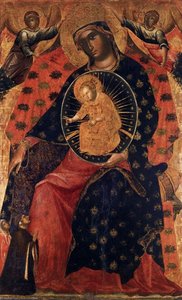 Madonna and Child with two Votaries - Paolo Veneziano
Paolo Veneziano stands as the monumental founder of the Venetian school, a pivotal figure who bridged the rigid, golden grandeur of the Byzantine tradition with the fluid, graceful elegance of the Gothic movement. His work represents a sophisticated synthesis, where the iconographic stability of the East meets the burgeoning emotionality of the Italian Gothic. By infusing his compositions with a new sense of movement and sophistication, he transformed the visual language of the fourteenth-century maritime empire, influencing subsequent masters like Lorenzo Veneziano.
In his representative masterpiece, Madonna and Child with two Votaries, this stylistic tension reaches a sublime peak. The painting radiates a luminous, ethereal quality, utilizing rich patterning and precious gold grounds that evoke a sense of the divine. Yet, within this sacred space, there is a palpable tenderness; the intimate positioning of the Christ Child near his mother’s heart introduces a human warmth characteristic of the Gothic style. Through this harmonious blend of Byzantine preciousness and Gothic lyricism, Veneziano created a unique aesthetic that defined an era of Venetian spirituality.
Bernardo Daddi
 Saint Gregory the Great (in pinnacle: a Prophet) - Bernardo Daddi
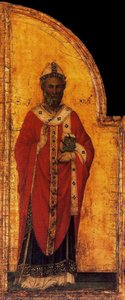
In the 1334 panel Saint Gregory the Great, the weight of gold and grace is palpable. The figure of the saint is suspended against a luminous, flat gold ground, his solemn gaze meeting the viewer from beneath a jeweled white mitre. His heavy red cope, decorated with intricate geometric borders of blue and gold, falls in deep, structural folds that demonstrate a masterful command of tempera on wood. This work exemplifies the elegance of the Italian Gothic movement through its use of symbolic, two-dimensional space and a palette of saturated, divine colors.
Bernardo Daddi (c. 1290–1348) was a pivotal Florentine master who bridged the gap between the stylized traditions of the Gothic era and the burgeoning naturalism of the early Renaissance. As a leading painter of his generation, Daddi’s style was deeply informed by the teachings of Giotto, blending a lyrical, courtly grace with an emerging interest in the believable representation of the human form. His ability to refine religious narratives through meticulous detail and emotional sensitivity allowed him to maintain the spiritual essence of the Gothic period while paving the way for the humanist ideals that would soon transform Italian art.
Andrea Pisano
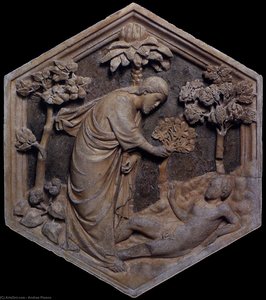 The Creation of Adam - Andrea Pisano
A pivotal figure in the transition from the medieval to the early Renaissance, Andrea Pisano (c. 1290–1348) embodies the elegance and evolving naturalism of the Italian Gothic movement. Originally trained as a goldsmith, Pisano brought a jeweler's precision to the monumental scale of sculpture, a skill that allowed him to bridge the gap between the stylized Byzantine traditions and the burgeoning humanism of the Trecento. His work is characterized by the graceful, rhythmic lines and the profound sense of narrative movement that defined the courtly Gothic aesthetic in Italy.
His mastery is most evident in his relief work, specifically in The Creation of Adam. This marble bas-relief, part of the grand series for the Florence Cathedral, showcases his ability to use light and shadow to breathe life into stone. In this piece, the tension of the genesis myth is captured through the yearning limbs of Adam, a composition that reflects the sophisticated storytelling typical of the period. Whether working on the intricate bronze doors of the Pisa Baptistery or the sacred reliefs of the Duomo, Pisano’s ability to infuse heavy marble with a sense of spiritual and physical vulnerability marks him as a master of the Gothic sculptural tradition.
Jacopo di Cione
 Pentecost - Jacopo di Cione
Jacopo di Cione stands as a vital figure in the Florentine Gothic tradition, a period defined by its courtly elegance and the luminous splendor of gold leaf. As a member of a prominent artistic dynasty, his work embodies the stylistic unity and technical precision characteristic of the late medieval era in Italy. His mastery of the Gothic aesthetic is most evident in his ability to weave complex theological narratives into highly structured, decorative compositions that emphasize spiritual transcendence through shimmering textures and graceful, slender figures.
His representative work, Pentecost, serves as a profound testament to this style. Created as part of the San Pier Maggiore Altarpiece around 1370, this panel captures the mystical descent of the Holy Ghost. The composition is a marvel of Gothic hierarchy, featuring the Virgin Mary and Saint Peter seated in a celestial circle. Above them, a white dove descends amidst radiating light, while delicate tongues of fire rest upon the apostles' heads. The interplay of rosy tones and intricate gold detailing creates a sense of divine presence, transforming the panel into a glowing window of spiritual devotion.
Pacino di Buonaguida
 The Chiarito Tabernacle - Pacino di Buonaguida
Pacino di Buonaguida stands as a vital bridge in the Florentine transition from Byzantine-rooted traditions toward the emerging Renaissance aesthetic. As a prominent figure of the Italian Gothic movement, his work is characterized by a profound sense of spiritual mysticism and the elegant, courtly grace typical of the fourteenth century. Active in Florence from approximately 1303 until his death around 1347, he was a highly respected professional, eventually enrolling in the Arte dei Medici e Speziali. His mastery is evident in a vast body of work, including illuminated manuscripts and altarpieces, where he infused sacred narratives with a delicate, rhythmic beauty.
His ability to blend the tactile with the divine is masterfully demonstrated in The Chiarito Tabernacle (1340). This complex polyptych, commissioned by the layman Chiarito del Voglia, exemplifies the Gothic preoccupation with personal piety and visionary experience. The work features a striking central gilded gesso relief that creates a sculptural depth, depicting a highly specific theological vision. Surrounding this celestial focus, painted narrative panels depict the Passion of Christ, while smaller scenes at the base bridge the gap between the earthly donor and the sacred realm through a sophisticated iconographic program.
Andrea Di Cione Di Arcangelo (Orcagna)
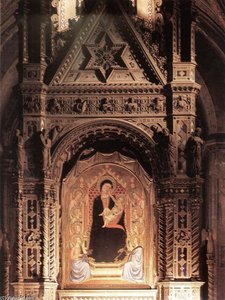 Tabernacle - Andrea Di Cione Di Arcangelo (Orcagna)
A central figure of the Florentine mid-14th century, Andrea Di Cione Di Arcangelo, widely known as Orcagna, embodies the transition of the Italian Gothic movement through his unique ability to merge sculptural monumentality with expressive, linear grace. Born around 1308 into a prestigious Florentine artisan family, he was the son of a skilled goldsmith, a lineage that instilled in him a profound mastery of fine detail and material execution. This background allowed him to operate as a rare polymath, excelling as a painter, sculptor, and architect. His work is characterized by a tension between structural rigidity and fluid, dramatic narratives, often infusing religious scenes with a haunting, spiritual intensity.
His mastery of the Gothic aesthetic is vividly realized in the Tabernacle (1359) located at Orsanmichele in Florence. Designed as a shrine for the Madonna, this three-tiered marble structure functions as a miniature Gothic church, utilizing pointed arches and ribbed vaulting to create a sense of verticality. The composition features rhythmic, sculpted reliefs of the virtues and scenes from the Life of the Virgin, demonstrating how Orcagna integrated architectural precision with the devotional elegance central to the period.
Conclusion
The legacy of these Italian Gothic masters lies in their ability to bridge the gap between the rigid symbolism of the early Middle Ages and the burgeoning humanism of the Renaissance. From the ethereal gold grounds of Duccio di Buoninsegna to the courtly elegance and rhythmic grace found in the works of Simone Martini, these artists transformed religious devotion into a visual language of profound beauty and slender, sophisticated form. Whether through the intricate storytelling of the Gaddi family or the monumental presence of Orcagna, this movement redefined the spiritual landscape of Italy, leaving behind a trail of luminous pigments and graceful silhouettes that still captivate the modern eye.
At Mus3ums.com, we invite you to bring this era of divine elegance into your own living space. Our master artists specialize in creating museum-quality, hand-painted oil reproductions that capture the unique texture and spiritual depth of these historical treasures. You can explore our full collection to find the perfect piece and experience the timeless grace of Italian Gothic art through a bespoke, handmade masterpiece.