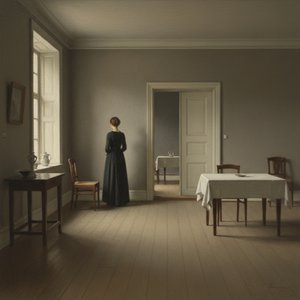
The Quietude of Øregård
Located in Hellerup, on the northern outskirts of Copenhagen, Denmark, Øregård Museum occupies a space that was once a private country house. The building was constructed by Johannes Søbøtker, a merchant and planter whose wealth was tied to the complex and often dark histories of the Atlantic slave trade and the triangular trade between Denmark, the Gold Coast, and the Danish West Indies. The architecture carries the weight of this history, transitioning from a site of private luxury to a public institution owned by the Gentofte Municipality. The surrounding park, once part of the estate, was renovated by Gudmund Nyeland Brandt, creating a landscape that invites a slower pace of observation.
The atmosphere within the walls is shaped by the transition from a domestic residence to a repository of memory. It is a place where the topography of Copenhagen and its northern environs is preserved through a vast collection of visual records. The museum holds approximately 3,000 works, ranging from oil paintings and watercolours to engravings and drawings, spanning the period from 1750 to 1930.
The Collected Vision
The collection finds much of its substance in the legacy of Jacob Hegel, the managing director of Gyldendal, whose private acquisitions were bequeathed to the municipality by his widow, Julie Hoel. These works offer a specific, localized gaze upon the development of the Danish landscape and its people. The presence of these pieces allows for a study of how the light and life of the region were perceived over several generations.
Notable works within the permanent collection include:
- Portrait of Adam Levin Søbøtker, 1792 - Jens Juel
- Portrait of a woman in a red skirt, 1848 - Lorenz Frølich
- A stream through fields with yellow Marsh Marigold, 1901 - Laurits Andersen Ring
- Summer Day at Taarbæk Strand, 1899 - Bertha Wegmann
A Space for Retrospection
Beyond the permanent holdings, the museum functions as a site for temporary exhibitions that often look backward to provide new perspectives on the past. There is a recurring tradition of presenting retrospective exhibitions focused on artists who faced adversity or remained underrated during their own lifetimes. This approach brings a specific focus to figures such as Elisabeth Jerichau-Baumann, Marie Krøyer, and Vilhelm Hammershøi. By centering these artists, the museum creates a dialogue between the established canon and those voices that were previously sidelined.