

The Genesis of Chaos: Post-War Trauma and the Birth of Dada
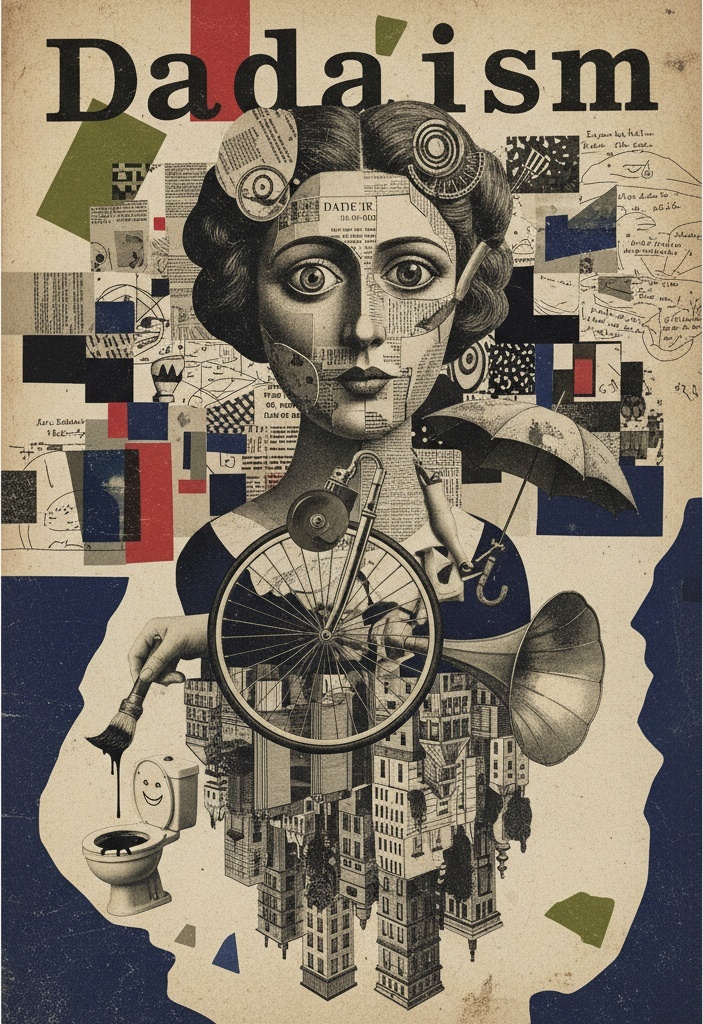
To understand the seismic shift that was Dadaism, one must first look toward the smoke-filled landscapes of early 20th-century Europe. The movement did not emerge from a desire for aesthetic beauty, but rather as a visceral, guttural scream against the senseless carnage of World War I. As the traditional structures of society—logic, nationalism, and even the concept of progress—collapsed under the weight of industrial warfare, a group of disillusioned intellectuals and artists found themselves in neutral Zurich, seeking refuge in the absurd. They saw that if "reason" had led to the trenches, then reason itself was the enemy. Thus, Dada was born not as an art movement, but as an anti-art rebellion, a way to mirror the fragmentation of a broken world through deliberate nonsense and chaotic spontaneity.
This era was defined by a profound sense of disillusionment. The artists gathered at the Cabaret Voltaire were not interested in the polished canvases of the Academy; they sought to dismantle the very idea of "culture" which they believed had failed humanity. By embracing the irrational, they aimed to strip away the pretenses of civilization. This period of gestation was crucial, as it established the foundational ethos that would later permeate much of modern art: the idea that destruction can be a form of creation, and that in the wreckage of old values, a new, raw truth might be found.
Anti-Art and the Readymade: Redefining the Artist's Role
Perhaps no concept within Dadaism is as intellectually disruptive as the readymade. This radical departure from traditional practice fundamentally altered the definition of what it means to be an artist. Before this revolution, the artist was viewed primarily as a skilled creator—a master of brushwork, anatomy, and light. However, through the provocative interventions of figures like Marcel Duchamp, the role shifted from that of a maker to that of a selector. When Duchamp presented his infamous work, Fountain, he was not showcasing technical virtuosity in the classical sense; instead, he was asserting that the artist's choice, the conceptual intent, and the context of the object were far more significant than the manual labor involved in its production.
This rejection of traditional craftsmanship challenged the very boundaries of art's legitimacy. By taking mass-produced, mundane objects—urinals, bicycle wheels, or even rotary mechanical components like his Rotary Demisphere—and elevating them to the status of art through mere designation, Dadaists forced the viewer to confront the arbitrary nature of aesthetic value. This intellectual exploration prioritized the mind over the eye, paving the way for a century of conceptualism. It suggested that art could exist anywhere, provided there was an idea behind it, effectively democratizing the creative impulse while simultaneously infuriating the established art institutions.
The Aesthetics of Absurdity: Collage, Photomontage, and Chance
If the readymade challenged the object, then new techniques like collage and photomontage challenged the composition. Dadaists embraced the aesthetics of fragmentation to reflect a world that no longer felt whole. By tearing images from newspapers, magazines, and advertisements, artists like Hannah Höch and others utilized the debris of mass media to construct biting social commentaries. This was not merely about decoration; it was about the recontextualization of reality. The jagged edges, the clashing scales, and the jarring juxtapositions served as a visual metaphor for the political instability and social upheaval of the time.
Central to this process was the embrace of chance. Moving away from the controlled precision of Cubism or the emotive brushstrokes of Expressionism, Dadaists sought to let gravity, randomness, and accident dictate the final form. Whether it was dropping scraps of paper onto a surface and gluing them where they landed or using random word selections from a hat, this reliance on the unpredictable stripped the artist of their god-like control. This surrender to the accidental was a profound philosophical statement: it acknowledged that life is governed by forces beyond human will, and that there is a unique, haunting beauty to be found in the unplanned and the unscripted.
Dada’s Intellectual Legacy: From Nihilism to Surrealist Foundations
While Dadaism is often characterized by its nihilistic impulse—a desire to negate and destroy—its true legacy lies in what it allowed to grow from its ashes. The movement acted as a vital bridge between the wreckage of the 19th century and the structured dreamscapes of Surrealism. As the initial shock of Dada began to settle, many of its practitioners found that the void left by the destruction of old values could be filled with the exploration of the subconscious. The chaotic energy of Dada provided the necessary groundwork for artists to move from the external critique of society toward an internal investigation of the psyche.
The transition was seamless because both movements shared a fundamental distrust of rationalism. Where Dada used absurdity to mock the conscious world, Surrealism used it to unlock the unconscious. The intellectual rigor found in works that explored optical illusions and mechanical movement, such as Duchamp's Rotoreliefs, demonstrated that even within the realm of the irrational, there was a profound depth of inquiry. The Dadaist spirit ensured that art would never again be confined to the purely decorative; it had forever become a tool for psychological, political, and philosophical interrogation.
Beyond the Canvas: The Performative and Provocative Spirit of Dada
To truly grasp the magnitude of Dada, one must look beyond the physical artifacts and consider its performative essence. Dada was as much an event as it was a collection of objects. It lived in the cacophony of simultaneous poems read aloud in different languages, in the provocative dance performances that sought to unsettle the audience, and in the scandalous exhibitions designed to incite riots. The movement understood that art could be an experience—a temporal moment of confrontation between the creator and the spectator that leaves the viewer irrevocably changed.
This performative audacity broke the "fourth wall" of the gallery space long before it became a staple of contemporary installation art. By making the audience part of the provocation, Dadaists turned the act of viewing into an act of participation. This spirit of rebellion continues to resonate in modern performance art and street art, reminding us that the most powerful art is often that which refuses to be contained by a frame or a pedestal. It remains a testament to the power of human creativity to find meaning, even—and perhaps especially—in the midst of total disorder.
At Mus3ums.com, we celebrate the enduring impact of these radical movements. Our mission is to preserve the profound legacy of art history by offering high-quality reproductions and custom commissions that honor the techniques of the masters. Whether you are an art student studying the textures of a Dadaist collage or a collector seeking a bespoke oil painting that captures the spirit of an era, our studio is dedicated to excellence. From meticulously layered oil paintings to museum-grade Giclée prints, we bring the depth and soul of historical masterpieces into the modern home.