The Genesis of the Mark: From Primitive Points to Intentional Paths
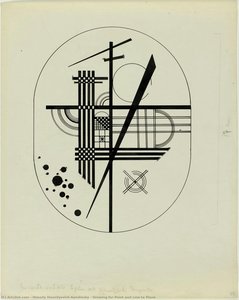
 Schematique Drawing for Komposition III
A Pioneer's Sketch Towards Harmony: Exploring Kandinsky’s “Komposition III” The year is 1910. Munich’s Academy of Fine Arts buzzes with ambition, but Wassily Kandinsky isn’t focused on accolades or mastering traditional methods. Instead, he sits befo...
Every significant mark begins with a singular moment of intent, a dot that decides to move. As Paul Klee famously observed, a line is simply a dot that went for a walk. This fundamental movement serves as the DNA of all visual expression, providing the first dimension of space upon a flat surface. When we examine the early experiments of the twentieth century, we see this transition from static points to active trajectories. In the works of Wassily Kandinsky, particularly his 1916 Abstract Composition, we witness lines that range from thick, heavy strokes to shaky, uncertain movements, each one a record of a physical gesture. These are not merely marks; they are the tracks left by an artist's movement through thought and space.
This evolution mirrors the broader shift in art history where the line moved from being a tool for boundary-making to an independent agent of rhythm. The transition from a point to a path allows for the birth of rhythm, as seen when an artist uses repetition to guide the eye, creating a sense of direction that feels both inevitable and spontaneous. Whether it is the precise, mathematical graphite lines found in technical illustrations or the more erratic, searching marks of an early sketch, the line acts as the primary messenger of the artist's initial contact with the void.
The Unbroken Gesture: Picasso’s Single Line and Modern Simplification
There is a specific discipline required to reduce complexity without losing essence. In the early 20th century, Pablo Picasso demonstrated this through his single-line drawings, where he took a complex, realistic subject and simplified it into one single, unbroken line. This technique demands a high level of concentration; the artist must capture the true essence of the shape in just one continuous movement, never lifting the pen from the paper. It is a method of extreme distillation, stripping away the superfluous to reveal the core identity of the subject.
This pursuit of simplification finds a modern parallel in the work of contemporary artists like Katie Acheson Wolford. Her approach challenges the coordination of hand and eye, finding that sweet spot between speed and deliberation. Much like Picasso’s early experiments, her work relies on the continuous flow to maintain structural integrity. This method proves that even with minimal intervention, a line can communicate profound depth, proving that the most effective way to describe an object in detail is often to use as little detail as possible.
Geometric Rigor: From Suprematist Order to LeWitt’s Instructions
As art moved further into the realm of abstraction, the line lost its connection to the organic and embraced the mathematical. The lines in Kazimir Malevich’s
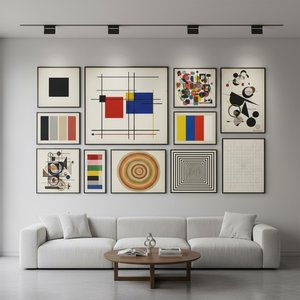
Suprematist Composition are not merely drawn; they are choreographed. This work represents a dance frozen in time, where geometric shapes collide and drift across a neutral void, stripping away the noise of the real world to leave only the raw energy of intersecting rectangles and sharp, decisive lines. It is an exercise in high-impact minimalism, where every shape carries massive weight.
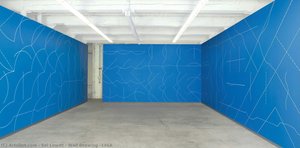
This mathematical precision reached its logical conclusion in the 1970s with the work of Solomon LeWitt. In pieces such as
Wall Drawing #338, the line becomes part of a larger system or "plan." LeWitt’s philosophy was that the idea itself constitutes the artwork. His wall drawings are often executed by professional draughtspeople following specific, detailed instructions—a method that mirrors the logic of a composer providing a score to an orchestra. By using precisely drawn horizontal and vertical lines in a structured geometric composition, LeWitt removed the artist's subjective hand, replacing it with intellectual rigor and a deliberate rejection of representational illusion.
Structural Anchors: The Psychological Weight of Horizontal and Vertical Planes
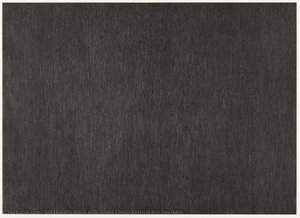
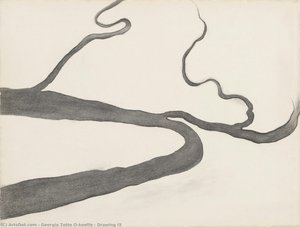 Drawing IX
The Poetry of Line: Rediscovering Georgia O’Keeffe’s Drawing IX In the quiet realm of modernist abstraction, few gestures possess the profound clarity found in Georgia O’Keeffe’s Drawing IX . Created in 1959, this charcoal masterpiece serves as a bre...
Beyond movement and geometry, lines establish the gravity of a composition. There is an inherent psychological weight to directionality that we feel before we can even name it. Horizontal lines act as the foundation of repose; they suggest the horizon, the earth, and a sense of quiet stability. They lower the energy of a piece, inviting a state of contemplation or rest. Conversely, vertical lines introduce a different tension—one of strength, growth, and authority. They reach upward, pulling the viewer's gaze toward height and permanence.
This structural tension is masterfully utilized in the works of Georgia O'Keeffe. In
Drawing IX, a singular, commanding curve traverses the paper with rhythmic confidence. While the line itself is fluid, it creates an implied perspective that draws the eye into a vast, contemplative space. Through the meticulous application of hatching and cross-hashing, O'Keeffe uses these lines to sculpt form out of emptiness, creating a sense of volume and weight on a flat surface. The interplay between the stability of the paper and the movement of the charcoal creates an atmosphere that is both intimate and infinite.
The Meticulous Trace: Scientific Observation as a Foundation for Abstraction
 Robbie Cornelissen
Robbie Cornelissen: Architectonic Spaces and the Pursuit of Detail Robbie Cornelissen (born Utrecht, Netherlands, 1954) stands apart from many contemporary artists as a master draughtsman whose monumental drawings explore profound themes of solitude,...
The precision of the line often finds its roots in the discipline of observation. Before the line was used to express pure abstraction, it was the primary tool for scientific discovery and anatomical study. The works of Leonardo da Vinci, for instance, utilized the line to map human anatomy with unparalleled accuracy. This tradition of using the line as a method of inquiry ensures that even the most abstract modern works possess an underlying structural truth.
This connection between biology and art is evident in the work of Robbie Cornelissen. Trained in biology and ecology, Cornelissen applies a meticulous, scientific level of detail to his monumental drawings. His process involves an obsessive dedication to craft, erasing and reworking lines countless times to achieve near perfection. His architectural spaces serve as metaphors for the human mind, constructed with a precision that mirrors the complexity of natural systems. In this way, the lineage of the line remains unbroken, moving from the literal documentation of the physical world to the complex construction of internal, psychological landscapes.
For collectors and professionals seeking to integrate these powerful linear aesthetics into large-scale projects, Mus3ums.com provides a vast catalog of high-quality reproductions and custom commissions. Whether you require the mathematical clarity of a LeWitt-inspired mural for a corporate lobby or a delicate O'Keeffe-style charcoal drawing for a private residence, our service ensures museum-grade quality with reliable global logistics.

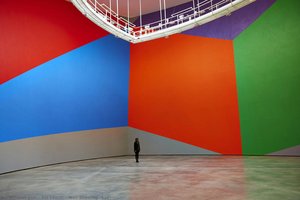
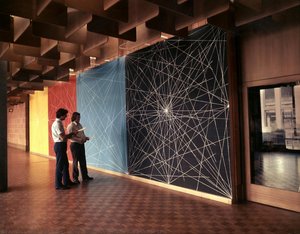
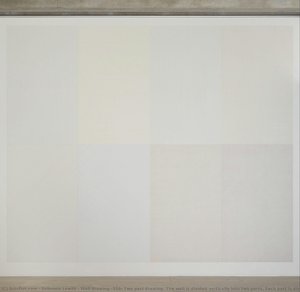 Wall drawing #338: Two part drawing. The wall is divided vertically into two parts. Each part is divided horizontally and vertically into four equal parts. 1st part: Lines in four directions, one direction in each quarter. 2nd part: Lines in four dir....