

Introduction
The 19th century was a period of profound transformation for the artists of the United Kingdom of Great Britain and Ireland, as the nation navigated the seismic shifts of the Industrial Revolution and the evolving social hierarchies of the Victorian era. This era of painting was defined by a tension between the romanticized ideals of the natural world and the burgeoning realism required by a rapidly changing society. From the sweeping, atmospheric landscapes that captured the sublime power of the British Isles to the meticulous precision of portraiture and maritime scenes, these painters sought to document a world in flux, blending technical mastery with a deep sense of national identity.
Throughout this century, the movement transitioned from the dramatic emotionalism of Romanticism toward the more observational and detailed approaches that would eventually pave the way for modernism. The works produced during this time serve as vital historical documents, capturing the light, the topography, and the very spirit of a landscape being reshaped by industry and urban expansion. Today, these artists remain essential to the art historical canon, offering a window into the aesthetic sensibilities and the cultural soul of a pivotal century.
To understand the breadth of this artistic legacy, one must examine the diverse practitioners who defined the period. The following selection explores ten significant painters from this era, including William Robinson, Alexander Melville, and E. J. Turner, whose contributions reflect the immense variety and enduring influence of 19th-century British art.
William Robinson
 Michael Thomas Sadler - William Robinson
Born in Leeds in 1799, William Robinson represents the vital connection between the burgeoning industrial North and the prestigious artistic circles of London. His journey into the pantheon of 19th century British painters began with the meticulous precision of a clock-dial enameller, a craft that instilled in him a discipline for fine detail. This technical foundation allowed him to flourish as a student at the Royal Academy, where he entered the studio of Sir Thomas Lawrence. Under Lawrence's tutelage, Robinson mastered the sophisticated portraiture that defined the era, eventually establishing a significant practice that bridged the gap between metropolitan elegance and regional prominence.
His 1830 masterpiece, Michael Thomas Sadler, serves as a profound testament to his ability to capture both social standing and psychological depth. In this work, Robinson utilizes a striking chiaroscuro effect, contrasting the luminous white of a cravat against deep, somber tones to create a sense of three-dimensional presence. His signature technique—rendering facial features with exacting precision while allowing the rest of the figure to dissolve into loose, expressive strokes—imbues the subject with a palpable sense of movement and life. This duality of touch ensures his place among the most accomplished portraitists of the 19th century in the United Kingdom of Great Britain and Ireland."
Alexander Melville
 Charles Haddon Spurgeon - Alexander Melville
In his 1885 portrait, Charles Haddon Spurgeon, Alexander Melville demonstrates the technical precision and psychological depth that defined his career as a prominent figure in nineteenth-century British art. This work serves as a profound example of how Melville utilized academic realism to capture the essence of influential men. The sitter, a renowned Baptist preacher, is rendered with a quiet dignity, his presence anchored by a controlled interplay of light and shadow that emphasizes his intellectual and spiritual weight.
Born in the United Kingdom of Great Britain and Ireland in 1821, Melville became a master of the portrait during a century defined by rigid social hierarchies and religious fervor. His ability to navigate these strata allowed him to secure commissions from the highest levels of society, ranging from the regal presence of Queen Victoria to the youthful dignity of the Prince of Wales. His portfolio is a testament to the era's diverse leadership, featuring subjects such as Johann Wolfgang Goethe and Princess Augusta of Cambridge. Whether capturing the secular majesty of the state or the spiritual intensity of a pulpit, Melville’s brushwork sought to pin down the character of an age, making him a vital chronicler of the nineteenth-century British social and religious landscape."
E. J. Turner
 Sunset From the Top of the Rigi - E. J. Turner
A central figure in the evolution of British Romanticism, E. J. Turner—often associated with the legacy of the great J.M.W. Turner—represents the profound shift in 19th century British painting from topographical precision to emotional abstraction. Born in the United Kingdom of Great Britain and Ireland, his work captures the era's fascination with the sublime power of the natural world. His approach moved beyond mere documentation, utilizing light and atmosphere to transform landscapes into visionary experiences.
In his notable work, Sunset From the Top of the Rigi, we see a masterful command of luminosity. Though painted in his studio based on secondary sources, the piece evokes the dizzying, ethereal heights of the Swiss Alps. The composition reflects a late-period style characterized by expressive brushwork and a sophisticated handling of light, a departure from the rigid traditions of earlier decades. This ability to translate the raw energy of storms, mountains, and sunsets into a tactile, glowing reality defines his contribution to the 19th century British canon, influencing how subsequent generations of artists perceived the interplay between color and the elements.
Frederick William Hayes
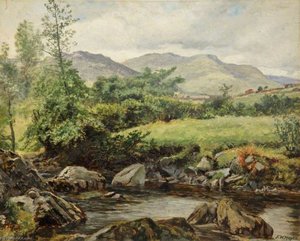 On the Colwyn, Beddgelert - Frederick William Hayes
Born in 1848 in Merseyside, Frederick William Hayes emerged as a significant figure among 19th century painters from United Kingdom of Great Britain and Ireland, specifically through his profound connection to the Welsh landscape. His artistic evolution was deeply shaped by his move to London in 1870, where he became a pupil of the esteemed Henry Dawson. Under Dawson’s mentorship, Hayes mastered a sophisticated technique of thin, meticulously layered oil colors, a method designed to capture the ephemeral nuances of light and atmosphere that would become his hallmark.
Hayes’ work is characterized by a serene, Romantic sensibility, often focusing on the rugged beauty of North Wales, from the coastline of Anglesey to the tranquil valleys of Llyn Du. His 1881 masterpiece, On the Colwyn, Beddgelert, serves as a quintessential example of his ability to evoke the sublime through stillness. In this work, he utilizes diffused, ethereal lighting to render moss-covered boulders and receding mountain silhouettes, creating a sense of timelessness. By translating the atmospheric qualities of the Welsh wilderness into oil on canvas, Hayes secured his legacy as a visionary of the Victorian era, capturing the quietude of nature with remarkable accuracy and emotional depth.
Alexander Davis Cooper
 Kish-ke-kosh - Alexander Davis Cooper
Alexander Davis Cooper (1820–1895) stands as a notable figure among 19th century British painters, a period characterized by a profound interest in both formal portraiture and the ethnographic documentation of distant cultures. As a painter, engraver, and illustrator born in the United Kingdom of Great Britain and Ireland, Cooper’s career spanned the vital mid-to-late Victorian era, contributing to the era's rich visual record through his diverse technical skills.
His work often navigated the intersection of social status and identity. This is exemplified in his portrait of Sir Alexander James Edmund Cockburn, held by the National Portrait Gallery, London, which showcases his ability to capture the essence of the British elite. However, his most evocative contribution to the 19th-century canon is found in his studies of non-Western subjects, such as the 1862 work Kish-ke-kosh. In this striking composition, Cooper moves beyond mere likeness to create a mystical study of a Fox Brave. Through a medium close-up against a dark ochre void, he utilizes textured fur headdresses and symbolic facial markings to present a subject of immense presence. His ability to render such specific, culturally significant details marks him as a versatile artist of the British nineteenth-century tradition."
Malcolm Stewart
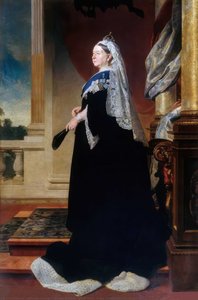 Queen Victoria (1819–1901) (copy of Heinrich von Angeli) - Malcolm Stewart
Born in Glasgow in 1829, Malcolm Stewart emerged as a significant figure within the landscape of 19th century painters from the United Kingdom of Great Britain and Ireland. His artistic evolution reflects the shifting social textures of the Victorian era, moving from early genre scenes of working-class life toward a sophisticated mastery of portraiture. Stewart’s ability to capture the psychological depth of his subjects—ranging from historical figures like Dr. Livingstone to the quiet dignity of everyday individuals—secured his reputation as a premier portraitist of his age.
His technique was uniquely informed by the principles of Luminism and the delicate aesthetics of Japanese Ukiyo-e prints, resulting in a style characterized by soft lighting and a certain melancholic atmosphere. This is masterfully demonstrated in his 1899 work, Queen Victoria, a study based on a composition by Heinrich von Angeli. In this portrait, Stewart utilizes meticulous layering and thin glazes to render the textures of black satin and ermine, creating an ethereal, inner glow that seems to settle around the monarch. Through this interplay of light and shadow, Stewart transformed formal portraiture into a profound exploration of character and stillness.
Edward Petre Novello
 Clara Novello - Edward Petre Novello
Edward Petre Novello (1813–1836) represents a poignant chapter in the history of 19th century British painters. Despite a life cut short in his early twenties, his technical proficiency placed him among the rising talents of the United Kingdom of Great Britain and Ireland during the Romantic era. His academic journey was marked by significant accolades, including a silver medal at the Royal Academy Schools in 1831 and the Silver Isis Medal from the Society for the Encouragement of Arts, Manufactures and Commerce. These honors underscore a talent that sought to master the classical traditions of light and shadow through the study of masters like Rembrandt and Rubens.
Novello's oeuvre is characterized by an intimate connection to his family and the literary spirit of his time. His most significant contribution to the period's portraiture is the 1833 oil on canvas, Clara Novello. This work depicts his sister, the celebrated soprano Clara Anastasia Novello, within a lush, romanticized woodland setting. Through this portrait, Novello captures a sense of poised elegance, integrating the sitter into a natural landscape that reflects the era's fascination with the intersection of human grace and the wildness of nature.
Robert Huskisson
 Lord Northwick's Picture Gallery at Thirlestaine House - Robert Huskisson
Born in Nottinghamshire around 1820, Robert Huskisson stands as a distinctive voice among 19th century painters from the United Kingdom of Great Britain and Ireland. While his contemporaries often focused on the rigid social structures of the Victorian era, Huskisson carved a niche in the Romantic movement by exploring the ethereal and the fantastical. His work is characterized by a delicate, almost dreamlike quality, often depicting graceful, human-like fairies inhabiting moonlit, enchanted landscapes. A viewer can recognize his hand through this mastery of atmospheric light and a soft, lyrical brushwork that captures the subtle textures of the unseen world.
His technical foundation was established by his father, the portrait painter Henry Huskinson, a training that allowed him to navigate both the whimsical and the formal with ease. This duality is masterfully displayed in his 1847 work, Lord Northwick's Picture Gallery at Thirlestaine House. In this piece, Huskisson moves away from his famous fairy realms to capture a moment of Victorian grandeur, utilizing sophisticated interior illumination to bring a sense of depth and lived-in warmth to a highly structured, opulent setting. His ability to balance the contemplative stillness of a subject with the vibrant, gilded details of a grand gallery marks him as a significant figure in British Romanticism."
John Adam Houston
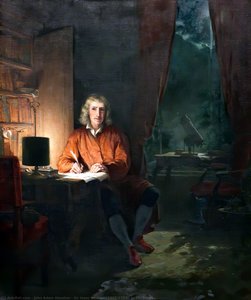 Sir Isaac Newton (1642–1727), in His Study - John Adam Houston
In his 1876 portrait, Sir Isaac Newton (1642–1727), in His Study, the artist captures a profound sense of intellectual stillness. The composition centers on the scholar at a wooden desk, surrounded by the quiet tools of academic labor, where controlled lighting casts soft shadows that define the contours of a private, contemplative domain. This mastery of atmosphere is a hallmark of John Adam Houston (1812–1884), a significant figure among 19th century painters from the United Kingdom of Great Britain and Ireland.
Born in Wales to Irish roots and later establishing his career in Edinburgh, Houston’s work is deeply intertwined with the heritage of the British Isles. His technical foundation was laid at the Trustees Academy in Edinburgh, supplemented by studies in Paris and Germany. He was a meticulous observer of both landscape and history, often imbuing his scenes with a sense of timelessness. Whether depicting the dramatic Secreting of the Regalia of Scotland in Kinneff Church, 1652 or quiet, scholarly interiors, Houston utilized a sophisticated layering technique. His ability to build color through gradual tonal variations allowed him to capture the evocative, often muted palettes that define his most celebrated historical and landscape works.
William Wallace Scott
 Robert Moffat, 1795 - 1883. Missionary (With John Mokoteri and Sarah Roby) - William Wallace Scott
William Wallace Scott (1820–1905) stands as a significant figure among 19th century painters from the United Kingdom of Great Britain and Ireland, embodying the era's transition from rigid academic traditions toward a more nuanced, atmospheric sensibility. His work is defined by a profound preoccupation with the weight of human presence and the tangible reality of his subjects, navigating the delicate balance between intimate psychological portraiture and the expansive requirements of landscape painting.
His technical mastery is most evident in his 1842 work, Robert Moffat, 1795 - 1883. Missionary (With John Mokoteri and Sarah Roby), currently held in the Scottish National Portrait Gallery. In this formal academic portrait, Scott utilizes a disciplined, soft brushwork to render the heavy textures of clothing and the dignified features of the figures. The composition employs a stable triangular arrangement, placing the missionary within a somber, earthy landscape that serves as a historical record of social and personal connection. Through this ability to capture both the specificities of character and the gravity of historical moments, Scott remains a vital representative of the mid-19th century British artistic canon.
Conclusion
The 19th century was a transformative era for the visual language of the British Isles, a period where the rigid traditions of classical portraiture began to dance with the atmospheric nuances of landscape and the burgeoning realism of a changing world. From the meticulous detail found in the works of Alexander Melville and William Robinson to the evocative compositions of E. J. Turner and Frederick William Hayes, these artists collectively captured the spirit of an age defined by both industrial progress and a profound reverence for the natural environment. Whether through the maritime precision of John Adam Houston or the tonal explorations of Malcolm Stewart, each painter contributed a unique perspective to the rich tapestry of British art history, ensuring that the aesthetic legacy of the 1800s remains a vital part of our cultural heritage.
For those seeking to bring this historical elegance into a contemporary setting, our full collection offers a gateway to these masterpieces. At Mus3ums.com, we specialize in preserving this heritage through museum-quality, hand-painted oil reproductions. Each piece is meticulously crafted by skilled artists on 100% cotton canvas, capturing the authentic brushstrokes and depth of the original works, allowing you to live with the sublime beauty of 19th-century British art every day.


