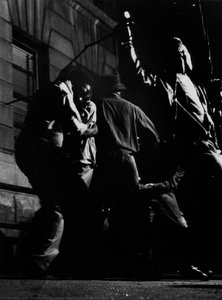
Introduction
The American documentary movement emerged as a profound visual response to the rapid social, industrial, and economic transformations that reshaped the United States throughout the 20th century. Rather than seeking the idealized beauty of studio portraiture, these artists turned their lenses toward the raw, unvarnished realities of human existence. They sought to capture the essence of a nation in flux—from the grit of the Great Depression and the struggles of the working class to the quiet dignity of rural life and the complexities of urban migration. Their work serves as a vital historical record, utilizing the camera not merely as a tool for observation, but as a witness to the social conscience of a developing superpower.
What unites these figures is a commitment to truth through evidence. Their compositions were rarely staged; instead, they relied on the profound power of the candid moment to evoke empathy and provoke thought. By documenting the lived experiences of marginalized communities and the sweeping shifts in the American landscape, they bridged the gap between art and sociology. Today, their legacy remains essential, providing a visual vocabulary for understanding the roots of modern social movements and the enduring human condition. Their images do more than show us how people lived; they challenge us to confront the systemic realities of our past and present.
The following selection examines ten pivotal figures whose work defined this era, exploring the distinct perspectives of masters such as Dorothea Lange, Walker Evans, and Berenice Abbott, each of whom left an indelible mark on the history of visual storytelling.
Gordon Parks
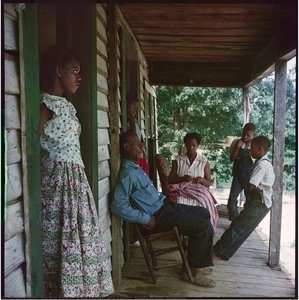 Willie Causey and Family, Shady Grove, Alabama - Gordon Parks
Gordon Parks (1912–2006) stands as a monumental figure in American documentary photography, utilizing his lens to confront the realities of segregation and poverty. Born in Fort Scott, Kansas, Parks was a self-taught artist who broke significant barriers, becoming the first African American staff photographer for Life and Vogue magazines. His work is defined by a profound humanistic vision, capturing the lived experiences of those often marginalized by society. He belongs to the documentary photography movement through his commitment to recording real-life social conditions as evidence of the American experience, moving beyond mere aesthetics to serve as a powerful social witness.
His technical precision is masterfully displayed in Willie Causey and Family, Shady Grove, Alabama (1956). In this evocative work, Parks captures a family seated on a porch, utilizing the soft afternoon light to imbue the subjects with a sense of quiet authority and resilience. The image serves as a poignant meditation on community and heritage during the Jim Crow era. Through his photographic essays and later work in film, Parks paved the way for generations of visual storytellers, ensuring that the dignity of his subjects remained at the forefront of the American narrative.
Walker Evans
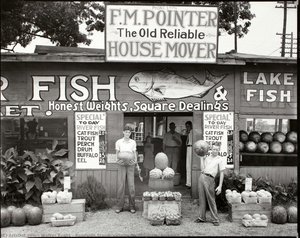 Roadside Stand, vicinity Birmingham, Alabama - Walker Evans
Walker Evans (1903–1975) stands as a foundational figure in the American documentary photography movement, a genre dedicated to recording real-life events and social conditions as unvarnished evidence. Unlike the stylized portraiture of his contemporaries, Evans sought a stark realism that captured the quiet dignity of the human condition. His aesthetic was deeply informed by the meticulous, objective cataloging of August Sander and the timeless street photography of Eugène Atget, as well as the rhythmic precision of modernist literature. By eschewing unnecessary embellishment, he transformed the mundane into the monumental, documenting the textures of American life with a clarity that felt both immediate and permanent.
His commitment to this movement is epitomized in works like "Roadside Stand, vicinity Birmingham, Alabama" (1971). In this composition, Evans utilizes a structured geometry to frame the weathered architecture and the figures within, creating a visual rhythm that balances rigid man-made lines with the organic presence of labor. Through his lens, the struggles and resilience of the Great Depression and the evolving American landscape were not merely captured; they were preserved as essential historical truths, cementing his legacy as a premier visual witness of his era.
Bruce Davidson
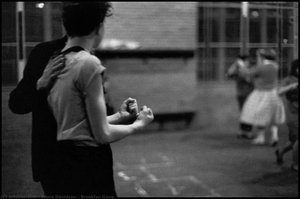 Brooklyn Gang - Bruce Davidson
Bruce Davidson stands as a profound figure in the lineage of American documentary photography, distinguished by his ability to transform social observation into deeply empathetic human narratives. His work is defined by an unflinching commitment to recording the lived realities of marginalized communities, moving beyond mere reportage to capture the essential soul of his subjects. This dedication to the documentary tradition is rooted in his early training under local photographers and his formative years at Yale University, where the influence of color theory and rigorous discipline shaped his sophisticated visual language.
His seminal 1959 work, Brooklyn Gang, serves as a masterclass in this genre. Rather than relying on staged compositions, Davidson immersed himself in the lives of a street gang known as the Jokers, documenting the complexities of urban adolescence in post-war New York. Through the use of a large-format camera, he captured the grit and texture of the streets with remarkable clarity. The resulting images are not just evidence of a specific time and place, but poignant, melancholic studies of identity, belonging, and the search for connection amidst the shadows of poverty.
Dorothea Lange
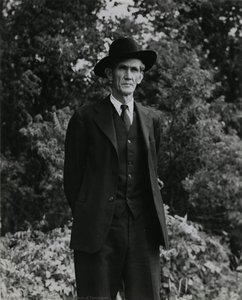 A Resident of Tennessee - Dorothea Lange
Dorothea Lange (1895–1965) stands as a vital figure in the American documentary photography movement, utilizing her lens to serve as a visual historian of the human spirit. After studying under Clarence H. White at Columbia University, Lange initially established herself as a portrait photographer in San Francisco. However, the economic collapse of the Great Depression fundamentally redirected her artistic purpose. Moving away from the controlled environment of the studio, she joined the Farm Security Administration, where her work transitioned into a profound moral mission to document the lived realities of the era.
Her photography belongs to the documentary movement because it eschews staged artifice in favor of recording real events and the authentic lives of those facing displacement. In her 1940 work, A Resident of Tennessee, she demonstrates this mastery by capturing the quiet dignity of rural life. Through a three-quarter pose and a sophisticated use of gelatin silver printing, she achieved a tonal range that emphasizes form and texture. This ability to transform the struggles of migrant workers and sharecroppers into powerful narratives of resilience ensured her place as a witness to the most transformative decades of American history.
David Dixon Porter
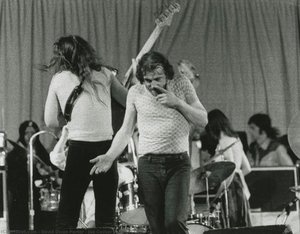 Joe Cocker (touches nose) - David Dixon Porter
David Dixon Porter represents a fascinating intersection of historical legacy and the evolution of the documentary lens. While his lineage is deeply rooted in the naval history of the United States—born in 1813 and serving as a distinguished Admiral—his contribution to the documentary tradition lies in his ability to capture raw, unscripted human moments. Unlike the staged portraiture of previous eras, his work aligns with the documentary movement by serving as a visual record of specific, fleeting realities rather than composed allegories.
His representative work, Joe Cocker (touches nose), exemplifies this commitment to the documentary ethos. Captured in 1972, the photograph documents a specific moment during a live performance in Australia. It is a stark, high-contrast study of energy and motion, freezing a single, spontaneous gesture amidst the chaotic geometry of a rock concert. Through the grain of black and white film, Porter moves beyond mere representation to provide a visceral, evidentiary account of the 1970s musical underground. By focusing on the tension of a hand or the tilt of a face in a moment of intense expression, he fulfills the core purpose of documentary photography: to preserve the authentic pulse of a lived experience.
William Eugene Smith
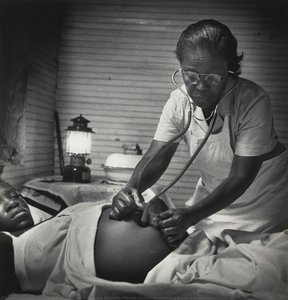 Nurse Midwife Maude Callen (examining pregnant woman) - William Eugene Smith
William Eugene Smith (1918–1978) stands as a transformative figure in American documentary photography, credited with evolving the medium from simple reportage into the sophisticated, multi-layered editorial photo essay. His approach was deeply rooted in the humanist traditions of his predecessors; he inherited a profound reverence for the expressive potential of the lens from Alfred Stieglitz and a fierce commitment to social advocacy from Lewis Hine. By fusing these influences, Smith moved beyond merely recording events to weaving complex narratives that captured the very heartbeat of human struggle and resilience.
His work is defined by a commitment to documenting real-world complexities, ranging from the harrowing realities of World War II to environmental crises like the Minamata disaster. A quintessential example of his ability to find sacredness in the mundane is his 1951 work, Nurse Midwife Maude Callen (examining pregnant woman). In this piece, Smith utilizes dramatic lighting and a masterful tonal range to transform a medical examination into a profound meditation on maternal care and human connection. Through his lens, the quiet dignity of service is elevated to a universal level, cementing his legacy as a master of visual storytelling.
Lewis Wickes Hine
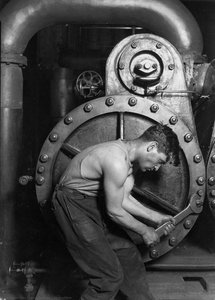 Steamfitter - Lewis Wickes Hine
Lewis Wickes Hine (1874–1940) stands as a foundational figure among American documentary photography painters, having utilized the camera not merely as an observational tool, but as a potent instrument for sociological reform. His work is defined by a profound commitment to recording the raw, unvarnished realities of the human condition, particularly during the Progressive Era and the Great Depression. Hine’s perspective was deeply informed by his own early experiences with hardship in Oshkosh, Wisconsin, which instilled in him a lifelong empathy for the working class and the marginalized.
He is most historically significant for his unflinching documentation of child labor, where his images served as visual manifestos that directly influenced the passage of essential labor laws in the United States. His ability to find dignity within grit is perfectly encapsulated in his 1921 work, Steamfitter. In this composition, Hine moves beyond simple reportage to create a meditation on resilience, using tight framing and industrial geometry to elevate the laborer to a position of quiet, monumental strength. By focusing on the intimate details of toil rather than staged grandeur, Hine secured his legacy as a witness to the essential, often unseen, pulse of American industrial life."
Michael Albert Smith
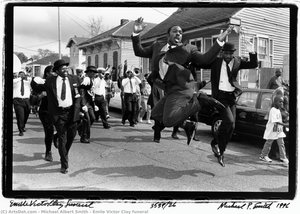 Emile Victor Clay funeral - Michael Albert Smith
Born in Rochester, New York, in 1963, Michael Albert Smith’s artistic trajectory took a remarkable turn when he was drafted by the Boston Celtics. However, the basketball court could not contain his true vocation; he ultimately found his voice through the lens of a camera, becoming a vital voice in the American documentary photography movement. His work is defined by an immersive, empathetic exploration of the cultural and spiritual heartbeat of New Orleans, capturing the resilience and soul of the community through a documentary lens that prioritizes lived experience over staged artifice.
Smith’s mastery of visual storytelling is perhaps most evident in his 1996 work, Emile Victor Clay funeral. This energetic black-and-white photograph documents the profound tradition of the jazz funeral, capturing a procession of African American men in formal attire parading through residential streets. The image, featuring the Pin Stripe Brass Band, freezes a moment of mid-air movement and collective celebration, serving as a poignant record of a specific cultural ritual. By documenting these essential rites of passage and the legends of gospel music, Smith fulfills the core mission of documentary photography: acting as a witness to the enduring spirit of human community.
Berenice Abbott
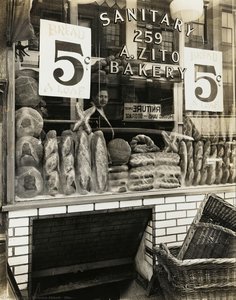 Zito - Berenice Abbott
Berenice Abbott stands as a cornerstone of the American documentary photography movement, a pioneer who utilized the camera to record the evolving reality of the 20th century. Her work is instantly recognizable by its profound architectural precision and its ability to capture the rhythmic, often gritty, essence of urban life. Unlike those who sought to stage scenes, Abbott’s lens functioned as a witness, documenting the structural shifts of New York City and the intimate, unvarnished moments of its inhabitants with a clarity that feels both immediate and timeless.
Her artistic foundation was shaped by the avant-garde circles of Paris, where she apprenticed under Man Ray, gaining a technical mastery of light and shadow that would define her career. This expertise is masterfully displayed in her 1937 work, Zito. In this evocative piece, she transforms a simple bakery scene on Bleecker Street into a profound meditation on the Great Depression. Through a sophisticated command of gelatin silver printing, Abbott captures the textures of brick and the quiet dignity of the working class, turning a mundane storefront into a monumental testament to human endurance and the soul of the city.
David Plowden
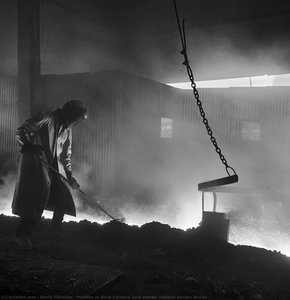 Puddler in Blast Furnace Cast House, Indiana Harbor Works - David Plowden
David Plowden (b. 1932) serves as a vital chronicler of a vanishing America, capturing the fading grandeur of a nation in transition. His work belongs to the American documentary photography movement because he eschews staged aesthetics in favor of recording real-world evidence of industrial and agricultural shifts. Rather than seeking the picturesque, Plowden focuses on the melancholy beauty of steam trains, small towns, and the rhythmic labor of the American heartland, preserving scenes that are rapidly becoming relics of a bygone era.
His photographic eye was sharpened through an apprenticeship under masters like Minor White and Nathan Lyons, which instilled in him a sculptural approach to composition and a profound respect for detail. This is vividly realized in his representative work, Puddler in Blast Furnace Cast House, Indiana Harbor Works (1982). In this striking image, Plowden utilizes high-contrast lighting to isolate a worker amidst the heavy shadows of the foundry. The composition relies on the stark geometry of industrial machinery and the incandescent, fluid glow of molten metal, transforming a moment of raw physical labor into a powerful testament to the human effort that once fueled the American industrial engine.
Conclusion
The legacy of these American masters lies in their ability to transform the ephemeral moments of human existence into permanent historical records. From the social urgency found in the work of Dorothea Lange and Lewis Wickes Hine to the quiet, architectural dignity captured by Berenice Abbott and Walker Evans, these photographers did more than merely observe; they bore witness to the evolving soul of a nation. Whether documenting the grit of the Great Depression or the intimate complexities of urban life, their visual language remains a vital bridge between raw reality and fine art. For those who wish to honor this profound heritage, we invite you to explore our full collection. You can bring the weight and grace of these iconic perspectives into your own space through our museum-quality, hand-painted oil reproductions, each meticulously crafted to capture the depth and texture of these historic visual narratives.