
The Genesis of Orphism: Beyond the Boundaries of Cubism
To understand the emergence of Orphism, one must first contemplate the structured, monochromatic world of early Cubism. While Picasso and Braque had successfully dismantled the traditional perspective, their explorations often remained anchored in a somber, earth-toned reality, focusing on the deconstruction of form through shadow and structure. However, as the twentieth century progressed, a new aesthetic hunger arose—a desire to infuse this structural revolution with the pure, unadultered energy of light itself. This transition marked the birth of Orphism, a movement that sought not just to analyze objects, but to celebrate the very essence of perception through a prismatic lens.
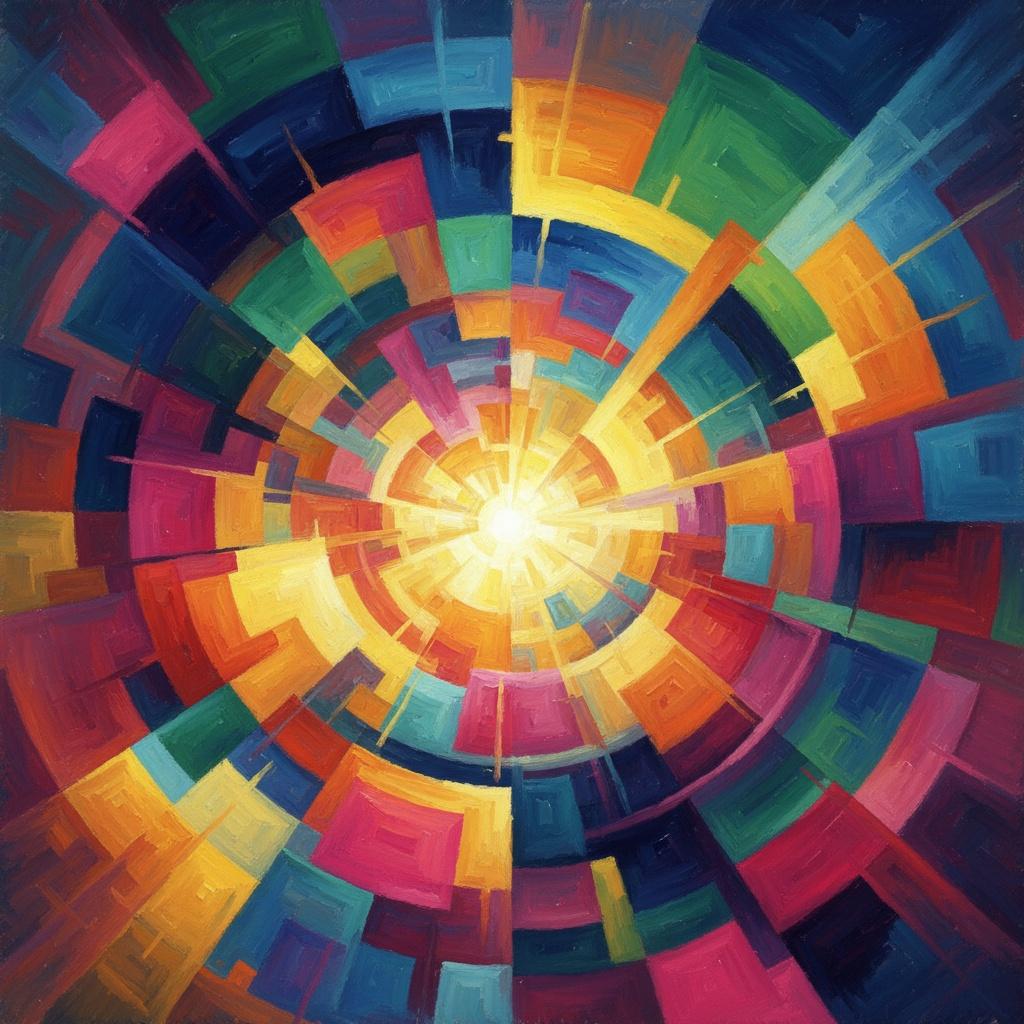
The term "Orphism" itself evokes the mythic resonance of Orpheus, the legendary musician whose lyre could charm all living things. Just as Orphic music moved the soul through pure sound, this new movement aimed to move the viewer through pure color. It was a departure from the intellectual rigidity of Cubism toward a more lyrical, sensory experience. By moving away from the literal representation of objects and toward the rhythmic arrangement of light, artists began to treat the canvas as a musical score, where every hue acted as a note in a grand, visual symphony.
This era represented a pivotal moment for the avant-garde, as it bridged the gap between the analytical deconstruction of the past and the total abstraction of the future. It was no longer enough to show what an object looked like; artists sought to capture how light danced upon its surface and how that movement resonated within the human spirit.
A Symphony of Light: The Revolutionary Color Theory of the Delaunays
At the heart of this chromatic revolution stood Robert and Sonia Delaunay, a duo whose collaborative vision redefined the boundaries of modern expression. Their approach was deeply rooted in a sophisticated understanding of color theory, specifically the concept of simultaneous contrast. They recognized that colors do not exist in isolation; rather, they gain their vitality from their relationship to the hues surrounding them. By placing complementary colors in direct proximity, they created a visual vibration—a shimmering effect that mimicked the flickering nature of light itself.
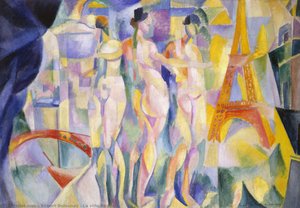
In masterpieces such as Rhythm Color, one observes an intricate dance of overlapping circles and geometric shapes that seem to pulsate with life. The Delaunays utilized color not merely as a decorative element, but as the primary subject of the work. For them, color was synonymous with light, and light was the fundamental building block of all experience. Their canvases became windows into a world where form was secondary to the luminous interplay of pigments, creating an atmosphere that felt both deeply modern and timelessly elemental.
Sonia Delaunay further expanded this vocabulary by integrating these abstract principles into textiles and fashion, proving that the Orphic rhythm could permeate every facet of design. Through their work, color became a language capable of expressing movement, depth, and emotion without the need for a single recognizable silhouette, forever altering the trajectory of twentieth-century aesthetics.
Rhythmic Abstraction: Exploring Geometric Movement and Form
The true magic of Orphism lies in its ability to evoke motion through static medium. This was achieved through a meticulous arrangement of geometric forms—circles, arcs, and diagonals—that guide the eye in a continuous, rhythmic loop across the canvas. Unlike the static compositions of classical art, an Orphic painting possesses an inherent kinetic energy. The viewer’s gaze is never permitted to rest; it is swept along by the momentum of intersecting planes and the centrifugal force of brightly colored discs.
This sense of rhythm was not limited to the Delaunays. The Czech pioneer František Kupka brought a unique, almost spiritual dimension to this geometric abstraction. In works such as Mme Kupka among Verticals, we see how verticality and bold color can envelop a subject, transforming a human presence into part of a larger, cosmic movement. Kupka’s ability to blend the organic with the mathematical allowed for a profound exploration of how abstract shapes can simulate the flow of energy and the passage of time.
The mastery of form in Orphism requires a delicate balance between chaos and order. If the composition is too structured, it loses its lyrical soul; if it is too haphazard, the rhythm is lost. The most successful Orphic works achieve a state of "dynamic equilibrium," where the tension between competing shapes creates a sense of perpetual motion, inviting the collector to lose themselves in the infinite complexity of the painted surface.
The Orphic Legacy: Influence on the Evolution of Modern Abstract Art
The ripples of the Orphic movement extended far beyond its initial period of peak activity, leaving an indelible mark on the landscape of modern abstraction. By liberating color from the duty of description, Orphism paved the way for subsequent movements such as Suprematism and even the later developments in Color Field painting. The idea that a painting could be a self-contained universe of light and rhythm became a foundational principle for generations of artists seeking to explore the limits of non-objective art.
The movement’s emphasis on the sensory experience over the intellectual analysis allowed art to become more accessible and emotionally resonant. It taught us that abstraction does not have to be cold or distant; it can be as vibrant, warm, and life-affirming as a sunrise. This legacy is visible in the way contemporary artists continue to manipulate light and pigment to evoke psychological states and atmospheric depths.
Furthermore, the Orphic approach to design—the marriage of fine art with applied arts—foreshadowed the modern era of multidisciplinary creativity. The movement’s influence can still be felt in graphic design, architecture, and even digital media, where the principles of color harmony and rhythmic composition remain essential tools for capturing human attention in an increasingly visual world.
Curating Luminosity: Integrating Orphic Vibrancy into Contemporary Interiors
For the discerning collector, bringing the spirit of Orphism into a contemporary living space offers a unique opportunity to introduce vitality and intellectual depth. An Orphic-inspired piece—whether an original work or a meticulously crafted reproduction—serves as a focal point that can transform the mood of an entire room. Because these works are centered on light and color, they possess a transformative quality, capable of brightening darker corners or adding a sophisticated layer of complexity to minimalist environments.
When integrating such vibrant compositions into your interior design, consider the surrounding palette. An Orphic painting often thrives when paired with neutral, architectural tones that allow its colors to sing without competition. However, for those seeking a more daring aesthetic, matching the secondary hues within the painting to textiles or accent pieces can create a cohesive, immersive experience of color. The key is to treat the artwork as the conductor of the room's visual orchestra.
At Mus3ums.com, we specialize in preserving this luminous legacy for the modern connoisseur. We offer everything from high-fidelity Giclée prints that capture every subtle nuance of light to breathtaking, handmade oil reproductions that replicate the tactile impasto and energetic brushstrokes of the masters. Whether you are looking to commission a custom piece that reimagines your own memories through an Orphic lens or seeking a museum-quality reproduction of a Delaunay masterpiece, our artisans are dedicated to bringing the vibrant dance of color and light into your home.