
Introduction
The 15th century in the Low Countries marked a profound revolution in the history of Western art, defined by a shift toward unparalleled naturalism and a meticulous obsession with detail. As the urban centers of the Netherlands flourished through trade and commerce, a new way of seeing emerged—one that moved away from the stylized abstractions of the Middle Ages toward a profound engagement with the physical world. These painters mastered the subtle interplay of light and shadow, using the medium of oil to capture the luminous texture of velvet, the glint of polished metal, and the delicate translucency of human skin with a precision never before seen.
This era was characterized by a deep spiritualism intertwined with a growing interest in the secular world. Artists began to place sacred figures within contemporary domestic settings, bridging the gap between the divine and the everyday. This period saw the birth of a visual language that prioritized optical truth, where every jewel and every wrinkle served a symbolic and descriptive purpose. The cultural landscape was one of intense devotion and burgeoning humanism, creating a fertile ground for masters who sought to replicate the complexity of God's creation through the lens of human observation.
The legacy of these masters remains vital today, as their innovations laid the foundational techniques for much of European painting that followed. Their ability to manipulate light and color continues to influence how we perceive depth and atmosphere in art. By examining the works of these pioneers, we gain insight into the very origins of modern visual storytelling. The following selection explores the diverse voices of this golden age, from the surreal landscapes of Hieronymus Bosch to the intricate compositions of the Limbourg Brothers and the masterful light of the Master of the Prado.
Hieronymus Bosch
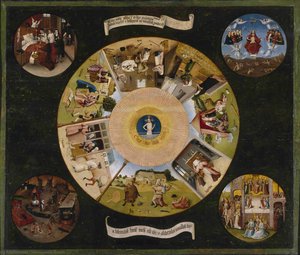
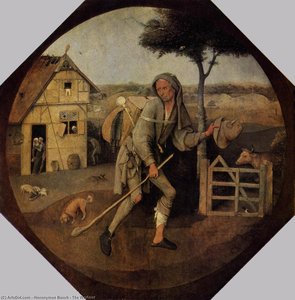
In his profound work The Seven Deadly Sins, created around 1480, the artist presents a complex allegorical meditation on the cyclical nature of fate and human morality. This piece serves as a quintessential example of the artist's ability to navigate the boundaries between the divine and the demonic, capturing the profound anxieties of the late medieval era through a highly individualistic lens.
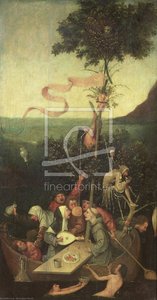
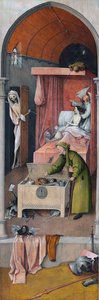
Born Jheronimus van Aken around 1450 in 's-Hertogenbosch, Hieronymus Bosch emerged from a lineage of creators in the Duchy of Brabant. As a prominent representative of the Early Netherlandish painting school, his identity is deeply rooted in the artistic traditions of the Netherlands. He was born into a family of painters; his grandfather, Jan van Aken, and his father, Anthonius, both practiced the craft, providing him with a foundational workshop education. While his contemporaries often sought serene beauty, Bosch turned his gaze toward the grotesque and the surreal. His intricate oil triptychs are renowned for their symbolic complexity, utilizing a meticulous technique to render a world where human folly is laid bare through fantastical imagery and profound religious symbolism.
Gerard David
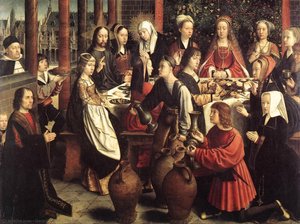 The Marriage at Cana - Gerard David
A prominent figure of the Northern Renaissance, Gerard David (c. 1460–1523) represents the evolution of the Netherlandish tradition into the early 16th century. Born in Oudewater, his career was defined by his presence in the major artistic hubs of Bruges and Antwerp, where he was inducted as a free master in Bruges in 1484. His style is deeply rooted in the meticulous attention to detail and religious narrative established by 15th-century masters such as Dieric Bouts and Geertgen tot Sint Jans. By absorbing the technical legacies of Jan van Eyck and Hans Memling, David bridged the gap between the late medieval period and the burgeoning Renaissance.
His technical mastery is most evident in The Marriage at Cana, a complex panel painting that showcases his ability to organize intricate compositions through linear perspective. In this work, David utilizes a sophisticated, muted color palette of gold, red, and green to create a warm, inviting atmosphere. His approach to landscape and soft, diffused lighting demonstrates a profound understanding of depth, making him a vital link in the lineage of 15th-century Netherlandish painters.
Dieric Bouts
 Christ Crowned with Thorns - Dieric Bouts
A central figure of the Northern Renaissance, Dieric Bouts represents the profound technical and spiritual evolution of 15th century Netherlandish painters. Born in Haarlem, his career reached its zenith in Leuven, where he served as the city painter from 1468 until his death in 1475. Bouts was a master of both painting and draftsmanship, establishing a workshop that would influence the region well into the 16th century through his sons.
He is celebrated for his pioneering use of a single vanishing point, a technique that brought a new sense of spatial logic to devotional art. His The Last Supper remains a landmark of this era, showcasing Christ amidst figures dressed in contemporary Flemish attire. This mastery of perspective and intimate composition is poignantly captured in his representative work, Christ Crowned with Thorns. In this somber, dramatic piece, Bouts utilizes a stark, dark background to push the luminous, suffering figure of Christ toward the viewer. Through the meticulous rendering of tears and the sharp textures of the thorns, he transforms a sacred historical event into a visceral, living encounter, cementing his legacy as a master of emotional intensity.
Geertgen tot Sint Jans
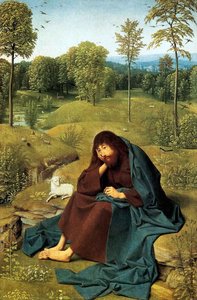 John the Baptist in the Wilderness - Geertgen tot Sint Jans
A luminous figure of the late 15th century, Geertgen tot Sint Jans represents the spiritual and technical height of the Haarlem school during this era. Flourishing in the Netherlands between approximately 1460 and 1490, his identity is inextricably linked to the Knights Hospitaller of Saint John, a connection suggested by his very name. While much of his life remains shrouded in mystery, his artistic lineage likely traces back to the influential Haarlem painter Albert van Ouwater, placing him at the heart of the Northern Renaissance's evolution in the Low Countries.
His surviving oeuvre, though tragically diminished by historical conflicts, showcases a profound mastery of emotional depth and naturalistic detail. In his representative work, John the Baptist in the Wilderness (c. 1490), Geertgen demonstrates a remarkable ability to harmonize religious iconography with expansive, tranquil landscapes. The composition utilizes fine brushwork and meticulous layering to create a sense of serene contemplation, inviting the viewer into a lush, detailed world. Through his ability to blend intense spiritual reflection with the physical textures of the natural world, Geertgen tot Sint Jans remains a vital voice among the 15th century painters from Netherlands."
Limbourg Brothers
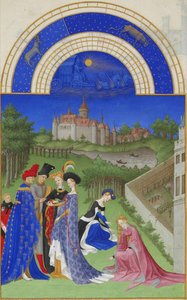 Les très riches heures du Duc de Berry: Avril (April) - Limbourg Brothers
Emerging from the Dutch city of Nijmegen, the Limbourg Brothers—Herman, Paul, and Jean—stand as pivotal figures of the 15th century Netherlandish painters. Though their lives were cut short around 1416, their influence helped transition the rigid iconography of the Middle Ages into the more fluid, atmospheric International Gothic style. Their early training under skilled goldsmiths provided them with a meticulous precision that allowed them to manipulate pigments with the delicacy of precious metals, a hallmark of the era's finest masters.
A defining moment in their journey was the intersection of high-court privilege and sudden political hardship; despite their apprenticeships in the prestigious workshops of Paris, the brothers faced imprisonment during the turbulent conflicts in Brussels. This resilience is reflected in the profound depth and emotional clarity of their surviving masterpieces. Their most celebrated achievement, Les très riches heures du Duc de Berry: Avril (April), created around 1412, exemplifies this mastery. In this illumination, the brothers transform vellum into a window of breathtaking depth, using brilliant azure skies and delicate textures to capture the rhythmic, spiritual connection between the nobility and the awakening natural world.
Jan Mostaert
 Joseph Explaining the Dreams of the Baker and the Cupbearer - Jan Mostaert
Jan Mostaert stands as a pivotal figure in the transition from late medieval traditions to the burgeoning innovations of the Northern Renaissance. Born in the Netherlands around 1475, his career flourished during the late 15th and early 16th centuries, a period of significant artistic ferment. His work is characterized by a meticulous attention to detail and a sophisticated synthesis of styles, absorbing the influence of earlier Haarlem masters like Geertgen tot Sint Jans while responding to the evolving tastes of high-ranking patrons such as Margaret of Austria.
A visitor can recognize Mostaert’s hand through his refined portraiture and his ability to infuse religious narratives with a sense of psychological depth. In his representative work, Joseph Explaining the Dreams of the Baker and the Cupbearer (c. 1500), he demonstrates a masterful command of interior composition and light. The scene, set within an Egyptian prison, utilizes a dramatic interplay of light and shadow to highlight the textures of heavy robes and metallic vessels. Through the use of linear perspective and a somber, rich color palette, Mostaert transforms a biblical episode into a compelling, humanized drama.
Master of the Saint Bartholomew Altarpiece
 Head of a Saint against a Landscape (fragment) - Master of the Saint Bartholomew Altarpiece
The Master of the Saint Bartholomew Altarpiece remains one of the most enigmatic figures of the Early Renaissance, a painter whose identity is shrouded in mystery but whose stylistic lineage is unmistakably linked to the Northern traditions. Though his career flourished in Germany between approximately 1475 and 1510, he is a quintessential member of the 15th century Netherlandish painters due to his formative training in the Low Countries. Scholars suggest his artistic roots lie in the Utrecht or Gelderland regions, and his early works, such as the miniatures for the book of hours of Sophia van Bylant, reveal a profound adherence to the conventions of his homeland.
His aesthetic language is a sophisticated synthesis of Netherlandish precision and a lingering Gothic sensibility. By absorbing the influences of masters like Rogier van der Weyden and Dieric Bouts, he developed a unique ability to marry vibrant color with deep spiritual intensity. This is masterfully exemplified in the fragment Head of a Saint against a Landscape, where the artist utilizes atmospheric perspective to create a sense of infinite depth. Through his command of oil on panel, he transforms a serene portrait into a window between the earthly and the divine, securing his legacy as a vital bridge between Dutch precision and German expression.
Master Of The Virgo Inter Virgines
 The Lamentation over the Dead Christ - Master Of The Virgo Inter Virgines
In The Lamentation over the Dead Christ (1482), the profound weight of mortality is rendered with a startling, visceral realism. A pale, emaciated body lies horizontal across the lower frame, its sickly white flesh contrasting sharply against the heavy, sculptural folds of deep red and forest green drapery. Above this lifeless form, a pyramidal arrangement of mourners gathers in a tight, suffocating space, their grief expressed through dignified, restrained gestures and anatomical precision. The artist employs a somber palette of midnight blues and saturated tones to anchor the viewer in the physical reality of sacrifice, utilizing soft, diffused lighting to grant the figures a three-dimensional presence.
As a phantom of the Dutch School active primarily around Delft between the late 1480s and the dawn of the sixteenth century, the Master of the Virgo inter Virgines stands as a significant figure among 15th century Netherlandish painters. While many of his contemporaries favored the decorative flourishes of the late Gothic, this artist sought an unadorned truth. His identity is inextricably linked to the Netherlandish Renaissance through works like the monumental Virgin and Child with Four Holy Virgins, where he orchestrated complex theological narratives through a lens of stark, revolutionary naturalism.
Master Of The Prado --- Adoration Of The Magi
 The Dance of Death - Master Of The Prado --- Adoration Of The Magi
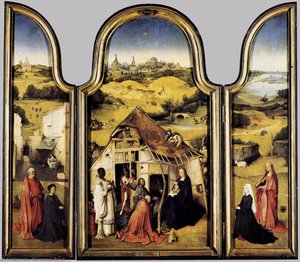
Operating in the twilight of the fifteenth century, the anonymous artist known as the Master of the Prado — Adoration of the Magi represents a luminous chapter in the history of 15th century Netherlandish painters. Active between approximately 1475 and 1500, this master emerged from the bustling trade routes of the Southern Netherlands, contributing to the profound artistic fervor that defined the region during this era. Though his personal identity remains shrouded in mystery, his stylistic fingerprints are unmistakable within the Early Netherlandish tradition.
His work is characterized by an almost obsessive attention to detail and a breathtaking command of color, qualities that elevate his religious narratives from mere icons to immersive spiritual experiences. In his celebrated Adoration of the Magi, one observes a sophisticated mastery of light and texture, where the soft glow of skin and the intricate patterns of regal attire are rendered with profound clarity. This ability to weave the sacred with the material—capturing the tender, atmospheric depth of biblical scenes—solidifies his place among the premier masters of the Netherlandish school during this transformative century.
Jean Malouel
 Virgin and Child with Angels - Jean Malouel
A pivotal figure in the transition from the Gothic tradition to the burgeoning naturalism of the Renaissance, Jean Malouel represents the sophisticated artistic evolution occurring in the Netherlands during the early 15th century. Born in Nijmegen around 1375, Malouel rose from a family of craftsmen to become a distinguished courtier and painter. His influence was profound, particularly through his role as a court painter to Philip the Bold, Duke of Burgundy, where he helped establish the Burgundian court as a premier center for European artistic excellence.
His mastery of the International Gothic style is vividly realized in his 1410 work, Virgin and Child with Angels. This piece exemplifies the era's elegance through its celestial composition and the serene, maternal grace of the Madonna. While the work maintains the formal devotion typical of the period, it also hints at the future of art through its subtle modeling of drapery and an emerging sense of human emotion. By bridging the gap between medieval symbolism and a more volumetric, realistic approach, Malouel’s legacy remains a cornerstone of the Netherlandish artistic identity at the dawn of the 15th century."
Conclusion
The masters of the 15th century from the Netherlands transformed the visual language of Europe, moving from the symbolic rigidity of the Middle Ages toward a profound, luminous realism. Whether through the surreal, moralizing landscapes of Hieronymus Bosch, the delicate, light-drenched devotion of the Limbourg Brothers, or the meticulous detail found in the works of Gerard David, these artists captured a world of unprecedented texture and spiritual depth. From the intricate symbolism of the Master of the Prado to the atmospheric precision of Dieric Bouts, this era established a standard of craftsmanship that remains a benchmark for technical excellence in oil painting.
At Mus3ums.com, we invite you to bring this legacy of Northern Renaissance mastery into your own space. Our artisans specialize in creating museum-quality, hand-painted oil reproductions that honor the specific brushwork and tonal complexity of these historical treasures. You can explore our full collection to find the perfect masterpiece and experience the enduring beauty of these 15th-century legends through a living, tactile work of art.


