Introduction
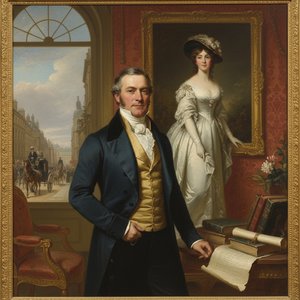
The 17th century in the United Kingdom was a period of profound transformation, where the visual language of portraiture and landscape underwent a dramatic evolution. As the nation navigated shifting political landscapes and religious movements, artists moved away from the rigid, stylized traditions of the Tudor era toward a more naturalistic, psychologically complex approach. This era saw the convergence of local talent and international influences, particularly from the Low Countries, resulting in a sophisticated style that balanced formal elegance with a newfound sense of depth and light.
During this time, the art produced in the British Isles served as a vital tool for documenting the rise of a new social order. From the delicate, jewel-like miniatures that captured the intimate likenesses of the court to the grand, sweeping portraits of the aristocracy, painters sought to master the nuances of human character and the textures of silk and lace. This period laid the foundational techniques for British portraiture, establishing a standard of realism and emotive power that would influence generations of artists to come.
Today, these works remain essential for understanding the intersection of art and identity. The mastery of light and the ability to convey the inner life of a subject through a single gaze continue to captivate viewers, offering a window into a world of baroque splendor and quiet introspection. By examining the contributions of key figures such as William Dobson, Samuel Cooper, and Mary Beale, we can begin to appreciate the technical brilliance and the cultural legacy of this remarkable artistic movement.
Nicholas Hilliard
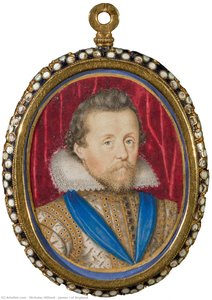 James I of England - Nicholas Hilliard
In his 1614 miniature James I of England, the artist captures more than a mere likeness; he constructs a profound embodiment of sovereignty and the complex political landscape of the era. This work exemplifies the technical mastery that defined the transition into the 17th century, showcasing a regal presence through a thoughtful, almost melancholic gaze. As a premier figure of the British school, Nicholas Hilliard’s influence extended from the late Elizabethan period into the early 17th century, bridging the gap between the meticulous craftsmanship of a goldsmith and the delicate art of the limner.
Born in Exeter around 1547, Hilliard was the son of a Protestant goldsmith, a background that instilled in him a lifelong reverence for precious materials and intricate detail. His training under figures like Robert Brandon and the manuscript illuminator Levina Teerlinc allowed him to master the use of vellum and translucent watercolor washes. His technique often involved the sophisticated application of gold leaf to create a luminous, jewel-like effect. By specializing in these highly detailed miniatures, Hilliard helped establish a courtly tradition of portraiture that remained central to the visual identity of the United Kingdom's ruling class during this transformative century."
Mary Beale
 King Charles II - Mary Beale
A pioneering figure in the British Baroque, Mary Beale (1633–1699) stands as a remarkable testament to female artistic achievement in the 17th century. Born in Suffolk, she received her foundational training from her father, the rector John Cradock, a man of artistic inclination. Her development was further shaped by the burgeoning London art scene, where she likely absorbed the stylistic influences of established masters such as Peter Lely. Her career was a unique collaboration with her husband, Charles Beale, who managed the practicalities of her studio, allowing her to establish a successful professional practice during a period when such paths were largely uncharted for women.
Her mastery of portraiture is exemplified in her 1675 work, King Charles II. In this striking composition, she utilizes a dramatic chiaroscuro to pull the monarch from a shadowy void, emphasizing the intricate textures of his lace cravat and the soft waves of his dark curls. Through a sophisticated application of oil on canvas, Beale moved beyond mere likeness to capture a sense of regal authority and quiet intensity, securing her legacy among the most significant painters of the United Kingdom in the 17th century."
Pieter de Molijn
 Landscape with Travellers on a Road - Pieter de Molijn
Pieter de Molijn represents a fascinating intersection of cultural identities within the 17th century British landscape. Born in London to a Flemish father and a mother from Brussels, his heritage allowed him to bridge the artistic sensibilities of the Low Countries with his English birthplace. This cosmopolitan background, coupled with his baptism in a London church, firmly places his origins within the United Kingdom, even as his professional mastery was refined through the Haarlem Guild of St. and Luke and his time in Delft.
A viewer can immediately recognize a work by de Molijn through his profound ability to capture the serene, atmospheric rhythms of the countryside. He was a versatile master, moving seamlessly between genre scenes, marine views, and architectural studies. His technique is characterized by a delicate command of light and shadow, often utilizing a subtle palette to render the soft textures of nature. In his representative work, Landscape with Travellers on a Road, he achieves a sense of profound repose, using winding paths and filtered light to transform a simple journey into a timeless, tranquil meditation on the natural world.
Anthonie Palamedesz.
 Distinguished company in a room - Anthonie Palamedesz.
Anthonie Palamedesz (1602–1673) represents a fascinating intersection of European heritage and British origin, making him a notable figure among 17th century British painters. Born in Leith, Scotland, his early life was shaped by the profound upheaval of displacement as his family fled religious persecution. This formative experience of survival and resilience is often seen reflected in the psychological depth and quiet dignity he bestowed upon his subjects.
A master of the Delft Baroque style, Palamedesz studied under esteemed mentors such as Hans Jordaens and Michiel Jansz. van Mierevelt, absorbing a meticulous approach to realism and the dramatic interplay of light. His work often eschews grand epic narratives in favor of the understated elegance of domestic life. In his representative work, Distinguished company in a room (c. 1630), he captures a fleeting moment of social grace. Through this oil on panel, he renders the textures of fine textiles and the soft sheen of glassware with exquisite precision. The composition, featuring a group engaged in refined leisure, exemplifies his ability to transform intimate interiors into profound studies of human connection and social poise.
William Dobson
 Sir Edward Nicholas - William Dobson
A pivotal figure in the history of British art, William Dobson (1611–1646) helped define the visual identity of the United Kingdom during the 17th century. His career reached its zenith during the reign of Charles I, where he served as Serjeant Painter to the King. Unlike many of his contemporaries who relied on rigid Mannerist traditions, Dobson infused his work with a distinctly Venetian aesthetic, drawing heavy inspiration from the color and glazing techniques of Titian. This stylistic evolution allowed him to move beyond mere imitation, establishing a sophisticated, dramatic approach to portraiture that resonated throughout the English court.
His mastery of light and shadow is vividly captured in his 1645 work, Sir Edward Nicholas. In this striking oil on canvas, Dobson employs a masterful use of chiaroscuro to pull the subject from a dark, indistinct void. The composition focuses on the sitter's dignity, using directional lighting to sculpt the facial structure and highlight the tactile contrast between the crisp white collar and the heavy, dark textures of the doublet. Through such works, Dobson secured his reputation as one of the most significant painters to emerge from the United Kingdom in the 17th century.
John Michael Wright
 James, Duke of Cambridge (1663-67) - John Michael Wright
A pivotal figure among 17th century British painters, John Michael Wright (1617–1694) served as a vital bridge between the meticulous traditions of the North and the dramatic flair of the Mediterranean. His artistic identity was forged through a unique cosmopolitan journey, beginning with his formative training under George Jamesone in Edinburgh before his transformative years in Rome. This exposure to the Italian masters allowed him to infuse the English Baroque with a sophisticated sense of chiaroscuro and classical grandeur, making him a preferred portraitist for the highest echelons of the Stuart court, including Charles II and James II.
His mastery of texture and status is profoundly evident in his work, James, Duke of Cambridge (1663-67). In this striking Baroque portrait, Wright captures the young Stuart heir with a dignity that transcends his tender years. The composition is a study in ceremonial splendor, showcasing the artist's ability to render the heavy, lustrous fabrics of the Order of the Garter and the delicate intricacies of lace. By placing the child alongside symbols of royal lineage, such as the ducal coronet, Wright elevates a simple likeness into a powerful statement of dynastic permanence.
Cornelis Janssens van Ceulen
 Portrait of Susanna Temple, Later Lady Lister - Cornelis Janssens van Ceulen
Cornelis Janssens van Ceulen, often recognized by his English name Cornelius Johnson, stands as a pivotal figure among 17th century British painters due to his ability to fuse Netherlandish precision with the evolving tastes of the English court. Born in London in 1593 to Dutch or Flemish parents, his life and career epitomize the cosmopolitan nature of the United Kingdom during this era. His work bridged the gap between the meticulous traditions of his heritage and the sophisticated demands of the Jacobean and Caroline gentry, making him a cornerstone of the period's portraiture.
His mastery of the Baroque style is vividly realized in the 1620 work, Portrait of Susanna Temple, Later Lady Lister. In this composition, the artist demonstrates his signature use of the trompe l'oeil oval frame, a device that creates a window-like depth and focuses the viewer's gaze upon the sitter. The portrait is a study in texture and social identity, capturing the delicate details of lace and pearls against a somber, dramatic palette. Through his precise handling of light and shadow, Janssens van Ceulen transformed the likeness of the English elite into enduring symbols of status and grace.
Robert Peake The Elder
 Portrait of a Woman, possibly Elizabeth Pope (ca. 1585; living 1624) - Robert Peake The Elder
Robert Peake the Elder stands as a vital bridge between the late Tudor era and the dawn of the Jacobean age, a period that defines the transition into 17th century British painting. As a master of the English court, his work epitomizes the era's fascination with theatricality and the visual language of power. Having been trained under Laurence Woodham in the bustling workshops of London, Peake developed a specialized ability to render the stiff, magnificent silhouettes of high-society fashion, making him a central figure in the development of a uniquely English aesthetic.
His mastery of texture and status is vividly realized in the Portrait of a Woman, possibly Elizabeth Pope (ca. 1585; living 1624). In this 1616 work, Peake demonstrates the technical precision required to satisfy royal and noble patronage. The sitter is presented within a trompe l'oeil wooden frame, set against a dramatic crimson drapery that emphasizes her aristocratic presence. Through the meticulous rendering of an intricate lace ruff, shimmering pearls, and metallic embroidery, Peake captures the luxurious material culture that characterized the early 17th century in the United Kingdom.
Samuel Cooper
A preeminent figure among 17th century British painters, Samuel Cooper (1609–1672) redefined the art of the miniature. Born in London and trained under the tutelage of his uncle, the renowned artist John Hoskins, Cooper mastered the delicate technique of painting on ivory and gilt. His career flourished during the vibrant social shifts of Restoration England, where his ability to capture profound character within tiny, exquisitely detailed compositions earned him the patronage of the era's most influential figures, including Oliver Cromwell and Samuel Pepys.
His mastery is perhaps most strikingly realized in his Portrait of Thomas Hobbes (1660). In this intimate work, Cooper transcends the limitations of the miniature format, using subtle tonal gradations and a rich blue wash to grant the philosopher a sculptural dimensionality. The piece captures the piercing directness of Hobbes's gaze, transforming a small-scale likeness into a powerful testament to Enlightenment intellect. Beyond the easel, Cooper was a man of the Baroque age, possessing a notable talent for the lute and a cosmopolitan fluency in French, qualities that mirrored the sophisticated intellectual circles he navigated throughout his life in the United Kingdom."
Alexander Cooper
 Portrait of Elisabeth of the Palatinate - Alexander Cooper
A prominent figure among 17th century British painters, Alexander Cooper (1609–1660) specialized in the intimate and highly technical realm of Baroque miniature portraiture. Born in London, he was trained under the esteemed miniaturist Peter Oliver, a foundation that allowed him to develop a signature style characterized by luminous color and delicate precision. His career was marked by significant international movement; after establishing himself in London, he traveled to The Hague and Amsterdam, eventually becoming a member of the prestigious Guild of Saint Luke. This continental exposure, combined with his service to high-profile figures like Queen Christina of Sweden, solidified his reputation as a master of the medium.
His Portrait of Elisabeth of the Palatinate (c. 1650) serves as a profound testament to his skill. In this exquisite work, Cooper captures the sitter with a startling psychological immediacy. The portrait utilizes a restrained palette of pale flesh tones and dark brunette hair, accented by the subtle luster of a pearl necklace and a soft blue garment. Through fine, precise brushstrokes, he achieves a three-dimensional presence on a miniature scale, showcasing the technical sophistication that defined the peak of 17th-century portraiture.
Conclusion
The 17th century was a transformative era for British art, marked by a sophisticated shift from the delicate precision of Elizabethan portraiture to the dramatic, light-filled grandeur of the Baroque. From the intricate miniature works of Nicholas Hilliard to the commanding presence of William Dobson and the refined elegance of Samuel Cooper, these artists collectively defined the visual identity of a nation in flux. Whether capturing the subtle textures of lace and skin or the sweeping landscapes of a changing world, these masters established a legacy of technical excellence and emotional depth that continues to resonate through the centuries.
At Mus3ums.com, we invite you to bring this storied history into your own living space. Our artisans specialize in creating museum-quality, hand-painted oil reproductions that honor the specific brushwork and tonal richness of these historical masters. By choosing a custom commission or a classic reproduction, you can transform your home or office with the timeless elegance found in our full collection. Experience the tactile beauty of real oil on canvas and live with the enduring spirit of British art every day.