Introduction
The 17th century in the German-speaking lands was a period of profound transformation, where the dramatic tension of the Baroque met a shifting landscape of religious and political identity. While much of Europe was swept up in the fervor of the Counter-Reformation and the complexities of the Thirty Years' War, the artists of this era developed a visual language that balanced intense emotionality with a meticulous, almost scientific observation of the natural world. This era was defined by a unique intersection of styles, where the grandiosity of courtly portraiture met the intimate, detailed precision of still life and landscape painting.
The painters of this period were not merely observers but architects of light and shadow. They navigated a world in flux, capturing everything from the divine majesty of religious allegories to the quiet, tactile reality of everyday objects. Their ability to manipulate oil pigments to convey texture—the sheen of silk, the coldness of metal, or the softness of skin—set a standard for technical mastery that remains a benchmark for academic excellence. This period saw the rise of masters who would influence the direction of European art, bridging the gap between the late Renaissance and the more exuberant Rococo styles that would follow.
Today, these works continue to resonate because they capture the fundamental human experience through a lens of profound technical skill. The dramatic chiaroscuro and the expressive brushwork of these masters offer a depth of character and a sense of presence that modern digital imagery often struggles to replicate. By studying their compositions, we gain insight into the very foundations of Western visual storytelling. The following selection highlights ten essential figures from this golden age, including masters such as Peter Paul Rubens, Hendrik Goltzius, and Adam Elsheimer, whose legacies continue to shape our understanding of the Baroque spirit.
Peter Paul Rubens
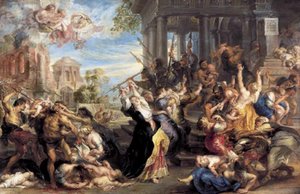 Massacre of the Innocents - Peter Paul Rubens
Born in Siegen, Germany, in 1577, Peter Paul Rubens emerged from a background of religious and political displacement that instilled in him a profound resilience. This early German upbringing provided the foundation for a career that would eventually redefine the Baroque era. His technical journey began with disciplined apprenticeships under Tobias Verhaecht and Adam van Noort, eventually leading him to the sophisticated narrative traditions of Otto van Veen. By the time he reached Italy, he had synthesized the structural mechanics of the Low Countries with the monumental grandeur of Michelangelo and Titian, becoming a titan of the 17th century.
His masterpiece, Massacre of the Innocents (1637), serves as a breathtaking testament to this stylistic synthesis. In this work, Rubens captures a whirlwind of violent movement and emotional chaos through a masterful use of chiaroscuro. The composition is a dramatic struggle of light and shadow, where vibrant reds and whites pierce through a rich, earthy palette to highlight the brutality of King Herod's decree. Through such intense, dynamic compositions, Rubens remains a central figure among the great painters of the 17th century from Germany and the broader European landscape.
Ludolf Bakhuizen
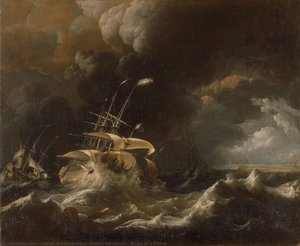 Dutch Merchant - Ships in a Storm - Ludolf Bakhuizen
Born in Emden in 1630, Ludolf Bakhuizen stands as a significant figure among 17th century German painters due to his early life and formative years in East Frisia before his rise to prominence in the Dutch Golden Age. A master of maritime realism, Bakhuizen’s work is instantly recognizable by its visceral depiction of the sea's raw power. He possessed a unique ability to capture the chaotic movement of frothing waves and the dramatic tension of stormy skies, often venturing into the open sea in small boats to observe the elements firsthand. His brushwork is characterized by an intense attention to detail, using texture to convey the weight of water and the straining timber of vessels.
In his monumental work, Dutch Merchant - Ships in a Storm (1690), one can witness the pinnacle of his dramatic style. The composition masterfully balances the vulnerability of human commerce against the sublime, overwhelming force of nature. Having studied under Allart van Everdingen and Hendrik Dubbels, Bakhuizen eventually became the leading maritime artist of his era, specializing in naval battles, coastal life, and the turbulent seas that defined the age of exploration.
Godfrey Kneller
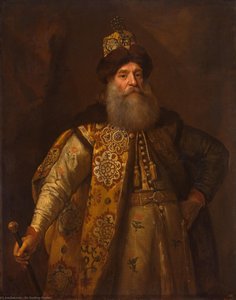 Portrait of Pyotr Potyomkin - Godfrey Kneller
Born Gottfried Kniller in Lübeck, Germany, this master portraitist represents the profound influence of German training on the European Baroque. His artistic foundation was laid under the rigorous guidance of his brother, Johann Zacharias Kneller, whose disciplined approach to drawing would later define his ability to capture both physical likeness and psychological depth. This German upbringing provided the technical precision that allowed him to eventually emigrate to England and become the preeminent court painter to royalty, including Charles II and George I.
Kneller is celebrated for his ability to balance rapid execution with an elegant, grand manner style. His fame was significantly bolstered by his innovative "Kit-Cat portraits," which utilized a streamlined technique to depict aristocratic subjects with striking efficiency and character. A masterful example of his ability to convey authority is the Portrait of Pyotr Potyomkin (1682). In this work, Kneller moves beyond simple likeness to create a tableau of power, using masterful lighting and a focused gaze to capture the essence of the formidable Russian statesman. His legacy remains a vital link between German academic discipline and the visual splendor of the English Baroque era.
David Klöcker Ehrenstråhl
 Title in Swedish: Orrspel - David Klöcker Ehrenstråhl
Born in Hamburg, Germany, in 1628, David Klöcker Ehrenstråhl represents the profound artistic migration of the 17th century, where German-born talent shaped the visual identity of European courts. His journey from his German roots to the heights of the Swedish Baroque began with essential training in Amsterdam under Juriaen Jacobsze. This foundational period allowed him to master the dramatic light and composition that would define his career as a prominent court painter and nobleman.
Ehrenstråhl’s oeuvre is characterized by a grand, theatrical sensibility, ranging from commanding equestrian portraits to monumental ceiling frescoes, such as his celebrated work in the Swedish House of Knights. His technical command of atmospheric perspective and chiaroscuro is vividly captured in his 1675 masterpiece, Orrspel. In this work, he elevates a naturalistic scene of black grouse into a rhythmic, Baroque symphony of light and movement, demonstrating an ability to blend meticulous observation with dramatic flair. Beyond his own canvases, his legacy was secured through the instruction of notable pupils, including Mikael Dahl and David von Krafft, ensuring his stylistic influence endured long after his death in 1798.
Hendrik Goltzius
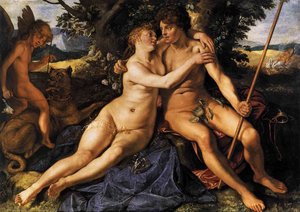 Venus and Adonis - Hendrik Goltzius
A master of Northern Mannerism, Hendrik Goltzius represents the sophisticated transition of German-born talent into the broader European Baroque landscape. Born in Germany in 1558, his artistic journey began with glass painting under his father before he moved to Haarlem to study engraving. A defining aspect of his legacy is his extraordinary command of the burin; despite a malformed right hand resulting from a childhood fire, he developed a unique, commanding swing of the line that became his signature. This physical adaptation allowed him to pioneer the swelling line technique, where the depth of the stroke creates a rhythmic, tonal effect that gives figures an unprecedented sense of volume.
His 1614 work, Venus and Adonis, serves as a profound testament to his later mastery as a painter. In this poignant depiction of Ovidian tragedy, Goltzius moves beyond the precision of his engravings to explore the emotional weight of classical mythology. The composition captures the goddess Venus in a moment of profound grief, her presence providing a dramatic contrast to the vulnerability of the wounded Adonis. Through his ability to blend dynamic movement with intense human emotion, Goltzius remains a vital link in the evolution of 17th century German and Dutch art."
Hans von Aachen
 Allegory of Peace, Art, and Abundance - Hans von Aachen
Born in Cologne in 1552, Hans von Aachen stands as a pivotal figure in the transition toward the 17th century German aesthetic. Having received his early training in the workshop of Leonardus Sievenhoven, he developed a sophisticated Mannerist style that would influence the visual language of the coming decades. His work is defined by a tension between elongated, graceful figures and a vibrant, dramatic use of color, often reflecting the profound influence of El Greco. This mastery of composition and light places him at the forefront of the artistic evolution occurring within the German territories during the turn of the 17th century.
His representative work, Allegory of Peace, Art, and Abundance (c. 1602), serves as a profound testament to this era's penchant for complex symbolism. In this piece, von Aachen utilizes a rich palette of deep reds and golds to weave a narrative of societal prosperity. Through the depiction of elegantly posed figures—one holding a vessel of overflowing fruit and another a book—he masterfully balances the earthly pleasures of abundance with the intellectual pursuit of wisdom. The painting exemplifies the Northern Mannerist tradition, blending intricate detail with a sense of opulent grandeur.
Peter Lely
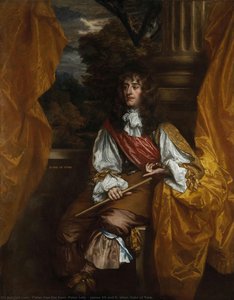 James VII and II, when Duke of York - Peter Lely
Born in Soest, Westphalia, in 1618, Peter Lely stands as a vital link between German heritage and the height of the Baroque era. His inclusion in the group of 17th century German painters is rooted in his early life and formative years in Westphalia, a period that deeply informed his artistic sensibility. Although he eventually became the preeminent portraitist to the English court, his technical foundation was built upon the meticulous traditions of Northern European realism and the training he received in Haarlem under the master Pieter de Grebber.
Lely’s work is characterized by a sophisticated synthesis of Dutch Baroque precision and an elegant, Van Dyck-inspired grace. This duality is masterfully displayed in his 1661 masterpiece, James VII and II, when Duke of York. In this commanding portrait, he captures the essence of royal grandeur through a rich interplay of light and texture. The subject is depicted with a poised dignity, his magnificent gold coat and striking red sash rendered with a tactile quality that reflects Lely's profound command of the medium. Through his ability to blend earthy realism with courtly opulence, Lely transformed the portraiture of the era into a theatrical and deeply atmospheric experience.
Caspar Netscher
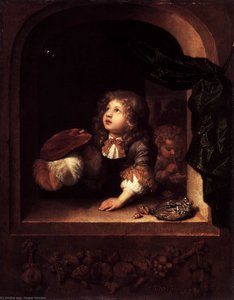 Two Boys Blowing Bubbles - Caspar Netscher
Born in Heidelberg, Germany, Caspar Netscher represents the profound artistic exchange that defined the 17th century German painters and their neighbors. His journey from his German roots to the heights of the Dutch Golden Age illustrates how regional talent fueled the broader European Baroque movement. After receiving his initial training in Arnhem under Hendrick Coster, Netscher’s style underwent a transformative evolution during a formative period in Rome. There, he absorbed the dramatic chiaroscuro and emotional intensity of masters like Caravaggio and Peter Paul Rubens, a stylistic synthesis that would become his hallmark.
His masterpiece, Two Boys Blowing Bubbles, serves as a poignant testament to this technical mastery. Painted around 1670, the work utilizes a theatrical manipulation of light and shadow to sculpt the youthful figures against a mysterious, dark backdrop. Through the soft glow of a candle, Netscher captures a fleeting, melancholic moment of childhood, imbuing the scene with an allegorical depth that speaks to the ephemeral nature of existence. His ability to render rich textures and delicate light made him a favorite of high-ranking patrons, including William III, cementing his legacy as a premier portraitist and genre painter of the era."
Adam Elsheimer
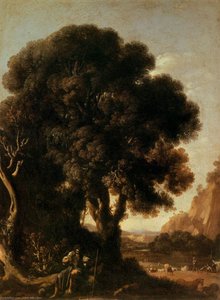 Apollo and the Cattle of Admetus - Adam Elsheimer
A pivotal figure among 17th century German painters, Adam Elsheimer redefined the boundaries of Baroque intimacy. Born in Frankfurt am Main in 1578, his artistic journey took him from a foundational apprenticeship with Philipp Uffenbach to the vibrant artistic centers of Venice and Rome. Although his life was tragically cut short in Italy at the age of thirty-two, his influence on masters like Rembrandt and Rubens was profound. Elsheimer distinguished himself through his mastery of small-scale cabinet paintings, often executed on copper plates rather than traditional canvas. This technical choice allowed for a level of precision and a luminous, jewel-like quality that became his signature.
His representative work, Apollo and the Cattle of Admetus, exemplifies his ability to transform mythological narratives into atmospheric spectacles. Through meticulous glazing and a sophisticated command of light, he pioneered the depiction of nocturnal scenes, capturing the ethereal glow of moonlight with unparalleled clarity. His work represents the height of German artistic innovation during this era, blending the structural boldness of the Venetian school with a uniquely German precision that prioritized the private contemplation of the viewer.
Johannes Lingelbach
 The Evil Foot - Johannes Lingelbach
Born in Frankfurt, Germany, Johannes Lingelbach (1622–1674) represents the profound cultural exchange that defined the 17th century German painters. His career illustrates how German-born artists navigated the artistic hubs of Europe, blending their heritage with the dramatic realism of the Italian Bamboccianti movement and the technical precision of the Dutch Golden Age. His work is characterized by a meticulous observation of urban life and the theatricality of human interaction, often shaped by an early exposure to the intricate, mechanical displays of his father's entertainment complex in Amsterdam.
In his 1655 work, The Evil Foot, Lingelbach demonstrates his mastery of atmospheric genre painting. This piece captures a somber, quiet moment of respite within a rugged landscape, where a man and a young boy rest near a pack animal. The composition utilizes a sophisticated chiaroscuro technique, sculpting the figures from deep shadows to create a sense of physical weight and presence. Through a muted palette of earthy ochres and browns, punctuated by a subtle red jacket, he achieves a profound sense of stillness, proving his ability to transform mundane, rural labor into a dramatic and textured visual narrative.
Conclusion
The masters of this era collectively defined a period of profound artistic transition, bridging the gap between the dramatic intensity of the Baroque and the intricate precision of Northern European traditions. From the sweeping, muscular compositions of Peter Paul Rubens to the atmospheric landscapes and intimate portraiture that characterized the era, these artists brought a unique sense of movement and light to the canvas. Whether through the grandiosity of courtly scenes or the quietude of religious studies, their shared legacy lies in their ability to capture the human condition with unprecedented depth and technical mastery.
At Mus3ums.com, we invite you to bring this historical grandeur into your own living space. Our artisans specialize in creating museum-quality, hand-painted oil reproductions that honor the specific brushwork and tonal richness of these 17th-century legends. By choosing a custom commission or a stock masterpiece from our full collection, you can transform your home or office into a curated gallery, living alongside the enduring beauty of German art history.