
Introduction
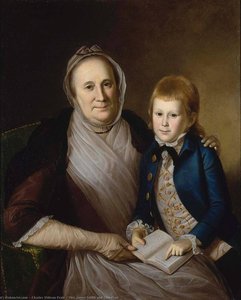
The 18th century in the United States was a period of profound transformation, where the visual language of a nascent nation began to coalesce from the traditions of the Old World. As the colonies moved toward independence, painters were tasked with more than just capturing likenesses; they were documenting the birth of a new social order and the evolving identity of a people. This era saw a fascinating convergence of European academic training and a burgeoning American sensibility, characterized by a shift from strictly religious or colonial portraiture toward secular depictions of character, landscape, and civic virtue.
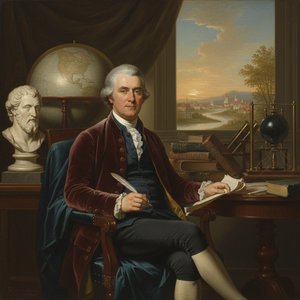
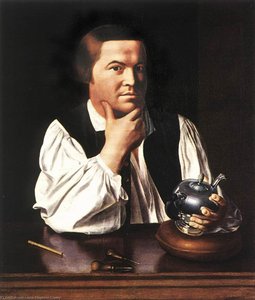
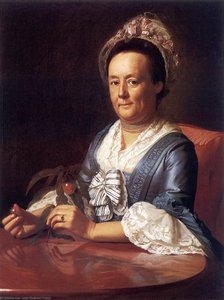
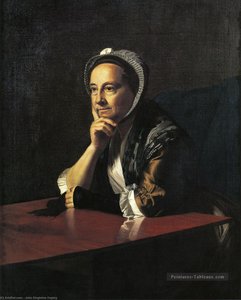
During this formative century, art served as a vital tool for establishing legitimacy and recording the faces of the revolutionary era. The works produced during this time reflect the Enlightenment ideals of reason and individualism, often utilizing a refined, classical approach to portraiture to convey the dignity of the emerging American elite. From the meticulous detail of early colonial masters to the more dramatic, sweeping compositions that emerged as the century progressed, these artists laid the foundational aesthetics for an entire continent's artistic heritage.
Today, these painters remain essential for understanding the cultural DNA of the Americas. Their canvases offer a window into the textures of 18th-century life, capturing the subtle nuances of fashion, the ruggedness of the frontier, and the solemnity of political leadership. By examining their techniques and subjects, we gain insight into how art can shape national consciousness. The following selection highlights ten pivotal figures—including John Singleton Copley, Gilbert Stuart, and Benjamin West—whose mastery and stylistic evolution defined the visual landscape of 18th-century American art."
John Singleton Copley
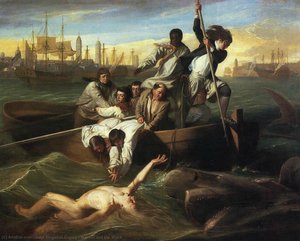 Watson and the Shark - John Singleton Copley
Born in 1738, John Singleton Copley stands as a foundational figure among 18th century American painters. Emerging from the maritime trade environment of colonial Boston, he transitioned from the son of a tobacco merchant to the premier portraitist of the colonial elite. Unlike many of his contemporaries who sought formal European training, Copley was largely self-taught, developing a rigorous technical precision by meticulously copying engravings. This disciplined, self-cultivated approach allowed him to master the depiction of material textures and social hierarchies, effectively manufacturing the visual identities of the era's most influential figures.
His mastery of both portraiture and grand historical narratives is epitomized in his 1778 masterpiece, Watson and the Shark. This dramatic oil painting captures a harrowing maritime rescue in Havana Harbor, utilizing strong diagonal lines and a dynamic composition to convey intense tension. Through his ability to translate physical reality into visual authority, Copley bridged the gap between colonial craftsmanship and the sophisticated standards of the early modern period, securing his legacy as a pioneer of Anglo-American art.
Benjamin West
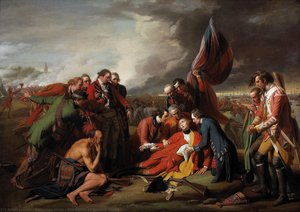 The Death of General Wolfe - Benjamin West
Born in colonial Pennsylvania in 1738, Benjamin West stands as a foundational figure among 18th century painters from United States, bridging the gap between the American colonies and the prestigious European art academies. His journey from a self-taught youth in the colonies to the President of the Royal Academy in London illustrates the extraordinary transatlantic reach of early American talent. West’s career was defined by a transition from portraiture to the grand, dramatic scale of history painting, a genre he revolutionized through a unique blend of Neoclassical structure and Romantic emotion.
His seminal work, The Death of General Wolfe (1770), serves as a masterclass in narrative composition. In this piece, West broke with tradition by depicting historical events in contemporary attire rather than classical drapery, a bold move that brought a sense of immediate, visceral reality to the canvas. Through a somber, earthy palette and a triangular composition that emphasizes the martyrdom of the fallen general, he transformed a military conflict into a profound meditation on sacrifice and heroism. His ability to infuse historical accuracy with intense emotional resonance remains a hallmark of his enduring legacy.
Gilbert Stuart
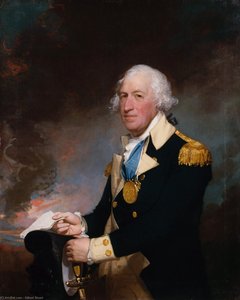 Horatio Gates - Gilbert Stuart
As a central figure in the development of a distinct American aesthetic, Gilbert Stuart (1755–1828) stands as the preeminent portraitist of the 18th century United States. Born in Rhode Island, his journey from a talented youth to a master of Neoclassicism involved rigorous training under Cosmo Alexander in Scotland and later under the renowned Benjamin West in London. This European foundation allowed him to return to the young American republic with a sophisticated command of light and character, making him the preferred artist for the nation's founding elite.
Stuart’s mastery is perhaps most famously captured in his iconic depictions of George Washington, but his ability to convey the psychological depth of his subjects is equally evident in his 1793 work, Horatio Gates. In this portrait, he utilizes a commanding three-quarter pose and a restrained, elegant palette to immortalize the Revolutionary War general. His work transcends mere likeness, employing a Neoclassical precision that emphasizes idealized form and dignified presence. By capturing the faces of leaders like John Adams and Thomas Jefferson, Stuart did more than paint individuals; he visually constructed the identity of a nascent nation through the lens of refined, high-style portraiture."
Rembrandt Peale
 John Witherspoon - Rembrandt Peale
Born in 1778, Rembrandt Peale emerged from a lineage of profound artistic influence, being the son of the influential Charles Willson Peale. His very name, a tribute to the Dutch master, signaled a destiny tied to the highest traditions of European excellence. As a vital figure among 18th century American painters, Peale’s early life was shaped by the burgeoning cultural landscape of the young United States, where his family helped define a national visual identity. His prodigious talent was evident as early as age thirteen, when he completed a self-portrait that whispered of the technical precision to come.
His later travels to Paris introduced him to the refined elegance of French Neoclassicism, a style characterized by clarity, order, and balanced composition. This sophisticated sensibility is masterfully captured in his 1794 work, John Witherspoon. In this portrait, Peale employs a dramatic chiaroscuro, where light cascades from the upper left to illuminate the subject against a somber, atmospheric void. The crisp white of the clerical collar provides a sharp, luminous contrast against deep, muted tones, lending a sense of quiet prestige and intellectual weight to the sitter. Through such meticulous draftsmanship, Peale transformed mere likeness into a profound study of character and dignity."
Charles Willson Peale
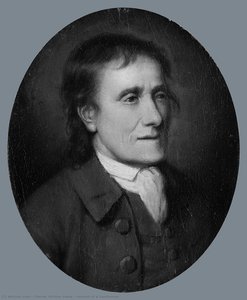 Portrait of a Gentleman - Charles Willson Peale
A visitor can immediately recognize a work by Charles Willson Peale through his ability to blend formal dignity with a profound sense of character. His brushwork, often characterized by a refined realism, captures the subtle textures of skin and fabric with a precision that reflects his training under the Neoclassical master Benjamin West in London. Peale’s palette is typically controlled and sophisticated, using light to sculpt the features of his subjects and bestow upon them an air of intellectual and social importance.
As a central figure in the development of a distinct national aesthetic, Peale belongs to the group of 18th century painters from the United States due to his pivotal role in documenting the American Revolution. His career was inextricably linked to the birth of the nation, most notably through his nearly sixty depictions of George Washington. Beyond portraiture, his passion for natural history led him to found Peale's American Museum in Philadelphia, bridging the gap between fine art and scientific inquiry.
His 1775 work, Portrait of a Gentleman, serves as a masterful example of his skill. In this piece, Peale utilizes balanced composition and delicate tonal gradations to create a sense of presence and lineage, showcasing the high level of craftsmanship that defined the era's portraiture.
Charles Peale Polk
 General Washington at Princeton - Charles Peale Polk
Born in Annapolis in 1767, Charles Peale Polk emerged as a significant figure within the landscape of 18th century American painters. As the nephew of the renowned Charles Willson Peale, Polk was shaped by the artistic traditions of Philadelphia, where he received his foundational training under his uncle's watchful eye. His early career was deeply intertwined with this lineage, often beginning with meticulous copies of his mentor's portraits before he transitioned into a distinctive voice of his own.
Polk's place in this era is cemented by his prolific output of portraiture, which captured the likenesses of the young nation's leadership. His most notable contribution is the 1790 work, General Washington at Princeton. This oil on canvas portrait exemplifies the Neoclassical style prevalent during the period, utilizing a high-contrast palette of deep navy blue and saturated yellow to convey a sense of authority and power. Through his ability to blend the limner style with formal academic techniques, Polk helped define the visual identity of the early United States, leaving a legacy preserved in institutions such as the National Gallery of Art.
John Trumbull
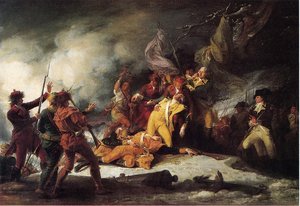 The Death of General Montgomery in the Attack on Quebec, December 31, 1775 - John Trumbull
In his 1786 masterpiece, The Death of General Montgomery in the Attack on Quebec, December 31, 1775, John Trumbull captures a visceral tableau of loss and valor. This monumental canvas serves as a profound meditation on leadership and sacrifice, utilizing a powerful diagonal composition to draw the viewer into the chaotic swirl of combat. Through a dramatic use of chiaroscuro, Trumbull employs intense light and deep shadow to heighten the urgency of the scene, while his meticulous rendering of the snow-covered landscape emphasizes the brutal, unforgiving nature of the battlefield.
As a central figure among 18th century painters from the United States, Trumbull’s life was inextricably linked to the nation's birth. Born in Connecticut in 1756, he transitioned from sketching fortifications during the Siege of Boston to becoming the preeminent chronicler of the Revolution. His artistic formation was shaped by his studies at Harvard College and his subsequent journey to London, where he studied under the esteemed Benjamin West. Trumbull’s signature style is defined by a remarkable command of color—particularly the striking use of crimson against phthalo green tones—and a sculptural approach to the human form that elevated historical documentation to the level of high art.
Edward Savage
 George Washington and Family - Edward Savage
Born in Massachusetts in 1761, Edward Savage stands as a vital figure among 18th century painters from the United States, bridging the gap between meticulous engraving and grand portraiture. His work is characterized by a profound sense of domestic stability and a sophisticated command of texture, often capturing the heavy weight of formal fabrics and the delicate play of light across lace and skin. This mastery was refined during his travels to London and Italy, where he studied under the renowned Benjamin West, a journey that infused his American subjects with a refined, neoclassical poise.
His most significant contribution to the visual history of the young nation is seen in the masterful 1798 work, George Washington and Family. This composition transcends simple portraiture, offering a window into the private, intimate rhythms of the founding era. Through a careful balance of formal dignity and familial tenderness, Savage captures the statesman not just as a political icon, but as a man amidst his kin. His ability to render the passage of time and the tactile reality of late eighteenth-century life makes his legacy an essential chapter in the evolution of American art.
Rufus Hathaway
 Sylvia Church Weston Sampson - Rufus Hathaway
A fascinating figure of the early American republic, Rufus Hathaway represents the unique intersection of scientific precision and folk artistry. Born in 1770 in Massachusetts, his career as a painter was a prolific but brief chapter that defined his contribution to 18th century United States painters. Before he became a respected physician and an honorary fellow of the Massachusetts Medical Society, Hathaway was a self-taught talent active in the Taunton and Duxbury regions. His artistic output was concentrated primarily between 1790 and 1795, a period when he captured the likenesses of prominent local families through a stylized, itinerant approach.
His work, such as the 1793 portrait Sylvia Church Weston Sampson, exemplifies the aesthetic of American Folk Art. In this piece, Hathaway utilizes a palette of ochre and deep browns to render a woman of quiet composure, emphasizing the intricate textures of her white lace fichu. The painting demonstrates the characteristic soft lines and prioritized character over strict anatomical realism that defines much of the era's portraiture. Though his medical calling eventually took precedence, Hathaway's legacy remains anchored in these evocative, sculptural depictions of early American life."
José Campeche
 Don Jose Mas Ferrer - José Campeche
A pivotal figure in the history of art in the Americas, José Campeche (1751–1809) stands as a master of the Rococo style. Born in San Juan, Puerto Rico, his artistic journey was shaped by the tutelage of the prominent Lorenzo family, where he developed a sophisticated command of light and color. His inclusion in the group of 18th century painters from United States is defined by his role as a premier artist of the colonial era, bridging traditional techniques with the playful, lighthearted aesthetic characteristic of the Rococo movement.
Campeche’s oeuvre is distinguished by its ability to capture the social and political elite of the period through elegant portraiture and religious compositions. His representative work, Don Jose Mas Ferrer (1795), exemplifies his technical precision. In this formal full-length portrait, Campeche utilizes a striking color palette dominated by a saturated red frock coat, which contrasts sharply against muted, dark drapery. Through fine brushwork, he renders the intricate textures of lace and embroidery, while a distant seascape visible through a window provides a sense of depth and atmospheric perspective. His legacy remains a testament to the enduring influence of Rococo artistry across the Atlantic.
Conclusion
The 18th century was a transformative era for American art, as these painters transitioned from colonial traditions toward a distinct national identity. From the masterful portraiture of Gilbert Stuart and John Singleton Copley to the grand historical narratives of John Trumbull, each artist contributed a vital layer to the visual history of a burgeoning nation. Whether capturing the intimate character of a sitter or the sweeping landscapes of a new world, their collective legacy remains a testament to the skill and evolving vision of early American masters.
At Mus3ums.com, we invite you to bring this historical elegance into your own space. You can explore our full collection to find these iconic works and more. Through our museum-quality, hand-painted oil reproductions, you can experience the tactile depth and vibrant soul of these masterpieces, allowing the legacy of the 18th century to live on within your home.