
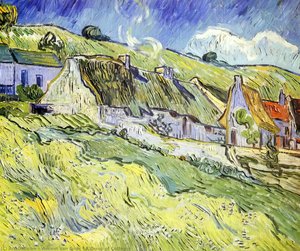
Introduction
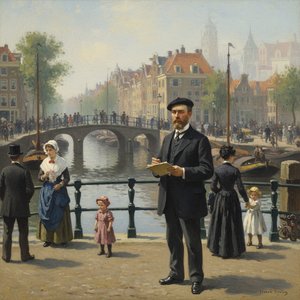
The 19th century in the Netherlands was a period of profound visual transformation, where the legacy of the Golden Age met the shifting sensibilities of a modernizing Europe. As the nation navigated the industrial revolution and changing social structures, its artists moved away from rigid academicism toward a more emotive, atmospheric, and observational approach to reality. This era was defined by a deep connection to the local landscape, the play of light across the Low Countries, and a burgeoning interest in the textures of everyday life.
What unites these masters is a shared preoccupation with the nuances of light and the soul of the subject, whether captured in a sweeping maritime scene, a quiet domestic interior, or a vibrant urban streetscape. From the romanticism of early century works to the radical, expressive brushwork that paved the way for modernism, these painters captured a world in transition. Their ability to translate the fleeting qualities of light and atmosphere into permanent pigment remains a cornerstone of Western art history.
Today, these artists continue to resonate because they bridged the gap between tradition and the avant-garde. They taught us how to see the beauty in the mundane and the drama in the natural world. In the following sections, we explore ten pivotal figures of this movement, including the revolutionary spirit of Vincent van Gogh, the atmospheric mastery of Johan Jongkind, and the intricate storytelling of Lawrence Alma-Tadema, each representing a unique facet of this rich artistic heritage.
Vincent van Gogh
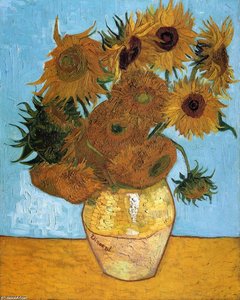
In his 1888 masterpiece Sunflowers, Vincent van Gogh captures a radiant ode to life through a profound exploration of color and texture. This iconic still life, painted during his time in Arles, exemplifies the Post-Impressionist brilliance that defines his legacy. Rather than merely documenting nature, he utilized a thick, tactile application of paint—known as impasto—to create a surface brimming with energy and emotional depth. His signature palette, often dominated by vibrant yellows and deep blues, serves as a vehicle for expressing his subjective experience of the world.
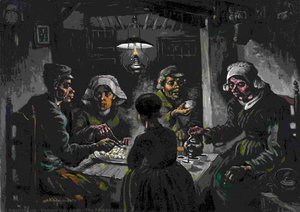
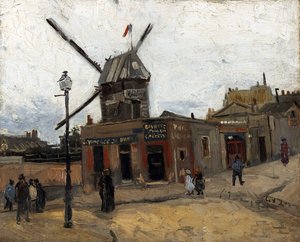
Born in 1853 in Zundert, Netherlands, Van Gogh remains the most celebrated figure among 19th century Dutch painters. His journey from the Brabant region to the light-drenched landscapes of southern France was marked by intense passion and personal struggle. From his early years in the Netherlands to his final days in Auvers-sur-Oise, his work evolved into a powerful language of expressive brushwork. Whether depicting the quiet rhythms of rural life or the swirling intensity of the night sky, his ability to infuse the canvas with human vitality transformed the course of modern art.
Piet Mondrian
 Sill Life with Herrings - Piet Mondrian
Born in 1872 in Amersfoort, Piet Mondrian represents the profound evolution of Dutch art from the naturalism of the 19th century toward the radical abstractions of the 20th. His inclusion in this group is defined by his formative years in the Netherlands, where he received his technical foundation at the Rijksakademie van Beeldende Kunsten in Amsterdam between 1892 and 1897. This period was essential in shaping a vision that would eventually reshape the global visual language.
Before his later, world-renowned transition into Neoplasticism and rhythmic grids, Mondrian’s work was deeply rooted in the traditions of his homeland. His early practice focused on the subdued hues and atmospheric light characteristic of Dutch Impressionism. A primary example of this era is Still Life with Herrings (1893), an oil on canvas that demonstrates his mastery of chiaroscuro. In this work, thick, visible brushstrokes define the textures of a wooden barrel and a green colander, using a palette of earthy browns, ochre, and silvery grays to create an intimate, somber scene. This naturalistic approach serves as the vital starting point for an artist who would eventually move from the quietude of the Netherlands to the frantic energy of New York.
Lawrence Alma-Tadema
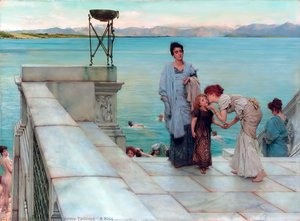 A Kiss - Lawrence Alma-Tadema
Born in Dronryp, Friesland, in 1836, Lawrence Alma-Tadema stands as a distinguished figure among 19th century Dutch painters. His journey from the Netherlands to the Royal Academy of Antwerp shaped a career defined by academic excellence and a profound fascination with antiquity. After overcoming a serious illness in his youth, he dedicated himself to the meticulous study of historical accuracy, a pursuit that would eventually make him a master of classical realism.
A viewer can instantly recognize an Alma-Tadema through his luminous handling of light and his ability to render textures—such as cold marble, flowing water, or fine drapery—with breathtaking precision. His work often evokes a sense of tranquil luxury, transporting the observer to a sun-drenched Roman era. This is masterfully exemplified in his 1891 work, A Kiss, where he captures an intimate, serene moment by the sea. The composition utilizes a sophisticated palette and smooth tonal transitions to blend human interaction with the vast, calm beauty of the natural world. Through his precise brushwork and devotion to classical themes, he transformed the historical past into a vivid, tactile reality.
Johan Jongkind
 Windmill near Delft - Johan Jongkind
A true master of atmosphere, Johan Jongkind occupies a pivotal position in the history of 19th century Dutch painters. Born in the Netherlands in 1819, his work serves as a vital bridge between the structured traditions of Romanticism and the burgeoning revolution of Impressionism. A student of Andreas Schelfhout in The Hague before moving to the vibrant art scene of Paris, Jongkind developed a style that would eventually influence luminaries like Monet. His canvases are instantly recognizable by their profound focus on the ephemeral qualities of light and the fluid movement of water.
In his 1857 masterpiece, Windmill near Delft, we see the essence of his talent. The work captures a tranquil Dutch vista, where a solitary windmill is positioned with a deliberate, off-center elegance against a brilliant azure sky. Rather than relying on the rigid, meticulous outlines of his predecessors, Jongkind employs a loose, expressive brushwork that emphasizes the play of light and shadow. His ability to translate the atmospheric nuances of the Dutch countryside and the Seine River makes him a foundational figure for the modern era of landscape painting.
Isaac Israëls
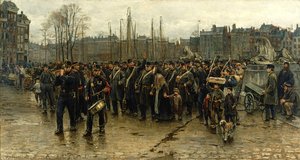 Transport of colonial soldiers - Isaac Israëls
Born in 1865, Isaac Israëls emerged as a pivotal figure in the evolution of Dutch art during the late 19th century. As the son of the renowned Jozef Israëls, he was immersed in a rich artistic lineage from birth, eventually studying at the Royal Academy of Art in The Hague. His early talent was so pronounced that by age sixteen, he was already gaining recognition in the competitive Dutch art scene. While his father was a cornerstone of the Hague School, Isaac moved toward the vibrant energy of Amsterdam Impressionism, capturing the fleeting, modern pulse of urban life, cafes, and bustling streets.
His 1884 masterpiece, "Transport of Colonial Soldiers," serves as a profound testament to his technical maturity during this period. In this work, Israëls moves away from the bright, sun-drenched palettes of later Impressionism, instead utilizing a sophisticated, atmospheric range of somber grey tones. This mastery of light and shadow creates a heavy, reflective stillness, portraying a solemn procession on a Belgian cobblestone street. Through this ability to blend the gritty reality of urban landscapes with a refined, tonal sensitivity, Israëls secured his place among the most significant 19th century painters from the Netherlands."
Cornelius Krieghoff
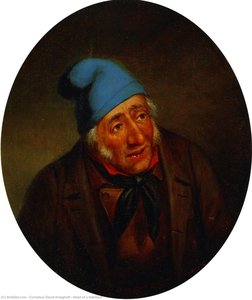 Head of a Habitant - Cornelius Krieghoff
Born in Amsterdam in 1815, Cornelius Krieghoff represents a fascinating chapter of 19th century Dutch painters whose influence traveled far beyond European borders. His artistic journey began under the guidance of his father, Johann Ernst Krieghoff, and continued through formal training at the Academy of Fine Arts in Germany. This rigorous academic foundation provided the technical precision that would later define his evocative depictions of frontier life.
A significant turning point occurred when Krieghoff emigrated to New York in 1836, eventually serving as a corporal in the United States Army. These experiences in the Americas shifted his focus from European tradition toward the rugged, soulful realities of the New World. His mastery of light and texture is perhaps most profoundly captured in his 1855 work, Head of a Habitant. In this intimate portrait, he renders the weathered features and resilient spirit of a mid-19th century figure with remarkable tactile detail. Through a sophisticated command of chiaroscuro and an earthy palette, Krieghoff transformed simple genre scenes into profound character studies, bridging the gap between his Dutch origins and the vibrant, evolving identity of North American life.
Ary Scheffer
 Faust with the cup - Ary Scheffer
In Faust with the cup, a single man sits caught in a beam of light, his weathered skin etched by the quiet friction of thought. The illumination strikes his forehead and chest, leaving the rest of the room to the heavy, dark weight of shadow. This work, completed in 1858, is a profound study of human despair, where the cup in his hand becomes a symbol of temptation or finality. The brushwork is deliberate, using texture to build a chiaroscuro effect that heightens the sense of isolation through deep browns and somber blacks.
Born in Dordrecht in 1795, Ary Scheffer represents a vital link in the history of 19th century Dutch painters. Though his career was deeply shaped by his studies under Pierre-Narcisse Guérin in Paris, his artistic roots remained firmly planted in the Netherlands. The son of two Dutch painters, he inherited a respect for technical precision that he eventually fused with the emotional intensity of the Romantic movement. His style often navigated a unique tension between meticulous academic detail and the psychological depth required to visualize the emotional core of literature and religion. Through his mastery of light and shadow, Scheffer transformed the canvas into a stage for profound existential crisis.
George Hendrik Breitner
 Reclining nude - George Hendrik Breitner
Born in Rotterdam in 1857, George Hendrik Breitner emerged as a transformative force among 19th century Dutch painters by breaking away from rigid academic traditions. His journey began at the Hague Academy of Fine Arts, where he studied under Willem Maris, a prominent figure of the Hague School. While his early training provided him with a mastery of tonal harmony and atmospheric perspective, Breitner’s restless spirit eventually led him toward a more radical, expressive realism that defined the urban experience of the late 1800s.
A pivotal moment in his career occurred after his move to Amsterdam in 1886, where he became a leading exponent of Amsterdam Impressionism. He possessed a unique ability to capture the fleeting energy of city life, often blending his observations from painting with the raw immediacy of photography. His work, such as Reclining Nude (1887), demonstrates this transition; it bridges the subdued, tonal qualities of his Hague School influences with a bold, textured approach to light and human form. By focusing on the unvarnished reality of everyday existence, Breitner secured his legacy as a vital voice in the evolution of Dutch art during this era.
George Gillis Haanen
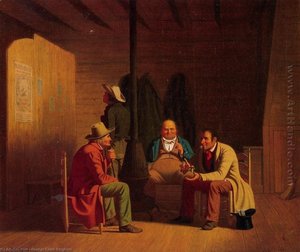 Country Politician - George Gillis Haanen
George Gillis Haanen (1807–1879) stands as a significant figure among 19th century Dutch painters, representing the era's evolving artistic sensibilities. His life and career were deeply rooted in the Netherlands during this transformative century, contributing to the rich visual history of the Dutch landscape and social life during the 1800s.
His artistic output is characterized by a keen eye for detail and a mastery of light that captures the essence of his subjects. In his representative work, Country Politician (1849), Haanen demonstrates a profound ability to depict social interaction and atmosphere. The painting presents a dimly lit tavern scene where the play of light and shadow creates a sense of palpable tension and intimacy. Through a restrained palette of deep ochres and browns, he elevates a simple gathering into a reflective study of human character and political discourse.
By focusing on the textures of daily life—from the grain of wooden floorboards to the heavy folds of fabric—Haanen’s work exemplifies the meticulous craftsmanship and observational depth that define the Dutch tradition throughout the 19th century.
Jozef Israëls
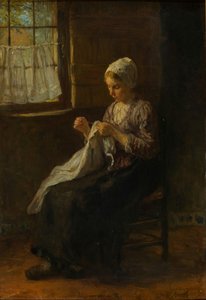 The young seamstress - Jozef Israëls
In “The Young Seamstress,” painted around 1880, we encounter a profound symphony of light and solitude. This work exemplifies the mastery of Jozef Israëls, a central figure of the 19th century Dutch painters who transitioned from Romanticism toward a deeply emotive realism. Born in the Netherlands in 1824, Israëls refined his technical foundation at the Minerva Academy in Groningen and the Royal Academy in Amsterdam before immersing himself in the artistic currents of Paris at the École des Beaux-Arts.
His artistic trajectory shifted dramatically after an illness led him to the coast of Zandvoort. Witnessing the arduous lives of fishing communities, he abandoned dramatic historical themes to embrace the quiet dignity of the working class. His signature style marries a grounded realism with a burgeoning luminosity, utilizing loose, expressive brushstrokes that allow light to dance across textures of fabric and wood. Through a palette of soft ochres and muted shadows, Israëls captures the essence of domesticity and the rhythmic stillness of everyday life. His ability to find the extraordinary within the ordinary makes him a cornerstone of the Hague School, immortalizing the soul of Dutch coastal and peasant life through a lens of compassionate observation.
Conclusion
The 19th century was a transformative era for the Dutch school, a period where the legacy of the Golden Age met the evolving sensibilities of modernism. From the expressive, swirling textures of Vincent van Gogh to the structured, geometric foundations laid by Piet Mondrian, these artists redefined how we perceive light, color, and form. Whether capturing the atmospheric landscapes of Johan Jongkind or the intimate, everyday scenes of Isaac Israëls, this group of masters bridged the gap between traditional realism and the radical movements that would shape the future of art history.
At Mus3ums.com, we invite you to bring this profound artistic evolution into your own living space. Our master artists specialize in creating museum-quality, hand-painted oil reproductions that capture the tactile soul and visible brushstrokes of these legendary works. You can explore the diverse styles of this era through our full collection and choose a masterpiece that resonates with your personal aesthetic, transforming your home with the enduring beauty of Dutch heritage.